

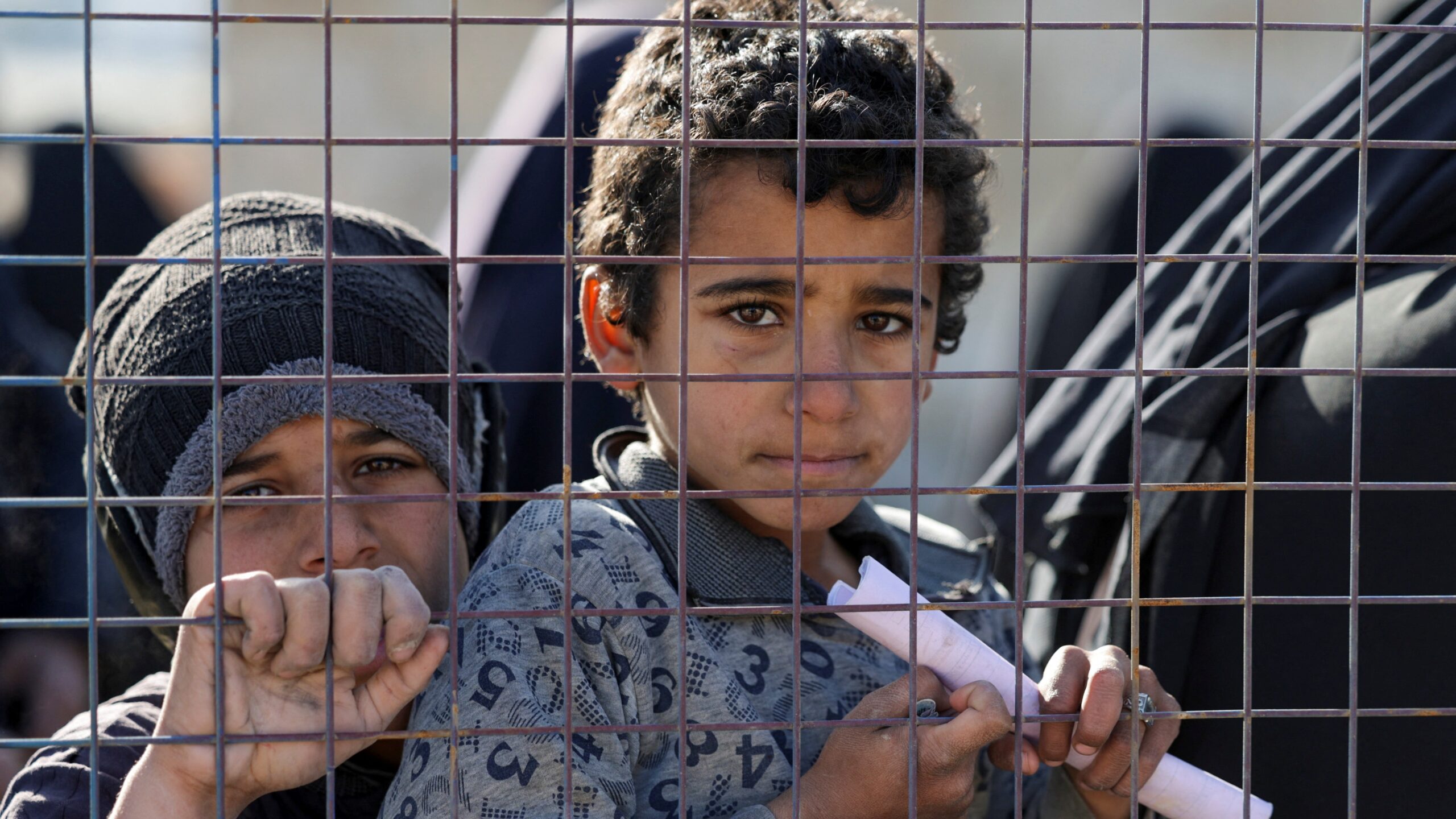
Concerns are mounting for the safety of women and children held in prison camps for detainees suspected of links to the Islamic State group (IS), as Kurdish authorities cede control of the camps to the Syrian government.
Women in al-Roj camp, where many foreign detainees are held and which remains in the hands of the Kurdish-led Syrian Democratic Forces (SDF), told Middle East Eye that women and children had suffered mistreatment, including beatings, during nightly raids by security forces.
“Every night I’m in fear for my safety and the kids’ as well,” said one female detainee from a European country.
Women and children were being forced out of their tents, stripped of warm clothing and doused with water in freezing temperatures during the nightly raids, she said.
Some women, she said, have been beaten inside their tents until they lost consciousness.
New MEE newsletter: Jerusalem Dispatch
Sign up to get the latest insights and analysis on
Israel-Palestine, alongside Turkey Unpacked and other MEE newsletters
“The situation is catastrophic at night,” she said. “As soon as night falls, the women and children tremble with fear that it will be their turn next.” She added that women have also been threatened with rape.
The female detainee described the women as feeling powerless to protect themselves or their children.
“There’s no protection we can give ourselves, let alone the kids,” she said, adding that families are being asked to pay money in exchange for the return of children taken from their mothers.
“They’re demanding $2,000 for the return of the children they’ve taken.”
‘As soon as night falls, the women and children tremble with fear that it will be their turn next’
– Female detainee, Roj camp
Similar accounts have been shared by other women inside the camp who spoke through intermediaries.
Another female detainee inside Roj described nightly violence and looting by authorities in control of the camp..
She described an atmosphere of constant fear after dark.
“Every night is stressful as long as they are there. As soon as we hear the car entering the camps, we are terrified,” she said, adding that women had been beaten and robbed during raids.
“These thieves are trying to take revenge and steal as much as possible before leaving [Roj].”
In one incident, the detainee said guards from the SDF entered a woman’s tent at night and attacked a child.
“They went into a sister’s tent and broke the young girl’s jaw with an iron bar so that her mother would give them her phone and money,” said the detainee.
“They are now beating up the sisters so that she bows down to a military woman.”
A third female detainee, who witnessed the beatings, said the Kurds still control the camps, and that she is desperate to be deported back to her country.
‘They’re demanding $2,000 for the return of the children they’ve taken’
– Female detainee, Roj camp
“If the women refuse, they are beaten, but even if they hand over their phones, they are still beaten,” the third woman told MEE.
“The children are witnessing all of this. Since it happens at night and we’re in a state of fear, no one dares to film it. The abuse happens inside the tents. Sometimes I hear screams and women crying. But of course, no one dares to intervene.”
The uncertainty follows an announcement by US Central Command (Centcom) that it was transferring some prisoners from northeast Syria to Iraq, amid broader shifts in control over detention facilities.
MEE approached the Syrian government and Kurdish officials from the Syrian Democratic Forces for comment.
Rights groups say these testimonies reflect a broader deterioration in security and treatment inside Roj camp, amid growing uncertainty over who is exercising authority on the ground.
Last month, the Syrian government said it planned to permanently close Roj and al-Hol camps, where tens of thousands of people swept up by the SDF in territory formerly under IS control have been held since 2019.
Physical violence
Beatrice Eriksson, spokesperson for the Swedish rights organisation Repatriate the Children (RTC), said the organisation is receiving reports of physical violence, threats – including death threats – and gunfire inside the camp.
She said there have also been multiple accounts of children being separated from their mothers, and of women and children being taken out of the camp without any information about where they are being transferred, or under whose authority.

Families fear for detainees as US moves Islamic State prisoners out of northeast Syria
Read More »
While RTC cannot verify these accounts, according to testimonies received by RTC, the situation has worsened in the last few days after the SDF signed an agreement to hand over institutions to the Syrian government.
“What is unfolding in these camps is not accidental,” said Eriksson.
“It is the predictable result of international prolonged abandonment and failure to resolve responsibility.”
The Swedish social worker said women in Roj fear their children will be transferred to other parts of Syria, forced into armed conflict or exploited by violent militant groups.
RTC argues that governments have the power to end arbitrary detention by taking responsibility for their own nationals through lawful, controlled repatriations.
Eriksson said repatriation should be understood not only as a child-protection measure, but also as a concrete step to prevent further exploitation and radicalisation.
“Children belong in schools, in families, and in protective environments, not in camps shaped by conflict and war,” she said, adding that coordinated state action is essential to reduce long-term security risks.
Yasmina, from the Families in Belgium group, which supports Belgian families with relatives in north east Syria, also corroborated the reports coming out of al-Roj camp.
“We are receiving little information from the women inside the camps, but the details that are emerging are very concerning,” said Yasmina.
“The situation is deteriorating: curfews, constant searches, tents ransacked, young boys beaten and humiliated by the guards, women beaten and mistreated in the camp’s prison, where children are also detained.”
