

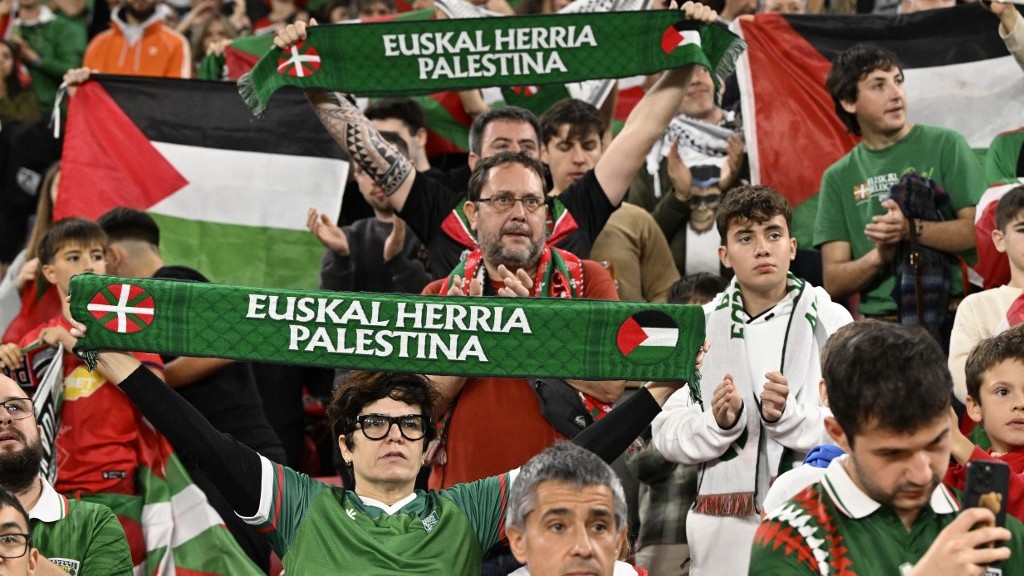
Athletic Club, famed for its Basque heritage, has distinguished itself from the rest of Europe’s footballing elite by showing strong and consistent solidarity with the Palestinian cause
At this time of year, the city of Bilbao, nestled between the lush green Artxanda and Pagasarri hills, is usually cloaked in a morale-sapping rain.
Today, however, the skies are clear and the city feels at ease.
I’m at the Ibaigane Palace, the striking headquarters of the Athletic Football Club in Bilbao, to meet with Johana Ruiz-Olabuenaga, the club’s director of community affairs, to talk about a topic you wouldn’t ordinarily associate with a European football club: Palestine.
For several months, Athletic Club has distinguished itself from the rest of Europe’s footballing elite.
In early October, days before a supposed ceasefire went into effect in Gaza, the club decided to make a contribution to the betterment of Palestinian lives in the only way it knew how.
New MEE newsletter: Jerusalem Dispatch
Sign up to get the latest insights and analysis on
Israel-Palestine, alongside Turkey Unpacked and other MEE newsletters
Together with UN agency for Palestinian refugees, Unrwa, it launched a football training program for 8,000 Palestinian children living in the refugee camps in Syria.
As part of the announcement, the club invited 11 Palestinians – some who have lived in Bilbao and the surrounding area for the past decade, and others, recent refugees from Gaza – to the San Mamés stadium ahead of a fixture against La Liga rival Mallorca.
Just before kick-off, the Palestinians, led by Honey Thaljieh, a former captain of the Palestinian women’s national football team, emerged from the tunnel and onto the pitch to a thunderous reception.
More than 50,000 football fans rose to their feet to honour their guests.
“That moment was overwhelming – emotionally, physically, spiritually,” Thaljieh told Middle East Eye.
“Walking onto the pitch with other Palestinians was not about ceremony. It was about presence. About saying: we are still here,” she said, adding that it was even more special that her mother was present.
‘For me, that moment was football doing what it should do at its best: standing with people, not power’
– Honey Thaljieh, former Palestine women’s team captain
“She represents the generations that carried this struggle long before cameras, long before stadiums, long before the world paid attention. Walking onto that field with her meant carrying our past, our pain, and our resilience together.”
On the scoreboard, the club put out an urgent message to the world: “Athletic Palestinaren alde. Stop genozidioa!” (Athletic stands with Palestine. Stop the genocide).
“For me, that moment was football doing what it should do at its best: standing with people, not power,” Thaljieh said.
“It was a call – clear and unmistakable – to stop the genocide, to stop the silence, and to remember that sport cannot exist disconnected from human life.”
Ruiz-Olabuenaga said the club didn’t want to overstate its actions because they knew there not going to solve the crisis, but it was important for them to be present.
“We know that for our community and for our Athletic fans, it is also important that we show our support to the Palestinian society,” Ruiz-Olabuenaga said.
Weeks later, Athletic Bilbao made its position clear, yet again.
It hosted a friendly between Palestine and Basque Country.


Again, tens of thousands filled the stands as Palestinian and Basque Country flags rippled through the stadium.
Whilst fans of several clubs, from Celtic FC to Paris Saint Germain have demonstrated solidarity with the Palestinian people, much to the discomfort of the clubs themselves, Athletic Bilbao is one of just a few European football clubs to officially endorse solidarity with Palestine.
How did one of Europe’s elite clubs reach this point? How was it connected to the wider Basque solidarity with the people of Palestine? How did it begin? And what did any of this have to do with football?
This is the story of how a football club in the heart of Europe was moved to stand with the Palestinian cause.
The people
Mohamed Farajallah said it’s a moment he will remember for the rest of his life.
Upon hearing that Athletic Club would be announcing a special programme with Palestinian refugees in Syria, he began searching for tickets for the La Liga fixture with Mallorca.
But then he received a call from the club. He, along with his family, were invited as guests to be part of the proceedings.
‘We have have always been connected with South Africa, Ireland, Palestina, and other countries’
– Maia Ruiz de Alda, activist
“I cannot explain it in words,” he said, attempting to describe the scenes at the San Mamés stadium.
“The feeling in your body. You want to cry because you see all the people in the stadium. We are talking about more than fifty thousand people. They stand up. They start clapping.”
He noticed families crying around him.
“Inside, I wanted to,” he said. “I want to give them this feeling, this energy that they gave us,” Farajallah said as we walked around a Bilbao decorated in pro-Palestine imagery and symbolism.
Farajallah said the world may have had a glimpse of Basque generosity towards Palestine over the course of the past few months; this solidarity was the work of decades-long exchanges between Palestinians and the local community that is deeply felt in the region.
And it’s hard to disagree.
In Basque Country – a region that straddles northern Spain and southwestern France – solidarity with the Palestinian people is everywhere: in bookstore windows, tattoo parlours, bars, and even boutiques.
And as narrated by several activists, the solidarity is woven into the very fabric of the region, stitched together by generations marked by their own experience of erasure and persecution.

Whilst the Basque region was granted a degree of autonomy within Spain in 1979, aspirations for independence have never fully disappeared.
And even if polls indicate an oscillation between full independence and deeper autonomy, Palestine is part of that dream deferred, and a reflection of the internationalism of the Basque independence movement, particularly the left.
In the old city, or Casco Viejo, bills addressing the genocide are pasted on the facades between shop windows; “Boikota Israel” (Boycott Israel) are widely sprayed on the walls of apartment blocks.
On the balconies of the colourful apartments overlooking the Nervion River, Palestinian flags are draped from every second or third apartment.
Every flag that flutters in the wet breeze announces itself as proof of life.
The level of pro-Palestine solidarity is unlike any other city I have visited in the western world over the course of the genocide.
Not London, with its million-strong marches. Not New York, where protests in the heart of empire capture headlines.
It was even different from my native South Africa, where an open, expressive solidarity with Palestine tends to be confined to specific neighbourhoods and largely shaped by racial divisions.
In the Basque Country, solidarity is visible in town centres and on highway verges across the region.
‘You stand with the little guy’
At Durango Azoka, a festival devoted to promoting and preserving the Basque language, solidarity with the Palestinian cause is ever present. Books in Euskara about Palestine can be found displayed on bookstore tables. Keffiyehs hang from stalls.
At noon, on the main day of the festival, stalls closed and hundreds walked out collectively to acknowledge the genocide in Gaza.
Maia Ruiz de Alda, a veteran activist I meet at Durango Azoka – wearing a black keffiyeh draped around her shoulders – said that Basque support for the Palestinian cause dates back to at least the 1950s.
“We have have always been connected with South Africa, Ireland, Palestina, and other countries… because we have been fighting to have a country,” she says with a hint of nonchalance as dogs, children and the festival’s ambient chaos envelop us.
A theatre actor selling books on poetry and screenplays said: “It’s simple. You stand with the little guy. We’ve always stood with the little guy.”
This is the kind of atmosphere that has struck visitors to the region over the past two years.

Champions League football: Why Israel competes in Europe – and what Uefa could do
Read More »
Take the observations of the London-based academic Nivi Manchanda, following a cycle tour with her partner from Caen in France to Bilbao in the summer of 2025.
Manchanda, an associate professor in international politics at Queen Mary University, wrote that it was impossible to ignore the “staunch commitment to a cause that should be universal, but has always been siloed, ghettoised, and ‘de-normalised’”.
She also noted that this show of solidarity was accompanied by action.
The local Basque government has supported Unrwa since 2006, and has continued to stand by it, even when many in the international community were trying to force its closure.
Several towns are twinned with Palestinian cities, while both Basque and Catalonia have pressed for policies that grant all Palestinians who come to Spain immediate refugee status.
For others, like Steven, a young football fan from Derry in Northern Ireland, the spirit of the people felt familiar.
“Walking the streets of Bilbao, I just feel like I am walking the streets of Derry,” he said.
It was the kind of solidarity that gave book stores the confidence to carry signs that read “Zionist you are not welcome here”, and boutique windows to foreground messages such as “Stop genocide” over their clothing displays.
There was no question of fear or reprisal associated with other European cities on the question of Palestine.
“I had to tell them they couldn’t be here. They cannot stay here. Get out of my house; you cannot stay here,” Natalia Gomez-Acebo Ara, a bookseller in the old city, told me, after an Israeli berated her over her “Zionist you are not welcome here” sign.

At the nearby University of Basque Country (EHU), students organise openly.
They hang banners, host film screenings, raise funds, and flaunt support for Palestinian armed resistance.
Posters venerating the Palestinian armed resistance stand side by side with condemnations of the US imperial project in Venezeula.
Estitxu Garai Artetxe, the vice rector of the Bizkaia Campus in Bilbao, said it would remain this way.
We meet in her office over coffee and German chocolates on a late Saturday afternoon to discuss how her university has responded to the catastrophe unfolding in Gaza.
A light drizzle hangs in the air.
Artetxe described denouncing the genocide in Gaza as a “priority” area for the administration, explaining that in 2024, the university’s governing council approved suspending all institutional relations with Israeli universities and research centres.
“We have also held an institutional stoppage to publicly reject the genocide,” Artetxe said.
The university also collaborated in the match between Basque and the Palestinian national teams, hosted the Palestinian delegation, and helped raise funds for Gaza through tickets and shirts.
“We understand protest as part of academic life, not a threat to it. For us, speaking out against injustice and supporting our community’s right to mobilise is central to our mission as a public university,” she added.
Basque Country
The Basque Country, or Euskal Herria, stretches across what is now France and Spain, though many who live within those borders have never rooted their identity in either nation.
The Basque people have, instead, understood themselves as a distinct nation, defined not by political borders but by a shared language, known as Euskara.
As one of the oldest surviving cultures in Europe, this distinction has culminated in a stubborn insistence on autonomy, culminating in decades-long repression from the Spanish state under Francisco Franco.
During the Spanish Civil War between 1936-1939, Franco banned Euskara and outlawed the region’s flag.
For decades, the level of persecution endured by Basques prompts Eneko Gerrikabeitia, an activist with the local NGO Mundabat, to describe it “a kind of apartheid”.
‘For us, speaking out against injustice and supporting our community’s right to mobilise is central to our mission as a public university’
– Estitxu Garai Artetxe, vice rector, Bilbao Bizkaia Campus
The second-class status experienced by Basques under Franco’s rule was, in some respects, comparable to the lives of Palestinian citizens of Israel.
The persecution of the Basque people culminated in the formation of armed resistance movements, most notably Euskadi Ta Askatasuna (ETA), which became the group most closely associated with the cause.
The group officially put down their arms in 2011 and disbanded in 2018.
“I think this is a very deep connection with the Palestinian struggle and the Palestinian cause,” he said as we sat down at a cafe in the old city of Bilbao.
“A country without a state. A country under occupation. A country systematically denied the right to self-determination,” Gerrikabeitia said.
Beyond the erasure of Basque language and culture, the bombing of Guernica (Gernika) that killed hundreds of civilians – children, women and men as they shopped at the local Monday market – left a deep scar in the psyche of the nation.
It was terror from the skies.
On 26 April 1937, Franco, supported by German and Italian air power, flattened Guernica, in what is now seen as a turning point in the history of modern warfare. The targeting of civilians and urban infrastructure by the Germans in Guernica became a template for the carpet bombings during the London Blitz, and later by the Allied forces in Hamburg and Dresden, and even the dropping of the atom bombs on Hiroshima and Nagasaki.
The massacre prompted Pablo Picasso to create Guernica, an icon of modern art, and his most enduring political work on the ravages of war.
“That’s why we say that today, conceptually, that yesterday’s Guernica is today’s Gaza,” Ibon Menika, from Gernika Palestina, a group leading pro-Palestine advocacy in the Basque region, said.
“They used [the city] as an experiment so that later in the Second World War they applied it systematically,” he added.

Perusing with Gerrikabeitia and Menika through the archive at the open photo exhibition in the town’s main market square that had once been a site of destruction 88 years back, I think out loud:
“You really get a sense of the devastation and why people here understand.”
“Because when you look at it,” Gerrikabeitia replies, “you are looking at Gaza.”
The people’s club
For those who closely follow La Liga, Athletic Bilbao has a reputation for being a football institution like no other.
Though it may not have the global reach and sustained success of Real Madrid or Barcelona, the club is part of an elite group that has never been relegated from the top flight in Spanish football. Like Real Madrid and Barcelona, too, the club is not privately owned. Instead, it is collectively owned by more than 43,000-plus members.
Most notably, however, and unlike any other club in Europe, Athletic exclusively fields players from its own region.
At a time of global capital, feverish transfer markets and detached foreign owners, this alone sets Athletic Bilbao apart.
It is in this way that it stands as a 128-year-old emblem of Basque identity; of perseverance and belonging. The club’s original stadium, known as La Catedral, was Spain’s oldest major stadium, standing for 100 years before its replacement.
As the legend goes, San Mamés was named after an early Christian martyred by lions, giving rise to nickname Los Leones.

Fifa urged to stop Israeli demolition of West Bank refugee camp football pitch
Read More »
“It’s a club that is very much linked to the community [and] very much linked to the society,” Johana Ruiz-Olabuenaga, community director at the club, tells me at their stunning headquarters in Bilbao.
What Ruiz-Olabuenaga means to say is that as a club embedded in its community, this week’s goal scorer is someone’s cousin, a friend’s neighbour, or the youngster you once saw at a Saturday five-a-side at the local church.
The reality, however, is a little less romantic, with the club having been accused of taking the best talent away from smaller clubs in the region.
Even so, the club’s effort to accommodate, highlight and include Palestine can only be be understood as an extension of a philosophy rooted in a commitment to community.
In November 2024, for instance, when administrators looked to increase ticket prices, the members – i.e, the owners of the club – voted it down.
It also means that the sentiment on the street is always likely to make their way to San Mames.
“Athletic Club is unique in that its identity has come from Bilbainos and the Basque people rather than being created or imposed,” Christopher James Evans, the author of Los Leones: The Unique Story of Athletic Club Bilbao (Pitch Books), said.
“When expressions of solidarity with Palestine have appeared in the stands at San Mames, they reflect positions that are already widely held within Basque society – it’s not a sudden politicisation driven by the club hierarchy. I certainly don’t think so anyway,” he added.
Evans said it was not surprising to see the club acknowledge or engage with the Palestinian struggle because Basque political culture has been shaped by experiences of oppression, loss, exile, cultural and language suppression, as well as the atrocities they suffered in towns like Guernica.
“Those experiences and memories continue to inform how many Basques interpret contemporary global conflicts, particularly where issues of statelessness, occupation, and civilian suffering are concerned,” he added.
‘Football cannot be neutral’
When the Palestinian football team played in November, it was reported that the negotiations that led to the fixture had been set up by Yasir Hamed, a senior player in the Palestinian national team.
But few know that Hamed had grown up at the Athletic Club’s youth academy in Lezama and had once played for Basque Country in regional competitions as a young man, prior to joining the Palestinian national team.
The connection to the lives of Palestinian footballers goes deeper when one considers that Honey Thaljieh, the former captain of the Palestinian women’s national football team who led the Palestinians contingent onto the San Mamés pitch in October, had been selected as the club’s first woman’s ambassador back in 2023.
‘By selecting a Palestinian woman as an ambassador, the club made it clear that football cannot be neutral in the face of injustice’
– Honey Thaljieh, club ambassador
Thaljieh said Athletic knew exactly what they were doing when they appointed her.
“By selecting a Palestinian woman as an ambassador, the club made it clear that football cannot be neutral in the face of injustice … it shows that football can still be moral, that clubs can still act with conscience – and that solidarity is always a choice,” she said.
It doesn’t mean that Basque solidarity for Palestine is not still a work in progress. There are activists breathing down the neck of companies in the region still working with Israel.
At the top of the BDS list in this part of the world is the Basque Country-based transit company Construcciones y Auxiliar de Ferrocarriles (CAF). In 2019, CAF won the tender to expand Israel’s Jerusalem Light Rail (JLR) network that serves illegal settlements in the occupied West Bank.
Since 2020, BDS Euskal Herria has railed against CAF’s business interests in Israel. Football is only the beginning as one activist told me; only a boycott would really hurt the Israeli state.
Naturally, then, the club did require some coaxing. It doesn’t mean there have not been other obstacles.
In August last year, after the beloved Palestinian footballer Suleiman al-Obaid was killed in an Israeli air strike in Gaza, Athletic fans urged the club to observe a minute’s silence during the fixture against Rayo Vallecano.
Club administrators reportedly refused. However, fans unleashed plans on online forums to observe a minute’s silence after kick off.
“The players have been informed of the action,” one post read.

Two months later, they were bringing Palestinians to the stadium and calling for the end of the genocide. However viewers of the television broadcast were denied the opportunity to watch the ceremony, as the main broadcaster shifted its focus to the exterior of the stadium and away from the proceedings inside.
The censorship didn’t work. The videos from inside the stadium made their way on to social media and went viral anyway.
Gerrikabeitia says the club’s action amounted to an “echo of the peoples’ demands” for a public expression of solidarity.
Ruiz-Olabuenga gently admits it, too.
At some point, it was beyond the control of the club. In much of Europe, Palestine is framed as controversial; a question that divides, unsettles, or carries political risk. In the Basque Country, it is treated as routine.
“When we decided to to do so, I’m not going to lie to you, it was a difficult decision.”
But she says the club went ahead because the leadership understood the power of football in a moment of despair.
“I mean it was a situation in which there was an humanity emergency, so we needed to move forward or to to do something,” she says.
“And we know that for our community and for our Athletic fans, it was also important that we show our support to to the Palestinian society.”
It also drew in members of the Basque community who didn’t care for football because it spoke to their other passion: liberation.
Shared history
I spoke to several people in Durango and Bilbao who either had no interest in football or had never been to a football match but had made sure they were present when the historic Palestine national team faced off with the Basque national team.
In other words, when the Athletic and the Basque Country welcomed the Palestinian team, it was in recognition of a shared history of oppression, displacement, solidarity and resilience.
And as narrated by Evans, the inextricable entanglement between football and politics in the Basque Country carries a special significance.
In the late 1930s, as Franco wreaked havoc on the region during the civil war, the first Basque government (Eusko Jaurlaritza) was set up with Jose Antonio Aguirre as its leader.
But Aguirre was no ordinary politician. He was a former Athletic player who stood up to face the moment to become a leader.
‘Matches like these are statements of existence. That was true for the Basque team in exile, and it remains true for the Palestinian team today’
– Christopher James Evans, author
Under Aguirre, the government hatched together a plan to put together a Basque football team that would go around the world as a means to raise funds and to assert the existence of a people and a culture that was being pilloried back home.
“Our mission is purely humanitarian and peaceful. The Basque people wish above all to humanise war, to avoid all useless evil, to avoid above all that the pains of war reach women and children and cause the ruin of the civilian population,” Euzkadi’s captain Luis Regueiro said, following a match against Racing de Paris on 26 April 1937, and on the same day of the bombing of Guernica.
The team travelled for two years throughout Europe, as well as Latin America, spending time in Argentina, Cuba and then in Mexico. Such tours in the name of a political cause were unheard of at the time.
“Football became a tool for survival, visibility, social diplomacy and raising awareness when traditional political channels were closed,” Evans told me.
Evans says that, as a result, hosting a Palestinian football team during a genocide feels deeply resonant rather than simply symbolic.
“It represents a reversal of roles – from a nation forced into exile seeking solidarity, to one capable of offering a platform to others facing displacement and violence. It’s a reflection of a historical memory, not just a fleeting gesture,” he added.
Following the bombings of Durango and Guernica, the government – fearing another massacre of civilians in the surrounding towns – evacuated 150,000 people to several countries around the world.

Around 33,000 children were separated from their parents and taken to safety abroad.
Several of these “children of war” would return to the Basque Country after the civil war to play football for Athletic Club, including the legendary goalkeeper Raimundo Pérez Lezama.
“Matches like these are statements of existence. That was true for the Basque team in exile, and it remains true for the Palestinian team and Palestinian people today,” Evans said.
The power of being seen
There is a light drizzle as Mohamed walks with me alongside the Nervion River that cuts through the city of Bilbao. We gaze at the Palestinian flags hanging from the colourful apartment buildings over the river.
“When you see all of this support here, how does it make you feel, as a Palestinian?” I ask him.
Mohamed looks away, then takes a deep breath.
“I think I feel that I’m not alone,” he says slowly.
“As a Palestinian, I’m not alone,” he says by way of clarification.
“There are still people who fight for us. There are still people who shout that Palestine will be free.”
