

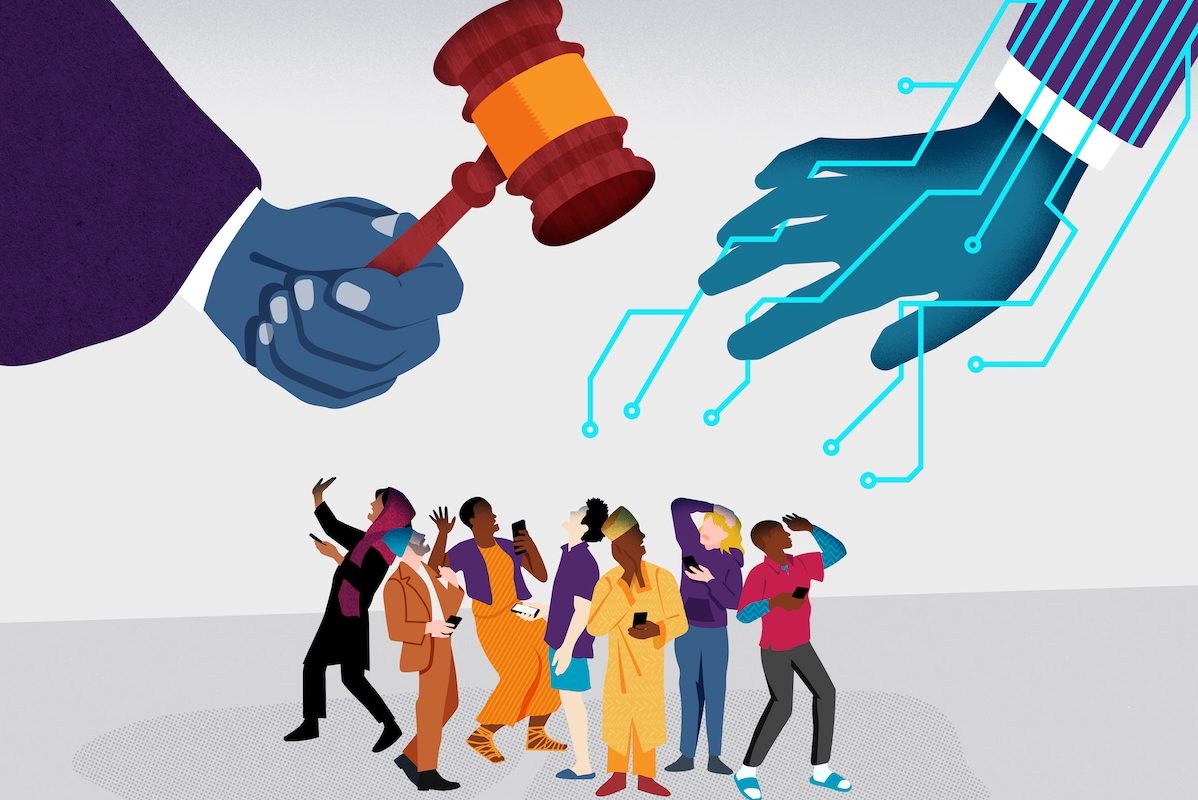
In 1938, watching the rise of totalitarianism in Europe and the looming shadow of global conflict, Bertrand Russell defined “naked power.”
In his seminal work Power: A New Social Analysis he described power that requires no consent, no tradition and no justification other than force itself. It was the raw, unmediated relationship of “the butcher to the sheep” – a dynamic in which the ruler’s will is imposed through sheer physical coercion rather than persuasion, law or custom.
Today, in the vast geopolitical expanse stretching from the sophisticated, algorithmically curated filters of the Great Firewall of China to the disconnected nodes of the Middle East and the intermittent blackouts of South Asia, Russell’s concept has found a new, terrifying manifestation.
Domination in the 21st century does not always appear as soldiers marching in the street or tanks rolling into a square. Increasingly, it appears as a sterile “connection timed out” error on a browser or a throttled bandwidth speed that renders communication impossible.
For the modern observer in Asia, the recurrence of internet shutdowns – whether in the dense urban centers of Iran during protests, the conflict zones of Myanmar or the periodic blackouts in India – is not merely a technical disruption or a temporary inconvenience. It is a profound sociological event.

This recurrence marks the return of Russell’s “naked power,” but in a sanitized, bureaucratic and highly efficient form. It represents the precise moment when the state stops trying to persuade its citizens through propaganda (what Russell termed “power over opinion”) and simply flips a switch, asserting absolute physical control over the very infrastructure of reality.
This article re-reads Russell’s book to understand this phenomenon not as a series of isolated political crises but as a structural shift in Asian governance: the transition from “managing consent” to “managing connectivity,” in which the fiber-optic cable replaces the prison wall as the primary instrument of containment.
From propaganda to silence in the physics of domination
Bertrand Russell argued that power flows like energy, constantly changing forms from wealth to weaponry to propaganda. He posited a crucial economic theory of tyranny: Among means of repression stable governments prefer propaganda because it creates willing subjects and is cheaper in the long run than naked power.
The latter alternative, he argued, is expensive, exhausting and unstable because it relies on constant, visible coercion that breeds resentment and requires a massive apparatus of enforcement.
However, the “Asian internet model” challenges Russell’s 20th-century calculation. In the 21st century, technology has inverted the economics of repression. Digital coercion has become cheap, instant and scalable.
When a government implements a blackout or a severe throttling of bandwidth during times of unrest, it is implicitly admitting that it has lost the battle for “hearts and minds” (propaganda). In Russell’s terms, the propaganda phase has failed, necessitating a retreat to naked power.
Yet, unlike the bloody crackdowns of the past, this new naked power is silent. Deploying riot police requires complex logistics, risks viral footage of brutality, endangers the morale of the troops and invites immediate international sanctions.
Shutting down the internet, by contrast, requires only a command sent to a server room. It is asymmetric warfare waged by the state against its own population. The cost of enforcement is near zero, but the cost of resistance is infinite.
This is the digital siege. It is a modern reimagining of medieval warfare tactics applied to the cognitive realm. Just as a medieval commander might encircle a rebellious city to cut off its food and water supplies, forcing submission through deprivation, modern technocracies cut off the flow of information.
This constitutes a sociological mechanism of control that bypasses the human will entirely. The state no longer needs to engage in the messy business of counter-argument. There is no need to convince a citizen that a protest is wrong or that a grievance is illegitimate if the citizen cannot see that the protest exists in the first place.
The siege creates a vacuum where the state’s narrative is the only oxygen left.
The sovereignty of the intranet and the god complex
With chilling foresight Russell wrote that “the man who has vast mechanical power at his command is likely, if uncontrolled, to feel himself a god.”
This god complex is visible in the aggressive push for “national internets” or “sovereign cyber-space” across the Asian continent. From China’s sophisticated overarching control system to Russia’s “Runet” tests, and the localized intranets being developed in the Middle East, the strategic goal is identical: to create a closed loop, a hermetically sealed reality.
In this closed environment, the state does not just govern the people; it governs the physics of their interactions. The state assumes the role of the architect of reality, deciding which packets of data live and which die, how fast information travels and who is visible to whom. This is the ultimate dream of the technocrat.
t is not necessarily violence in the traditional, kinetic sense – no blood is spilled when a server is unplugged, and no bones are broken by a firewall rule – but it is the purest form of domination imaginable.
It fundamentally alters the social contract. The citizen is reduced to a “user” with “read-only” access. Connectivity transforms from a right, essential for economic and social life, into a privilege granted by the administrator, revocable at any moment for “violations of terms.”
In this digital panopticon, the state is not just the watcher; it is the switch-holder, capable of pausing time and space for its subjects at will. By controlling the latency and availability of the network, the state controls the metabolic rate of society itself.
Breaking the collective mind to atomize society
Russell warned that “sectarian fanaticism” thrives when communication is severed. He believed that for a society to be rational, moderate and progressive, there must be a free flow of ideas and a cross-pollination of perspectives. He saw conversation as the antidote to extremism.
Internet shutdowns and extreme filtering create the exact opposite effect: the atomization of society. When the network goes down, the “collective” – that intangible entity formed by the shared consciousness of millions – dissolves instantly into millions of isolated, frightened individuals. The “social brain” is effectively lobotomized.
In this state of enforced isolation, the verification of truth becomes impossible. A citizen in one neighborhood cannot know if the protest in the next block is still active or if it has been crushed. Rumor replaces news, conspiracy replaces analysis and fear replaces logic.
This fragmentation serves the purposes of naked power perfectly. An atomized population cannot organize, cannot coordinate and cannot validate its own grievances. It cannot form the “revolutionary power” that Russell identified as the necessary check against established tyranny.
The psychological impact of this digital isolation is profound and often underestimated by outside observers. It induces a sense of helplessness (learned helplessness) that is far more effective than physical containment.
When a citizen checks on the phone for the news or tries to contact a loved one and finds only a dead signal, the message from the state is visceral and immediate: You are alone, and you are powerless. The silence of the phone screen becomes a mirror reflecting the individual’s absolute vulnerability before the state apparatus.
The bureaucratization of the kill switch
What is perhaps most disturbing – and what would have fascinated a logician such as Russell – is how this raw power has been bureaucratized and banalized.

In many Asian contexts, the decision to cut connectivity is rarely framed as a political crackdown or an act of censorship. Instead, it is framed as a “security measure,” a “maintenance protocol,” or a “technical necessity to preserve public order,” often managed by engineering commissions, regulatory bodies and Internet Service Providers (ISPs).
This effectively depoliticizes the act of domination. It moves the violence from the realm of politics to the realm of administration. When power hides behind technical protocols and service agreements, it becomes incredibly difficult to challenge. One cannot argue against a “bandwidth limitation” or a “DNS filtering rule” in the same way one argues against a bad law or an unjust decree.
The enemy is no longer a dictator giving a speech; it is a faceless network error.
The violence is hidden in the code. ISPs and tech companies are deputized as the enforcers of state will, creating a layer of insulation between the ruler and the ruled. The anger of the citizen is directed at the modem, the phone or the service provider, while the “invisible Leviathan” remains untouched, operating the levers of control from behind a veil of bureaucratic neutrality.
This diffusion of responsibility makes the new naked power remarkably resilient. There is no single figurehead to topple, only a labyrinth of protocols to navigate.
The Russellian warning for Asia
Bertrand Russell concluded his 1938 masterpiece with a desperate plea for “taming power” to flow through the democratization of control and the education of the masses. He wrote: “There is no hope for the world unless power can be tamed … and brought into the service of the whole human race.”
In the context of the “Asian century,” this warning takes on a new, critical urgency. The technological infrastructure being built today – the localized clouds, the national firewalls, the deep packet inspection tools and the surveillance algorithms – creates a capacity for naked power that no 20th-century dictator, not even Stalin or Hitler, could have dreamed of. They could control bodies, but they could never fully control the flow of every whisper.
If Russell were alive today, looking at the blinking cursors on the screens of millions of disconnected Asian citizens, he would likely warn us that the greatest threat to freedom in our time is not the noise of war but the silence of the network.
The challenge for the developing world is not just economic growth or digital transformation; it is the preservation of the “human element” in governance. If we accept that the off switch is a legitimate tool of statecraft, a standard operating procedure for managing dissent, we accept a society in which citizens are merely nodes in a network, to be connected or disconnected at the whim of the system administrator.
That is not order, nor is it stability. It is the quietest, most pervasive form of tyranny history has ever known.
Amirreza Etasi is a Tehran-based senior construction management expert.
