

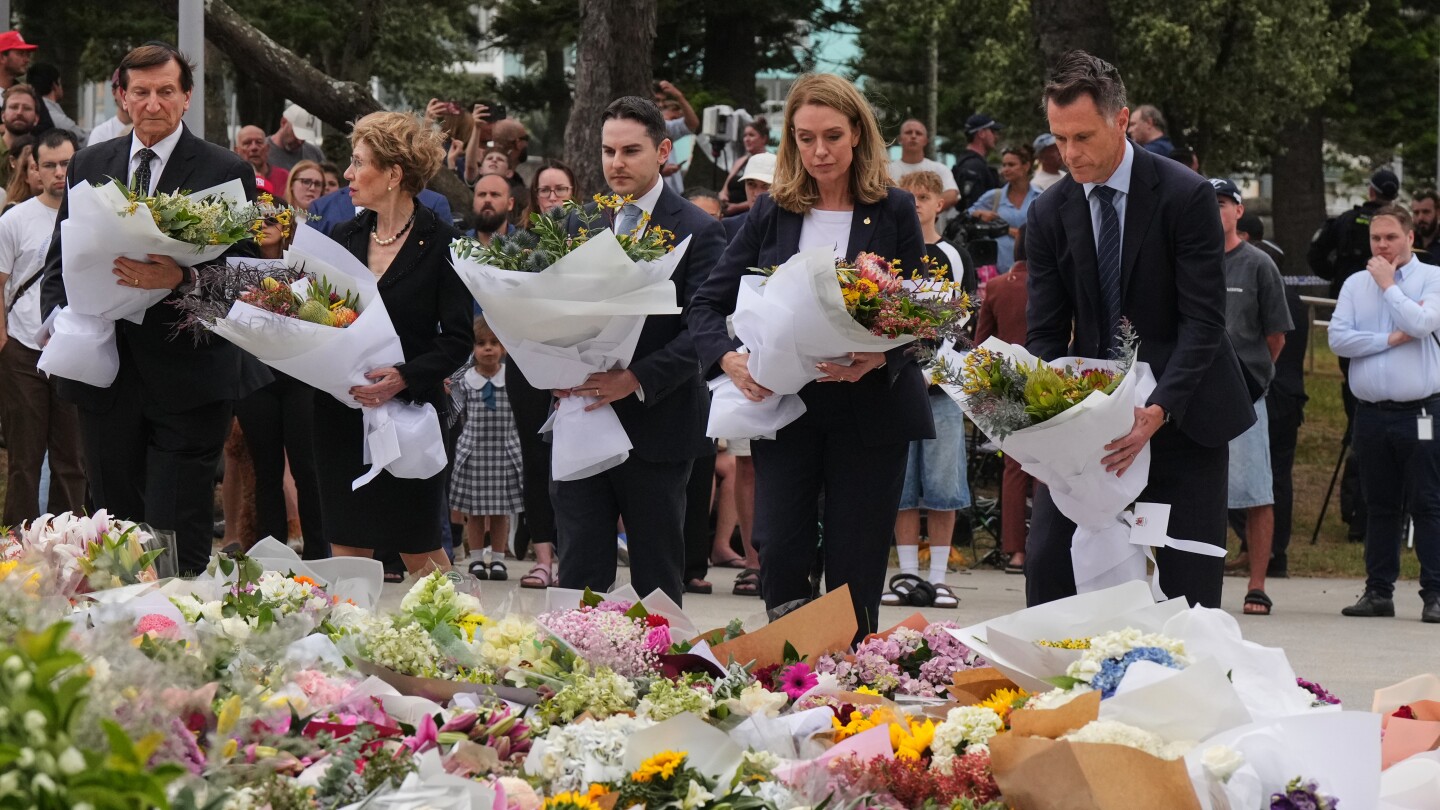
SYDNEY (AP) — A father and son are suspected by officials to have killed 15 people on a popular Australian beach, shocking a country where gun violence is rare. The government on Monday, a day after the shootings, proposed tougher new gun laws amid criticism that officials didn’t take seriously enough a string of antisemitic attacks.
Here’s a look at what to know from the attack at Bondi Beach:
The suspects attacked a Jewish beachside gathering
Little is known about the suspects in the attack on Sydney’s famous Bondi Beach, but there was widespread shock when officials said that the two men pictured firing weapons in social media videos were related.
The 50-year-old father, who was killed, arrived in Australia in 1998 on a student visa, authorities said, and was an Australian resident when he died. Officials wouldn’t confirm what country he had migrated from.
His 24-year-old Australian-born son, who was shot and wounded, is being treated at a hospital
The target was a Hanukkah celebration where hundreds had gathered to celebrate the first day of the eight-day Jewish holiday. Prime Minister Anthony Albanese called it an act of antisemitic terrorism.
The dead included a 10-year-old girl, a rabbi and a Holocaust survivor. Dozens of others were injured, some seriously.
Police said officers were examining a number of suspicious items, including improvised explosive devices found in one of the suspect’s car.
One dramatic clip broadcast on Australian television showed a man appearing to tackle and disarm one of the gunmen, before pointing the man’s weapon at him, then setting the gun on the ground.
Police said the father held a firearms license that entitles an adult with a “genuine reason” to own a rifle or shotgun, other than a rapid-fire variety. Accepted reasons include target shooting, recreational hunting and vermin control. Self-defense is not an accepted reason. Police say the father was a member of a gun club, which suggests he was a target shooter.
Hate crimes targeting Jews in Australia are on the rise
A wave of antisemitic attacks have shocked and angered many in Australia over the last year.
Australia has 28 million people and about 117,000 Jews.
Antisemitic incidents, including assaults, vandalism, threats and intimidation, surged more than threefold in the country during the year after Hamas attacked Israel on Oct. 7, 2023, and Israel launched a war on Hamas in Gaza in response, the government’s Special Envoy to Combat Antisemitism Jillian Segal reported in July.
Last year, there were antisemitic attacks in Sydney and Melbourne. Synagogues and cars have been torched, businesses and homes vandalized with graffiti, and Jews attacked in cities where 85% of the nation’s Jewish population lives.
Albanese in August blamed Iran for two of the attacks and cut diplomatic ties to Tehran.
Israel urged Australia’s government to address crimes targeting Jews. Prime Minister Benjamin Netanyahu said he warned Australia’s leaders months ago about the dangers of failing to take action against antisemitism. He claimed Australia’s decision — in line with scores of other countries — to recognize a Palestinian state “pours fuel on the antisemitic fire.”
This is the deadliest shooting in Australia in three decades
Australia has strict gun control laws.
Mass shootings are extremely rare. A 1996 massacre in the Tasmanian town of Port Arthur, where a lone gunman killed 35 people, prompted the government to drastically tighten gun laws, making it much more difficult to acquire firearms.
Significant mass shootings this century included two murder-suicides with death tolls of five people in 2014 and seven in 2018, in which gunmen killed their own families and themselves.
In 2022, six people were killed in a shootout between police and Christian extremists at a rural property in Queensland state.
The prime minister said he was pushing for tougher gun laws.
