

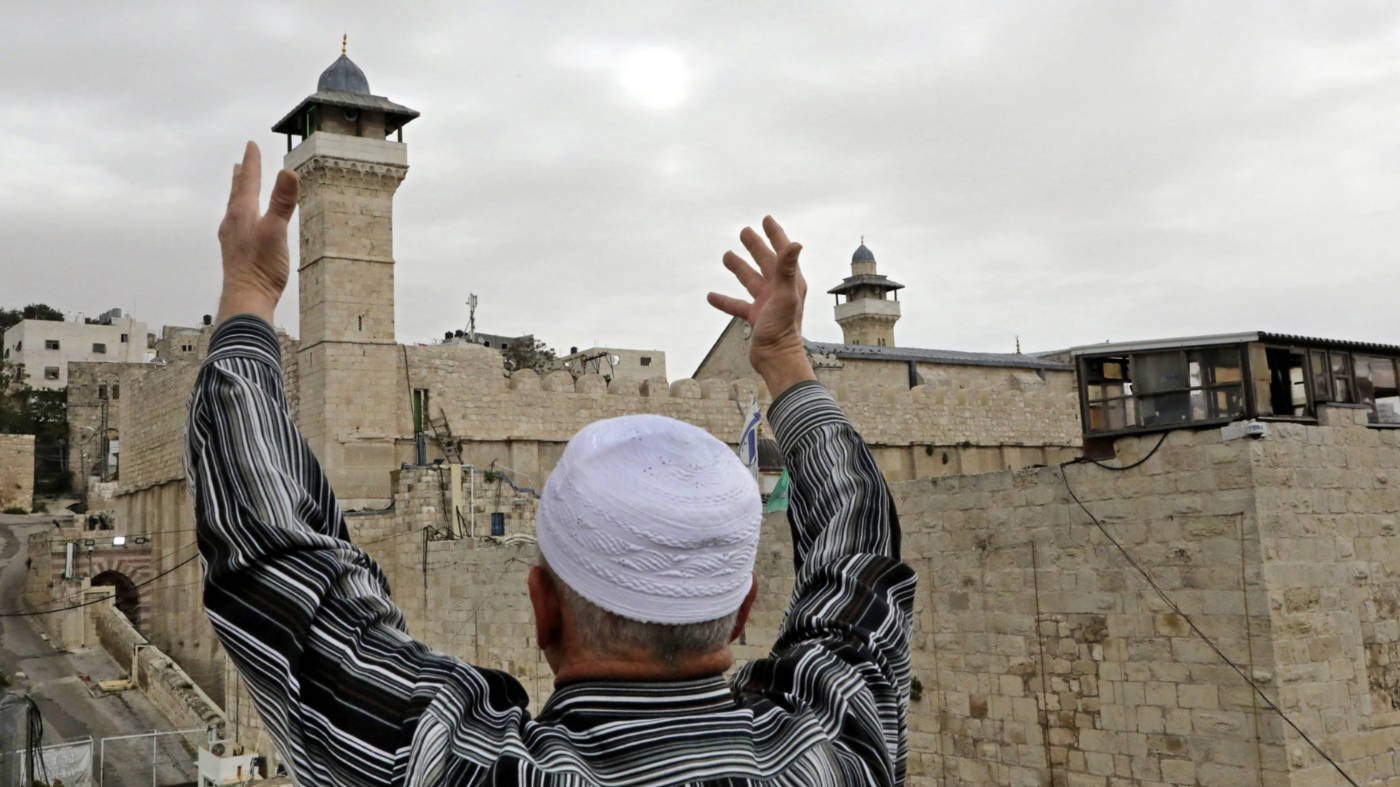
The ancient Ibrahimi Mosque in Hebron, occupied West Bank, is among the holiest sites in Islam, Judaism and Christianity.
It has been administered by Palestinians and used as a mosque for more than 1,400 years.
But in recent times, Israel has sought to take broader control of the site. In January, it barred the mosque’s Palestinian directors and seized planning rights over part of the site, in contravention of longstanding arrangements.
It has come amid increasing settler attacks and access restrictions against Palestinian holy sites since October 2023, including the Al-Aqsa Mosque in occupied East Jerusalem and Joseph’s Tomb in Nablus.
In January, the Israeli military began an assault on Hebron and other Palestinian towns and villages in the occupied West Bank, including raids on Palestinian homes and businesses.
New MEE newsletter: Jerusalem Dispatch
Sign up to get the latest insights and analysis on
Israel-Palestine, alongside Turkey Unpacked and other MEE newsletters
Here, Middle East Eye explains the significance of the site and the recent Israeli incursions.
What’s the history of the Ibrahimi Mosque?
The Ibrahimi Mosque is a medieval religious structure. It sits above a cave system that hosts an ancient tomb complex dating back more than 2,000 years.
The mosque is located in the Old City of Hebron in the West Bank, which Israel has occupied in contravention of international law since 1967.


The site is believed to be the resting place of Abraham, the biblical patriarch of the three major Abrahamic religions (Judaism, Christianity, and Islam) and his family, including his son Isaac and grandson Jacob.
In the Talmud and the Old Testament, the site is called the Cave of Machpelah. For modern Christians and Jews, it is the Cave of the Patriarchs. And for Muslims, it is the Ibrahimi Mosque.
Much of the current building is a Romanesque Christian church, constructed during the 12th century. It was built on top of an earlier mosque that was destroyed during the Crusades.
The site was converted back to a mosque by the Muslim Ayubbid dynasty during the late 12th century. Access was limited to Muslims for several centuries, including the subsequent Mamluk (1250-1517) and Ottoman (1516-1917) periods of rule in Palestine.

However, after the British Mandate of Palestine in 1921, Jewish immigrants sought to gain access to the site and parts of Al-Aqsa Mosque, sparking protests by Palestinians and subsequent deadly clashes in the city.
From 1948 until 1967, the West Bank was under Jordanian control. Jews were banned from entering the territory and, by extension, the site.
In 2017, Unesco, the UN cultural agency, designated the site and the surrounding Old City of Hebron as an endangered World Heritage Site belonging to the State of Palestine.
The decision was condemned by Israel and the US, both of which subsequently withdrew from the UN body.
How has Israeli occupation affected the Ibrahimi Mosque?
Jewish access to the mosque increased after Israel seized the West Bank during the 1967 Arab-Israeli war, and a synagogue was established at the site.
From the late 1960s onwards, the Israeli government allowed the development of Kiryat Arba, a Jewish settlement built on confiscated Palestinian land on the outskirts of Hebron’s Old City. The settlement now hosts around 7,000 settlers who live in a segregated enclave next to Hebron’s 200,000 Palestinians.
In 1994 Baruch Goldstein, a US-born settler living at Kiryat Arba, opened fire on hundreds of Muslims worshipping in the mosque during Ramadan, killing 29 Palestinians and wounding another 125. Goldstein was eventually disarmed and killed by survivors.

Dozens more Palestinians were killed by the Israeli military in the protests and rioting that followed. Palestinians are still barred from accessing al-Shuhada Street, the main approach to the mosque.
Palestinian groups had previously written to Israeli Prime Minister Yitzhak Rabin about the “dangers” of Goldstein, who poured acid over the floor of the mosque in October 1993.
The attack was condemned by Rabin but venerated by some on the Israeli far right. Goldstein’s tomb in Kiryat Arba subsequently attracted pilgrimages from Zionist extremists. Itamar Ben Gvir, Israel’s far-right national security minister, gave a speech in front of Goldstein’s portrait in 2023.
After the attack, the prayer hall was formally partitioned in 1994 on the recommendations of an Israeli-led commission. Two-thirds of the space is reserved for Jews and the remaining third for Muslims.

Officially, Muslims are forbidden from using the mosque on the dates of 10 Jewish holidays. Jews are forbidden from using the site on 10 days marked for Muslim holidays.
In 1997, the Hebron Protocol divided the city into two further administrative zones: H1 and H2. The mosque is in H2, which puts it under Israeli military control.
But the management of the mosque itself remained with the Islamic waqf (trust) and the Hebron Municipality, which is controlled by the Palestinian Authority.
What has happened to the site during Israel’s war on Gaza?
The Ibrahimi Mosque is one of several West Bank holy sites that have seen an increase in access restrictions and settler attacks since October 2023.
Israel has imposed restrictions on Palestinian use of the mosque, including bans on the call to prayer and restrictions on when it can be used.
Israel arrested the independent Palestinian mayor of Hebron, Yayseer Abu Sneineh, in September 2025 amid reports that local sheikhs were planning to secede from the PA to establish an “emirate of Hebron” that recognised the state of Israel.

On 30 December, the Civil Administration (CA), the Israeli-run governing body in the West Bank, unilaterally seized municipal control of the mosque’s central courtyard from the Hebron Municipality.
This gave the CA the authority to begin constructing of a roof over the courtyard, despite long-running Palestinian opposition.
Israel also banned the mosque’s director, Sheik Mu’taz Abu Sneineh, and the site’s custodian, Hammam Abu Murkhiya, from entering the mosque for 15 days.
Israeli settlers have repeatedly stormed the mosque in violation of prayer arrangements. Others have hosted weddings and music festivals in its grounds.
They include far-right Israeli ministers Bezalel Smotrich and Itamar Ben Gvir, who have frequented the mosque alongside large security details. Ben Gvir is a resident of Kiryat Arba.
Past visits by Israeli politicians to Muslim holy sites have caused outrage in occupied Palestine. In 2000, right-wing Israeli leader Ariel Sharon toured Al-Aqsa, triggering protests that spiralled into the Palestinian uprising known as the Second Intifada.
What have Palestinians said about Israeli incursions?
The PA has described Israel’s unilateral seizure of part of the mosque in December as part of its “Judaization projects” in the West Bank.

The PA said in a statement that the seizure “constitutes a flagrant violation of international resolutions and international law, its obligations as an occupying power, and represents a serious encroachment on the legal and historical status of the Ibrahimi Sanctuary”.
Hamas also condemned the move, stating that “the Israeli government seeks to undermine the mosque’s identity, as well as the Arab and Islamic identity of Hebron”.
What has Israel said?
Israeli Prime Minister Benjamin Netanyahu, who made a controversial visit to the mosque ahead of the September 2019 Knesset elections, has not recently commented on the mosque.
The Israeli Civil Administration has said that the move “preserves the status quo and does not affect prayer arrangements”.
Eyal Gelman, a settler who leads the parallel Israeli Hebron Municipality, told Israeli news site Makor Rishon that Israel’s seizure of planning rights over the mosque was an “important step to strengthen Jewish control over the resting place of the forefathers and mothers”.
He added: “We are working to restore Jewish control over the entire area of the Cave of the Patriarchs as in ancient times.”
What happens next?
The foreign ministries of Qatar, Turkey and the UAE condemned the Israeli seizure of planning rights over the mosque when the move was first announced in July.
The ministries each called on the international community to prevent the Israeli encroachment, but did not take further action when planning rights were ultimately seized in December.
Palestinian lawyers for the Hebron Municipality are petitioning Israel’s Supreme Court over the move.
They cited the Unesco ruling that the site is endangered and belongs to the State of Palestine as evidence that the Israeli incursions violate international law, and have challenged the legal grounds of the construction permits used.
The lawyers told Haaretz that all decisions regarding the site had been made “without authority” and constituted “a systematic and unlawful violation of the status quo at the site”.
