

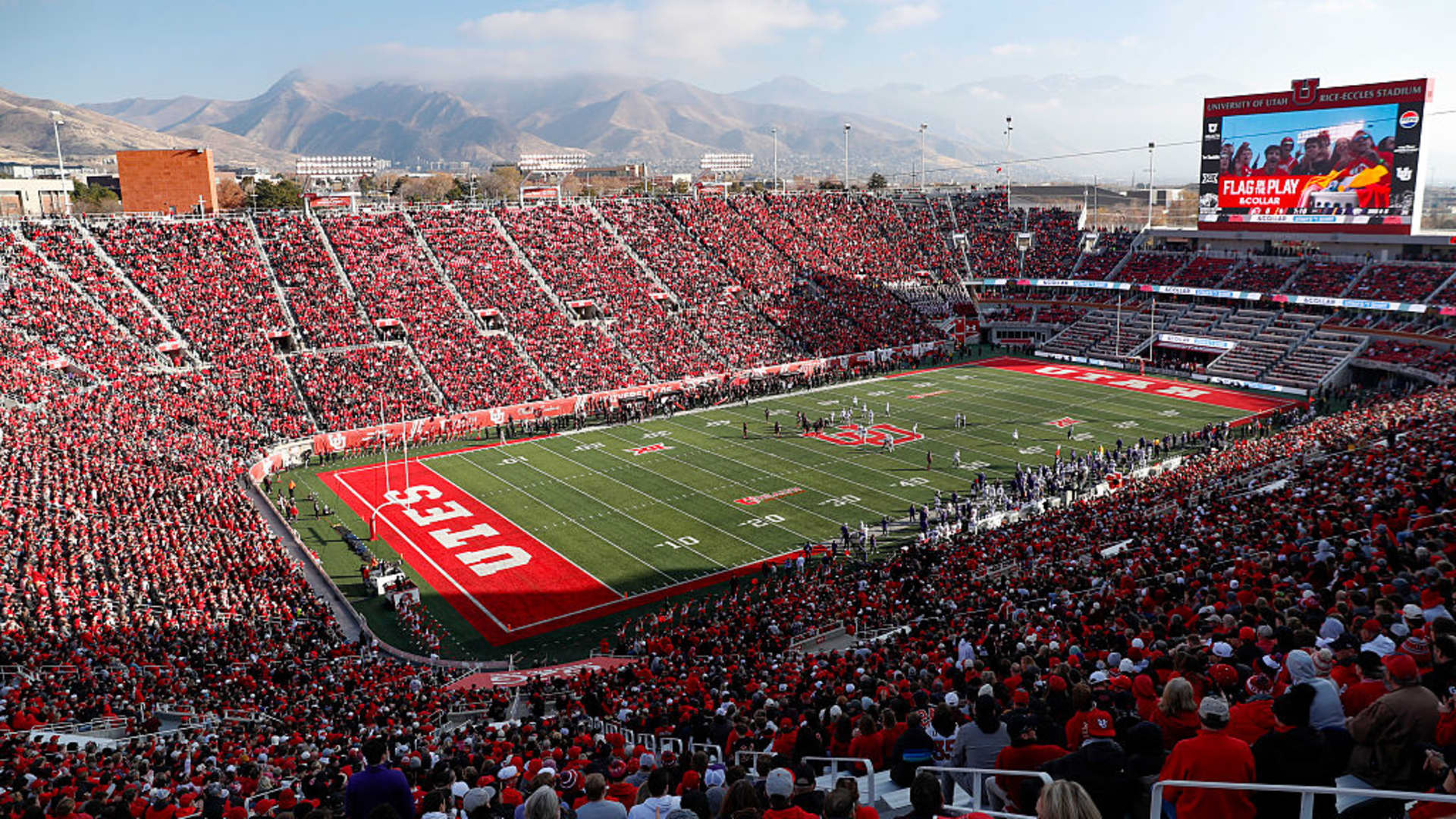
A version of this article first appeared in the CNBC Sport newsletter with Alex Sherman, which brings you the biggest news and exclusive interviews from the worlds of sports business and media. Sign up to receive future editions, straight to your inbox. When most people think about Utah, I’m pretty sure private equity isn’t their first thought. But the University of Utah will go down in NCAA history as the first college athletic department to accept private equity money. This week, the school announced the formation of Utah Brands & Entertainment LLC, a new company owned by the University of Utah Foundation. Utah Brands and Entertainment will now own “select core revenue-generating operations,” University of Utah President Taylor Randall and Athletics Director Mark Harlan wrote in an open letter Tuesday. The new business will partner with Otro Capital, a private equity firm “with deep operational experience in sports, entertainment and media, to help support and strengthen this new venture and its long-term growth potential,” Randall and Harlan wrote. Yahoo Sports reported “the new venture is expected to generate as much or more than $500 million in capital.” Utah may have designed a template for other schools to bring in private capital to help fund their athletic programs, which are now financially taxed by having to pay students who play certain sports. Utah isn’t selling teams or parts of its athletic department, and it’s not ceding operational control to a private equity firm. All decisions regarding operations and athletics will be made by the AD, Randall and Harland wrote. NCAA President Charlie Baker said this week at Sports Business Journal ‘s Intercollegiate Athletics Forum that the formation of Utah Brands & Entertainment is “really well thought out and really well designed,” praising the concept for keeping decision making in-house to the Utah athletic department. Baker has long been skeptical of shifting too much power to private equity. “My message to everybody on this would be really simple: ‘Be really careful,'” Baker said in October about private equity deals. Colleges have toyed with inviting in private equity money for several years but had thus far balked. When I spoke with sports investor Marc Lasry in September, he told me the biggest hurdle to private equity investment in college sports was convincing someone to go first. “We’ve been on the 1-yard line about five times,” said Lasry. “It’ll get done. The hurdle is always at the end day, nobody wants to be first.” Utah decided to take the leap because the financial burden of paying athletes simply looked too steep. The school relies on student fees and government support to fund athletics. “The decision to share revenues with student-athletes under the House Settlement and the emergence of the transfer portal have disrupted the status quo and introduced significant costs to the university,” Randall and Harlan wrote. “The cost of supporting a nationally competitive athletics program has risen dramatically and far outpaces revenue growth.” Now we wait to see if this opens the floodgates on private equity investment. *** Several of you have asked or emailed me in recent days how I think the battle between Netflix and Paramount over Warner Bros. Discovery will play out. Obviously, like everyone else, I have no idea. But there’s one scenario where each company could walk away saying it won. Let’s say Paramount raises its bid for WBD to the point where Netflix thinks it’s too expensive. WBD can walk away with a massive premium – possibly more than 150% over the unaffected share price of $12.54 on Sept. 10. Even at Netflix’s $27.75 per share for the studio and streaming assets ($82.7 billion enterprise value), it’s already one of the largest premiums ever on a media deal of significance – perhaps the largest. Netflix would receive $2.8 billion from WBD as a breakup fee if the streamer takes Paramount’s sweetened offer. Not bad for a few months of due diligence and Oval Office meetings . Netflix could also argue it made Paramount pay through the nose for WBD. And Paramount can walk away with what it’s wanted the whole time – a combined media company of scale to challenge Disney, Netflix and Amazon. The biggest obstacle to this happening is Netflix’s desire to own Warner Bros.’s studio and HBO. If you listened to what Netflix co-CEO Ted Sarandos said at the UBS Media and Global Communications Conference this week, it sure sounds like he doesn’t want to lose his grasp on the assets. “We think it’s great for our shareholders. We think it’s great for consumers. We think it’s a great way to create and protect jobs in the entertainment industry. We’re super confident we’re going to get it across the line and finish. So we’re excited,” Sarandos said. If Paramount raises its bid to shareholders, perhaps Netflix keeps bidding higher until Paramount caves. Maybe WBD shareholders are scared by the amount of foreign money ($24 billion of Middle Eastern sovereign wealth as of Dec. 1) in Paramount’s bid, which could go even higher if the company raises its offer again. Netflix, in its history, has cast itself as above the fray on legacy media transactions. This is the first time the company has done an acquisition of more than $1 billion. That would logically lead one to believe that Netflix really wants WBD. One top media executive told me this week he thinks Netflix would be embarrassed if it loses to Ellison, given Paramount’s diminutive stature in the entertainment world compared to Netflix. I don’t know about that. The market has punished Netflix stock since the company’s interest in WBD got more and more serious. But this executive said now that an actual deal has been announced, losing WBD would seem like “getting schooled in M & A.” Still, the win-win-win scenario I laid out is the one situation where all companies involved could make a case to their shareholders that they’re better off. Maybe that’s where we’re ultimately headed. Or, for competitive advantage reasons, maybe Netflix wants to make sure that’s the one place it really doesn’t want us to go. On the record With Robert Griffin III … This week’s On The Record is former Heisman trophy winner and current Fox Sports college football broadcaster Robert Griffin III . RG3, as he was dubbed by a broadcaster he can’t remember during the first game of his freshman year of college at Baylor, told me (with a smile) he wants to be named college football commissioner – a position that doesn’t exist. “I’d love to be the commissioner of college football. That would be a fun job, to try to figure out the best way to serve both the coaches, the players, the student athletes and the universities in a better way,” Griffin said. There are so many controversial issues right now around college football, from NIL payments to the aforementioned private equity to the College Football Playoffs. Griffin didn’t hold back on any of them. “When you punish a team that’s in the Big 12 that’s playing in a powerful conference, in BYU, and you don’t punish Alabama who’s in the SEC, it looks like SEC bias. And to be quite frank, it is SEC bias. That, to me, is something that we can never have in that committee,” he said of the selection process for playoff teams this year. “We have to judge these teams based off their resumes and what they do on the field, not the money that they can bring in via TV viewership.” He also has a surprising pick to win the CFP National Championship this year. You can watch that entire conversation here . Or listen here and follow the CNBC Sport podcast if you prefer the audio version. Contessa’s Corner Normally when I write about prediction platforms here, I’m focused on the way they’re muscling into sports betting and how states, tribes and the courts are reacting. But Polymarket, PredictIt, ForecastTrader and Kalshi are also making their way into other areas of culture and the economy. CNBC last week announced an exclusive partnership and commercial relationship with prediction platform Kalshi. CNBC President KC Sullivan said at a Versant investor day last week that there’s opportunity to harness the power of prediction data to inform reporting and drive insights for the CNBC audience. *** FanDuel struck a partnership of its own with Zoo55, part of ITV Studios, in an effort to capture the growing reality TV audience for “Love Island.” Fans of the show are certainly committed and engaged, and FanDuel is trying to coax some of them onto its platform. Gamblers in New Jersey, Pennsylvania and Connecticut can play “Love Island Reel Vibes” in FanDuel’s online slot offerings, with Ontario, Canada, and Michigan coming soon. FanDuel said it’s planning a multi-game collaboration that focuses on immersive experiences. No word on whether those will be inspired by the kind of cringe-worthy games played in the villa during the show. “Pucker or Pie” anyone? *** And at the same time, the audience for sweepstakes casinos is under scrutiny. Sweeps are available in many states where online gambling has not been legalized, and they often draw players who are younger than the minimum age requirement of 21 in most states. Regulators are taking notice. Dozens have sent cease and desist letters. New York has just become the sixth state to pass laws banning sweeps and prohibiting any payment processor, geolocation provider or content providers from supporting those kinds of games. CNBC Sport highlight reel The best of CNBC Sport from the past week: I mentioned Marc Lasry earlier — well, his son, Alex, is CEO of FIFA World Cup 26 New York/New Jersey. The World Cup final will take place at MetLife Stadium in East Rutherford, New Jersey on July 19, 2026. Alex Lasry told CNBC’s Scott Wapner he expects several million people to come to the region for the 40 days of the World Cup. CNBC’s Steve Sedgwick sat down with Hugh Brashner , the CEO of London Marathon Events, about how his experience playing sports led him to a career in developing races for runners. “I just think sport is brilliant at teaching people life lessons,” Brashner told Sedgwick. “I really, passionately believe that children have the right to be active.” The big number: 24-1 As in, the Oklahoma City Thunder have started the NBA season with 24 wins and 1 loss. That ties the 2015-16 Golden State Warriors for the best start in NBA history. The Thunder won the NBA title last year, and superficially, the team’s rise to the top validates NBA Commissioner Adam Silver ‘s strategy to value parity over dynasties. “The data is absolutely crystal clear that the more competition you have, the more it drives interest in the league,” Silver told me last year . OKC is a small market team competing against historical juggernauts like the Los Angeles Lakers and the Houston Rockets for the title this season. But OKC may be so good — armed with three more first-round draft picks next year — that the small market Thunder could actually become a dynasty of its own. Quote of the Week “Pete’s behavior has been egregious….I think he is totally out of bounds in his approach, and if he was in the room, I’d tell him the same thing.” –The always outspoken Brett Yormark , Big 12 commissioner, defending his peer, ACC Commissioner Jim Phillips , from Notre Dame Athletic Director Pete Bevacqua . Yormark spoke at the Sports Business Journal’s Intercollegiate Athletics Forum . Notre Dame missed out on one of 12 CFP berths despite winning its last 10 games. Bevacqua, the former head of NBC Sports, earlier this week accused the ACC of supporting the Miami Hurricanes to be in the CFP over the Fighting Irish. Both teams finished 10-2, but Miami defeated Notre Dame 27-24 in Week 1 of the season. “What we were really surprised by and disappointed by was how the ACC conference really went on a social media campaign (that) in my opinion (was) attacking our football program,” said Bevacqua, according to ESPN’s Pete Thamel. Bevacqua told Dan Patrick the ACC had done ” permanent damage ” to its relationship with Notre Dame. While Notre Dame football is independent of a conference, all other Notre Dame sports other than men’s hockey play in the ACC. Around the league Versant, the soon-to-be parent company of CNBC, showcased its sports offerings, including PGA golf, Premiere League, WWE and the Olympics at its investor day last week . Now, another company of cable networks is getting into live sports: AMC Networks and TNA Wrestling reached a multiyear deal to bring TNA’s weekly TV show “Thursday Night iMPACT!” to AMC, beginning Jan. 15, 2026. I’d also be remiss not to mention AMC’s upcoming four-part sports docuseries “Rise of the 49ers,” highlighting the team’s success in the 1980s and early 90s, which will air Feb. 1 and Feb. 2. Fine, twist my arm, I’ll watch! NFL teams voted Wednesday to authorize 32 Equity, the league’s collective investment vehicle, to enter into an agreement with a partner to operate a professional flag football league with an investment up to $32 million. The NFL notes that “flag football is now offered at a high school level in 38 states, and the sport continues to grow at a rapid pace at the collegiate level, with hundreds of colleges and universities across the country offering flag football programming.” YouTube TV is the latest pay-TV distributor to launch genre-specific bundles of linear networks, allowing consumers to buy smaller packages of channels for less money. YouTube TV plans to introduce a sports-focused package that will include the broadcast networks, ESPN, FS1, the new NBC Sports Network, TNT, USA and others that include sports. The product will be available in early 2026. YouTube hasn’t announced a price.
