

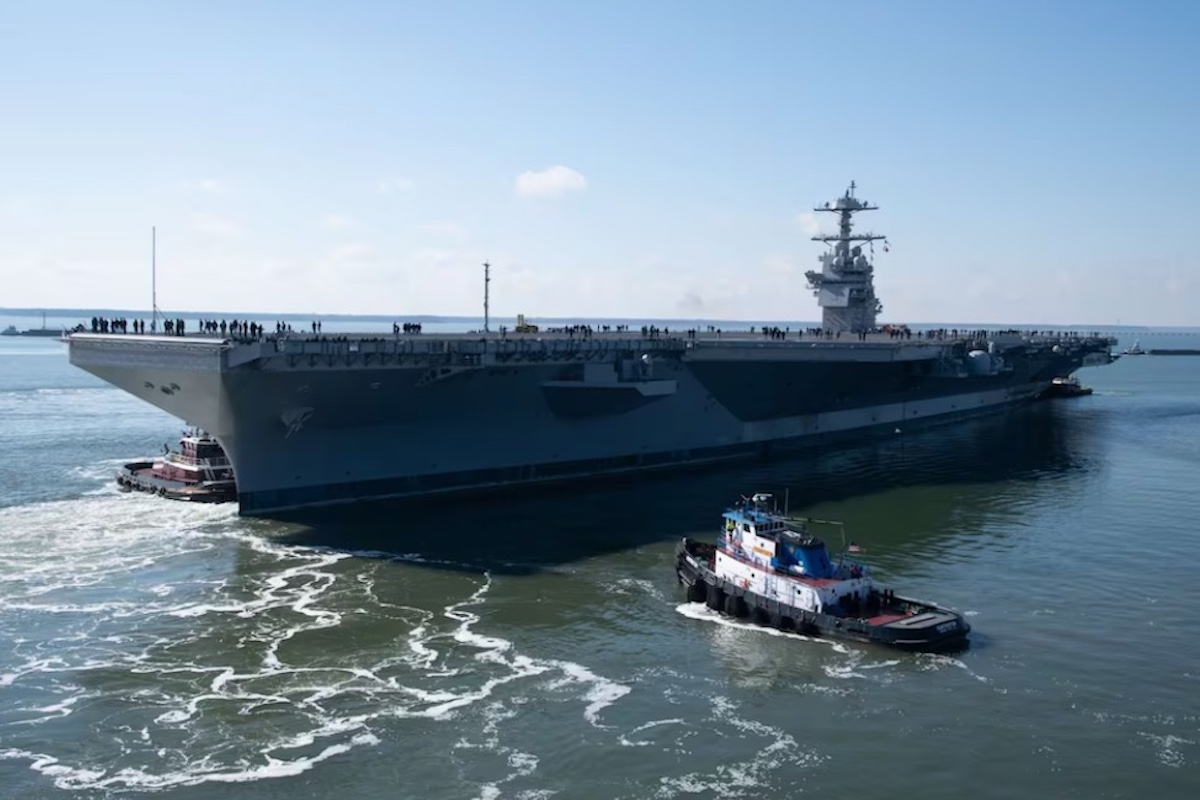
The USS John F. Kennedy’s progress toward service highlights both the US Navy’s investment in carriers and the mounting pressure on a fleet stretched thin by global commitments.
This month, multiple media outlets reported that the US Navy’s next carrier, the future USS John F. Kennedy (CVN-79), returned to Huntington Ingalls Industries’ (HII) Newport News Shipbuilding in Virginia after completing its first weeklong builder’s sea trials, a key milestone as the US$13.2 billion ship moves toward delivery and commissioning in March 2027.
The second Gerald R Ford-class carrier, the nuclear-powered ship sailed out in January to test propulsion, navigation and other critical systems, bringing together shipbuilders, US Navy supervisors and pre-commissioning crew to demonstrate ship operations before formal acceptance trials later this year.
The program has been dogged by delays as the service opted to deliver the ship with upgrades for the F-35C fighter and the new Enterprise Air Surveillance Radar (EASR). At the same time, the certification and integration of novel systems, such as the Advanced Arresting Gear (AAG) and Advanced Weapons Elevators (AWE), pushed the schedule back again last year.
The slippage will temporarily reduce the US carrier fleet to 10 ships for about a year when the USS Nimitz retires. Still, US Navy and industry leaders said the Ford-class design, which also uses electromagnetic launch systems and more powerful reactors, is intended to boost efficiency, cut crew requirements and lower lifetime costs as the service plans a 10-ship class to replace the aging Nimitz fleet.
The key question is whether the US can still credibly rely on carriers for Indo-Pacific power projection, given their contested survivability, vulnerable logistics and limited numbers to handle multiple crises.
Mark Cancian and other writers say in a January 2023 report for the Center for Strategic and International Studies (CSIS) that in multiple wargame scenarios of a US-China conflict over Taiwan, the US would likely lose two aircraft carriers, defined as ships sunk or so badly damaged they would be unavailable for the rest of the war.
Cancian and others mention that these losses typically occur early, with China’s long-range, massed missile strikes overwhelming US naval defenses and knocking out the forward-deployed carriers within the first turn or two of the conflict.
However, US carriers were designed with high survivability in mind. Walker Gargagliano points out in a 2025 article for the US Naval War College Review that US aircraft carriers are far more survivable than critics assume, emphasizing their layered defenses, structural resilience and exceptional damage-control capacity.
Gargagliano says that past Nimitz-class (and, by extension, Ford-class) carriers improve on this with compartmentalization, armor, redundant systems, insensitive munitions, and robust firefighting systems.
He states that even mass missile attacks would struggle to sink or mission-kill a responsibly operated carrier, making US carriers among the most survivable airfields in the Pacific.
Furthermore, Harrison Kass notes in a January 2026 article for 19FortyFive that carriers may offer capabilities that cannot be substituted by any other asset.
Kass maintains that carriers offer persistent air power, flexible responses and control over escalation, unlike land bases, which are fixed and limited by political factors; bombers, which have limited mission persistence; and one-time-use missiles.
Kass argues that even if carriers remain viable, they must adapt by emphasizing standoff operations, longer-range aircraft and acting as mobile hubs in a wider combat network.
Building on Kass’s ideas, Keith Turner and other writers, in an October 2025 article for the Combined Joint Operations from the Sea Center of Excellence, contrast traditional carrier-centric operations—built around large, concentrated carrier strike groups optimized for massed power projection—with the newer Distributed Maritime Operations (DMO) concept, which emphasizes dispersing forces while concentrating effects.
Turner and others say that under older concepts, carriers and their escorts operated in tightly grouped formations, making them lucrative targets for modern anti-access/area denial (A2/AD) systems.
In contrast, they point out that the DMO concept instead spreads ships, submarines, aircraft, and unmanned systems across vast areas, integrating them through networks to complicate enemy targeting and improve survivability.
They emphasize that the shift reduces reliance on single, concentrated formations, favors smaller task groups, and uses maneuver, integration, and distribution to generate combat power without abandoning carriers.
But even if US carriers remain survivable thanks to new technologies and operating concepts, their real vulnerability may lie not in the ships themselves but in the support systems that sustain them—and in having too few carriers overall.
Ronald Ti argues in a November 2025 article for the Rabdan Defense and Security Institute that in a US-China conflict, China would seek to undermine carrier operations by attacking the logistics, sustainment, and enabling networks rather than only the carriers themselves.
Ti describes “contested logistics” as a frontline vulnerability, noting that China’s missile forces, cyber tools, maritime militia, and space and air capabilities could target ports, expeditionary sea bases, tankers, satellites, and commercial shipping that sustain US forces.
He notes that by disrupting fuel, munitions, maintenance, command-and-control and movement across land, sea, air, cyber and space, an adversary could degrade carrier effectiveness without sinking the carriers themselves.
But as the USS John F. Kennedy enters service, the US has too few carriers – just 10 instead of the legally mandated 11-strong fleet – potentially having a significant strategic impact on US capability to sustain power projection across multiple theaters.
As USNI News reported in January 2026, the departure of the USS Abraham Lincoln carrier strike group (CSG) from the South China Sea to the Persian Gulf leaves the USS George Washington as the only US carrier in the region.
One US carrier may not be enough to respond to multiple and simultaneous crises in the Pacific, especially in the South China Sea, the Taiwan Strait, and the Korean Peninsula. In contrast, the US Department of Defense’s 2025 China Military Power Report (CMPR) mentions that China aims to produce six aircraft carriers by 2035, for a total of nine.
A December 2025 Nikkei report says that for China to achieve that, it would need to produce one carrier every 20 months, and by the same timeframe to 2035, the report says the US could produce only three carriers.
The report adds that, even with a 60/40 split favoring the Pacific, that would imply seven or fewer US carriers assigned there over time, and maintenance cycles would reduce what is actually available at any given time.
Even if China gains a numerical edge in carriers, US carriers may retain a qualitative advantage through nuclear propulsion, larger air wings, and combat experience.
But as the USS John F. Kennedy enters service, the more immediate risk may not be losing carriers to missiles but discovering that too few ships and a fragile logistics backbone leave US sea power overstretched in the Indo-Pacific.
