

The issue of Hezbollah’s total disarmament, demanded by Israel and the United States, has dominated Lebanese political life for more than a year.
But since early January, tensions have sharply escalated, revealing a rift between President Joseph Aoun and the Lebanese movement.
Aoun has hardened his rhetoric towards Hezbollah, departing markedly from the cautious and balanced stance he had previously maintained on the highly sensitive issue of the movement’s weapons.
Lebanese authorities have officially stated that Hezbollah no longer maintains any military presence between the Litani River and the border area. But both US and Israel consider this insufficient, and continue to demand the movement’s disarmament across the entire country.
On Thursday, following a stormy meeting with Rodolphe Haykal, Lebanese army commander, US Republican Senator Lindsey Graham, a staunch supporter of Israel who once suggested that killing of Lebanese civilians was ‘necessary collateral’, maintained that the Lebanese Army “is not a reliable partner”.
New MEE newsletter: Jerusalem Dispatch
Sign up to get the latest insights and analysis on
Israel-Palestine, alongside Turkey Unpacked and other MEE newsletters
While Graham’s position reflects a view that is influential within parts of the US political establishment, decisions regarding relations with the Lebanese army are not made by individual senators but by the Pentagon.
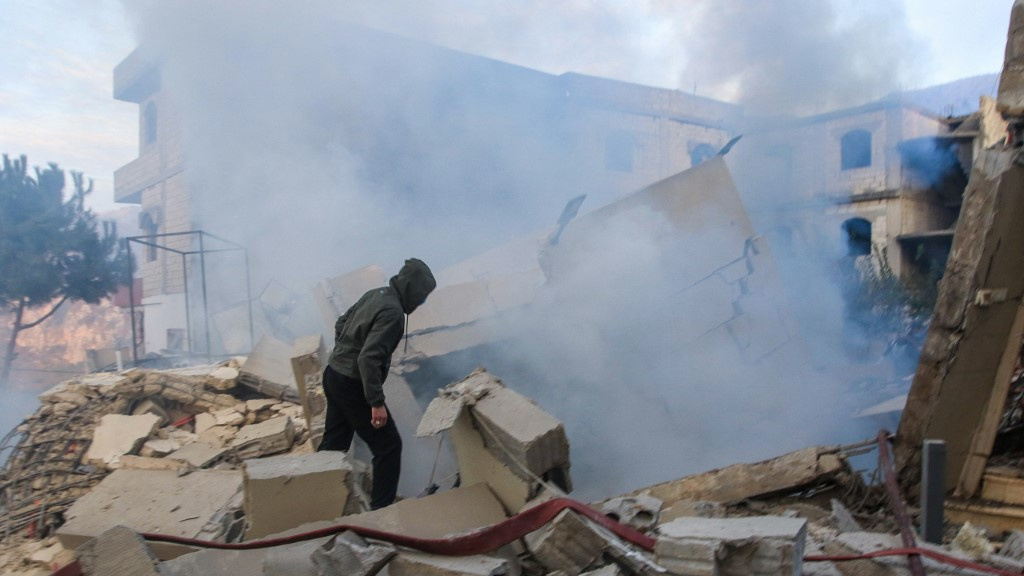
Israel has never fully respected the November 2024 ceasefire deal that ended the 66-day war with Hezbollah. Since then, it has carried out hundreds of air strikes and dozens of ground incursions, demolishing homes and other buildings. Nearly 400 people have been killed and dozens wounded.
On 2 February, Israel’s planes and drones struck civilian areas in several locations in south Lebanon, destroying dozens of residential apartments in the villages of Kfar Tebnit and Aïn Qana.
Rising tensions
In a televised interview on 11 January with a journalist openly hostile to Hezbollah, Aoun described the group’s weapons as “a burden on Lebanon”. Speaking on the first anniversary of his election as president, he said that the circumstances justifying Hezbollah’s armament “no longer exist”, calling instead for “wisdom and state sovereignty”.

Why Lebanon’s army cannot defend the nation after a year of ‘ceasefire’
Read More »
A week later, the president doubled down in remarks to foreign diplomats in Lebanon. He said the Lebanese army had carried out extensive operations to “clear vast areas of all illegal weapons, regardless of their nature or affiliation, despite provocations, continued aggression, and smear campaigns”.
He added: “We will continue along this path during the second year of my mandate so that the entire territory comes under the exclusive authority of the state.”
These statements marked a clear break from the more measured tone Aoun had adopted during his first year in office, repeatedly linking progress on disarmament to Israel’s withdrawal from five positions it occupies in southern Lebanon, and to an end to violations of Lebanese sovereignty.
Aoun previously accused Israel of obstructing the deployment of the Lebanese army in the south, and threatened to suspend the disarmament plan formally adopted by the cabinet on 5 September.
Frustration over this stance reportedly ran so high in Washington that a planned visit by Haykal was abruptly cancelled by US officials in late September.
American tutelage
Aoun’s recent shift in tone proved to be the breaking point. On 16 January, Hezbollah’s secretary general, Naim Qassem, launched a scathing attack on the foreign minister, calling for his removal.
Qassem condemned political parties and officials who were “subordinate to American tutelage and encouraging Israeli aggression”, and accused the Lebanese Foriegn Minister Yousef Raggi, who is close to the Christian Lebanese Forces party, of “aligning with the Israeli position and seeking to drag Lebanon into civil war”.
He further warned: “Undermining Lebanon’s stability and the resistance – an essential component of the country – will affect everyone. No one will be spared.”
The confrontation quickly spilled over onto social media, where fierce exchanges erupted between supporters and opponents of the various camps. Tensions escalated further when a prominent journalist was summoned by the public prosecutor on charges of “insulting the president of the republic”.
The political escalation came days ahead of Haykal’s visit to Washington during which he met with members of Congress and Pentagon officials.
The trip coincided with the Lebanese army’s anticipated release in mid-February of the second phase of Hezbollah’s disarmament plan, covering the area between the Litani and Awali rivers, north of Sidon. While the plan includes five stages, no timetable has been set.
General Haykal’s visit to Washington was overshadowed by a hostile exchange with the Republican Senator Graham.
Tensions arose when Haykal declined to label Hezbollah a terrorist organisation in response to a question from the US senator. Shortly after the meeting, Graham tweeted on his X account, saying he had “ended” a “very brief meeting” with Haykal after he refused to describe Hezbollah as a terrorist organisation. “I do not see the Lebanese army as a reliable partner,” Graham wrote.
According to informed sources, the meeting lasted only five minutes. The army chief left without making any public statement. Although Graham’s stance was widely condemned by politicians and online commentators across the political spectrum, it was also cheered on by some actors, including the Christian party Lebanese Forces.
Lebanese government sources told Middle East Eye that “the visit’s scheduale proceeded as planned” and that “a productive meeting took place between General Haykal and his American counterpart, Joint Chiefs of Staff Chairman Dan Caine.”
Breaking point
Amid this turmoil, privately, Hezbollah officials say they are not surprised by Aoun’s shift. “The president has reached the limits of the pressure he can withstand,” one senior party figure told Middle East Eye on condition of anonymity. “His already narrow margin of maneuver has shrunk further, and the Americans are demanding rapid results.”
A former minister close to Aoun described the situation as “odious blackmail”.

Why Trump must stop pushing Israel’s agenda in Lebanon
Read More »
“Either Hezbollah’s disarmament proceeds without any Israeli concessions, or military aid to the army is suspended and international financial support remains frozen,” he told MEE.
Some figures close to Hezbollah, including MP Jamil al-Sayyed, have called for a de-escalation of rhetoric to avoid “pushing the president irreversibly into the arms of the Americans”.
In a post on X (formerly Twitter) on 23 January, Sayyed said that since taking office, Aoun had sought to maintain an objective stance towards the resistance in the south – “neither neutral, nor supportive, nor hostile”. He concluded with a call for restraint, arguing that “despite this deep moral and material wound [caused by Aoun’s remarks], the national interest requires that we overcome it”.
Parliament Speaker Nabih Berri, one of Hezbollah’s remaining allies within the state, has also stepped in to calm tensions. He met Aoun on 23 January in an effort to reopen channels of dialogue.
These de-escalation efforts appear to have been successful. On 4 February, Aoun received Mohammad Raad, head of the parliamentary bloc of Hezbollah – who, after the meeting, called for “dialogue and reason”, the same words used by Aoun during his televised interview.
But the conciliatory approach adopted by Hezbollah’s leadership is not unanimously supported within the party. The Shura Council, Hezbollah’s highest decision-making body, recently accepted the resignation of Wafic Safa, former head of the liaison and coordination unit. This body is responsible for internal coordination, relations with Lebanon’s political forces, and communication with state authorities and security services.
Safa, a close associate of Hezbollah’s former secretary general, Hassan Nasrallah, was widely seen as a proponent of a harder-line current, less inclined towards political and military concessions. It is clear that the internal debate within Hezbollah has yet to conclusively determine the course the party will adopt in the period ahead.
The views expressed in this article belong to the author and do not necessarily reflect the editorial policy of Middle East Eye.
