

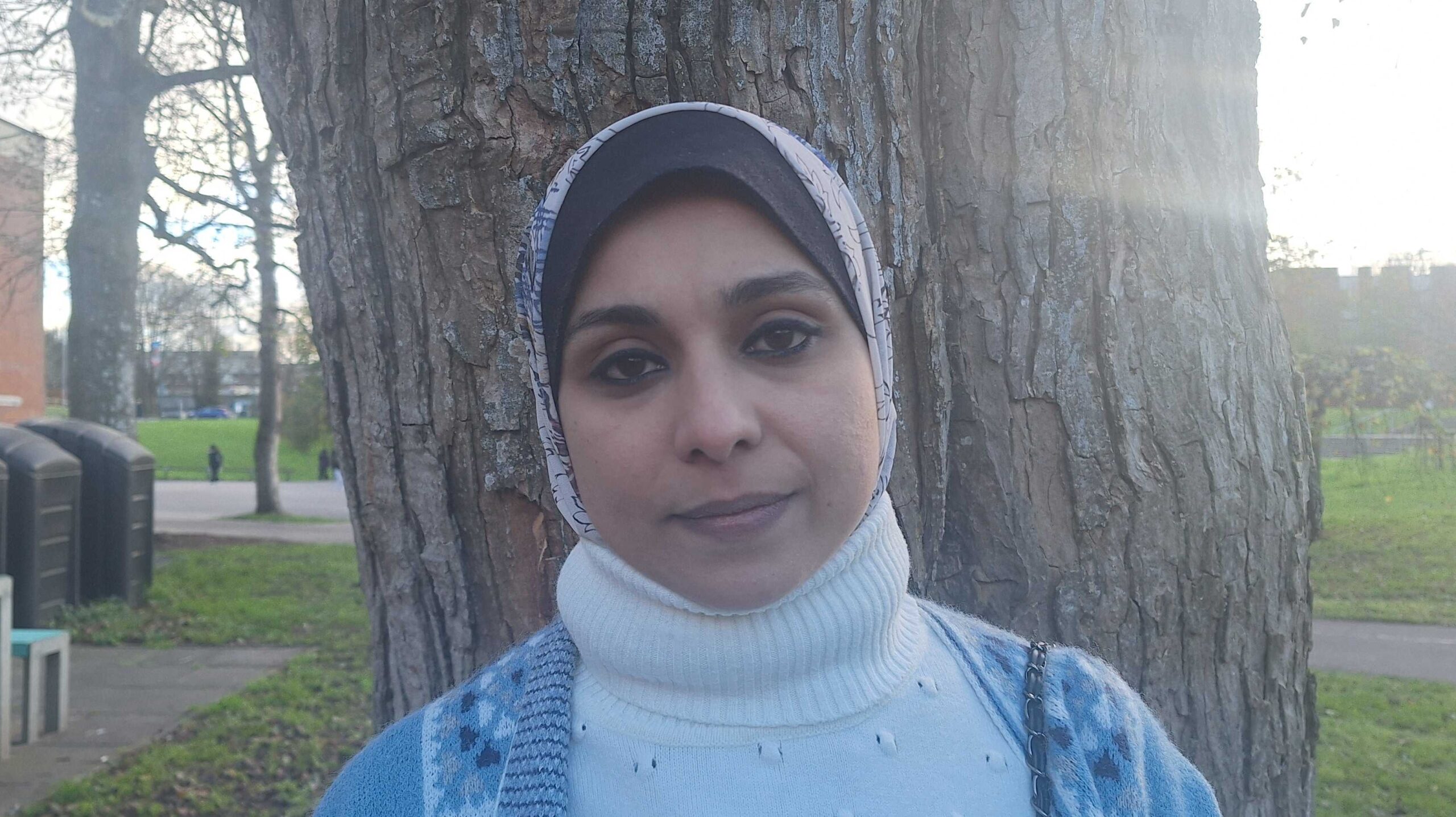
Faten Sweedan remembers celebrating her 28th birthday in October 2023, the day before the Hamas-led attack on Israel and the start of Israel’s ongoing war on Gaza.
She was born on 7 October, a date now forever associated with the start of the Gaza genocide.
“It was a special birthday, on the Friday,” she told Middle East Eye. “I ate bowls of chocolate, I ate ice cream, iced sweet drinks, I ate lamb barbecue and also barbecued chicken. And stuffed vine leaves… it was a beautiful day.”
The Unrwa school teacher, now in the UK on a scholarship, smiles as she remembers this special occasion, the day before the war and her family’s displacement began.
“The first street to be bombed [by Israel] was our street… We were displaced from the very first day,” she said.
New MEE newsletter: Jerusalem Dispatch
Sign up to get the latest insights and analysis on
Israel-Palestine, alongside Turkey Unpacked and other MEE newsletters
Her husband suggested they leave immediately with their two young children. Her youngest, Abdurahman, was a baby. “I remember leaving everything that was dear to me… I just took my makeup and a few things. I was sure I would not see the house again.”
She was right. Her home in the 13-storey Andalus tower, one of the tallest in Gaza, was bombed and destroyed 12 days into the war.
“I didn’t feel sorry, I didn’t feel sad, because a lot of people were losing loved ones,” she explains to MEE on the campus of Sussex University, where she is now studying international education and development.
“Things are haphazard, random when it comes to killing us [Palestinians] – it is not targeted.”
Sweedan’s face is etched with the struggle, loss and separation inflicted on Gaza’s Palestinians during the genocide, an emotional toll that can’t be measured.
She says death was not what she feared. “It’s not all about death. I fear losing people, losing organs, being amputated, being left on the ground bleeding with no one to help me. But death itself was not frightening to me.”
‘Fake ceasefire’
Sweedan has lost her grandfather and several cousins in the genocide. After two years of war and displacement, she arrived in the UK on a scholarship in October. In her 30 years she had never left Gaza, which has been under Israeli siege since 2006, making an exit for Palestinians very difficult.
On stage last month at the Brighton launch of an anthology of writing by students in Gaza, We Are Still Here, Smeedan revealed her profound regret about leaving her two children in the besieged territory, believing wrongly that they would be able to join her husband in Egypt because of the ceasefire.
‘It’s just a fake, media ceasefire. We fell into a trap… my little kids are trapped’
– Faten Sweedan, teacher and UK scholarship student
Israel has refused to open the Rafah crossing, as stipulated under the ceasefire agreement.
Sweedan is one of around 100 scholarship students from Gaza who the UK have assisted to evacuate in recent weeks as a result of a scheme announced by the Labour government in August, following growing protests and criticism of UK inaction and complicity with Israel’s genocide in Gaza.
“Universities have really fought for their students to be evacuated to the UK, and pushed the government to do this,” says a source familiar with UK government policy on Gaza students with places and funding at UK universities, who did not want to be named.
However, under UK student visa rules, PhD students and those on Chevening scholarships are able to bring family members, but other fully funded scholarship students are not.
As a result, many mostly female students in Gaza are being asked to choose between their children and pursuing their education in the UK, warn refugee rights groups.

UK government faces legal challenge over broken promise to rescue family from Gaza
Read More »
Smeedan says: “I thought it was going to be a real ceasefire, [but] it’s like a word to make people stop thinking about Gaza.
“It’s just a fake, media ceasefire. We fell into a trap… my little kids are trapped.”
She adds, plaintively: “I forgot how Israel are liars. I don’t know how I ever trusted them.”
Israel has violated the ceasefire more than 300 times, killing hundreds in Gaza since 10 October, and blocking most aid from entering.
Her children live in a tent for displaced people in Nuseirat, southern Gaza, with Sweedan’s sister and mother. Her husband left Gaza for Egypt six months into the war.
After receiving confirmation of her scholarship and evacuation from the Foreign, Commonwealth and Development Office (FCDO) in July, amid Israel’s onslaught, she recalls how her son would ask each day, “Are we really going out?”, and “Are you going to leave us?”
“I always promised him, of course, we are going to be evacuated together.
“I cannot explain to people how my kids feel waiting for help… I’m not regretful for leaving them, [the regret] is because of the immense feelings [my kids] are going through,” she says.
‘We are seen as subhumans’
Unlike Ukrainian families, who have been welcomed to Britain since Russia’s invasion, Palestinians have no easy route to family reunification, despite facing Israel’s siege, starvation and a widely recognised genocide.
A Gaza PhD student who won a fully funded scholarship to the University of Glasgow last month told of her devastation after her family was denied entry to the UK, despite her scholarship including support for her family, who are stranded in a tent in Khan Younis.
“The fact that the UK government hasn’t even bothered to make a request on my family’s behalf is heartbreaking,” she told The Guardian.
A British government spokesperson confirmed to MEE that more students are expected to arrive in the UK this month, and that it supports the departure of family members of students from Gaza on a “case by case” basis.
The spokesperson told MEE that London “is continuing to seek to support students from Gaza who have been awarded fully funded scholarships and have places at UK universities, so they can start their studies.
‘He used to speak good English. He used to watch Peppa Pig, Curious George. Now he’s lost it all’
– Faten Sweedan on her son
“We are reliant on factors outside of our control, including collaboration of international partners, so this remains a complex operation,” said the spokesperson.
Sweedan asks Israel only to “be human beings for one day, just give us one day to be human beings”, by opening the crossings and allow her to reunite with her children.
As for the western world’s treatment of Palestinians, she says that “Gazans are seen as subhuman. What applies to some people should not be applied to Gazans.”
At Sussex University, she says “everyone is supportive, my classmates, professors, teachers. The support is beyond what I could ever have wished for. This keeps me from diving into sadness and grief.” But she admits that separation from her family means “I’m not enjoying anything.”
When internet services in Gaza are working, she speaks to her eldest son Zain by phone and tries to reassure him, but it is close to impossible to do so.
“He’s always angry and disappointed. He says, ‘Mummy, I think we are going to become young men while we are waiting here for you to get us out of here,’” she recalls.

A Gaza ceasefire without justice or Palestinians at the table is a betrayal
Read More »
He screams and shouts, and says: “The emails [from the UK Foreign Office] are lying to you, Mummy, they all just want us to be bombed and die here,” she recounts.
Her youngest, Abdurahman, now three, is autistic. He wakes in the night, calling for her.
She contemplates having to choose one of the children to join her, like the Polish mother in the famous novel Sophie’s Choice, set in Nazi-occupied Poland.
Her eldest son, like countless children in Gaza, has been changed by the genocide. As a result of two years of displacement, and loss of access to the kind of childhood most kids enjoy, she says “He used to speak good English. He used to watch Peppa Pig, Curious George. Now he’s lost it all.
“He’s uneducated, unnurtured, always shouting, nervous – this is the new Zain. He lost his sense of satisfaction. He doesn’t show contentment.”
She recalls her husband saying that once their child is with them again, “we can go and modify his settings back to the old Zain”.
Teaching children amid a genocide
As an Unrwa teacher in Gaza, Sweedan tried to find ways to continue the children’s teaching amid the war, believing that there must be a strategy beyond simply keeping people alive in displacement shelters.
“I could see the education of the kids was deteriorating. The level of the students at the end of this war will be horrible. There are 47 to 52 kids per class – too many kids with low levels [of learning].”
‘If we are dead, we are dead. But as long as we live, we learn’
– Faten Sweedan
Israel’s ongoing campaign to destroy Palestinian society targets education, by destroying schools and universities and by killing the teachers and academics who teach students.
“Government schools were [turned into] shelters, so I made initiatives to talk to parents to empower them with numeracy and literacy skills.”
This is her burning concern, in the absence of what she sees as Unrwa taking concrete action during the war to ensure children still receive an education. “What are the strategies to follow to teach our kids, to leave the knowledge in the hearts of the parents?” she asks.
Sweedan reveals a philosophy of how to live amid the constant threat of violent death. “If we are dead, we are dead. But as long as we live, we learn. Thank God I have this privilege to be educated enough to know how to dream.”
She asks: “Where is the danger in bringing my kids with me for nine months?”
