

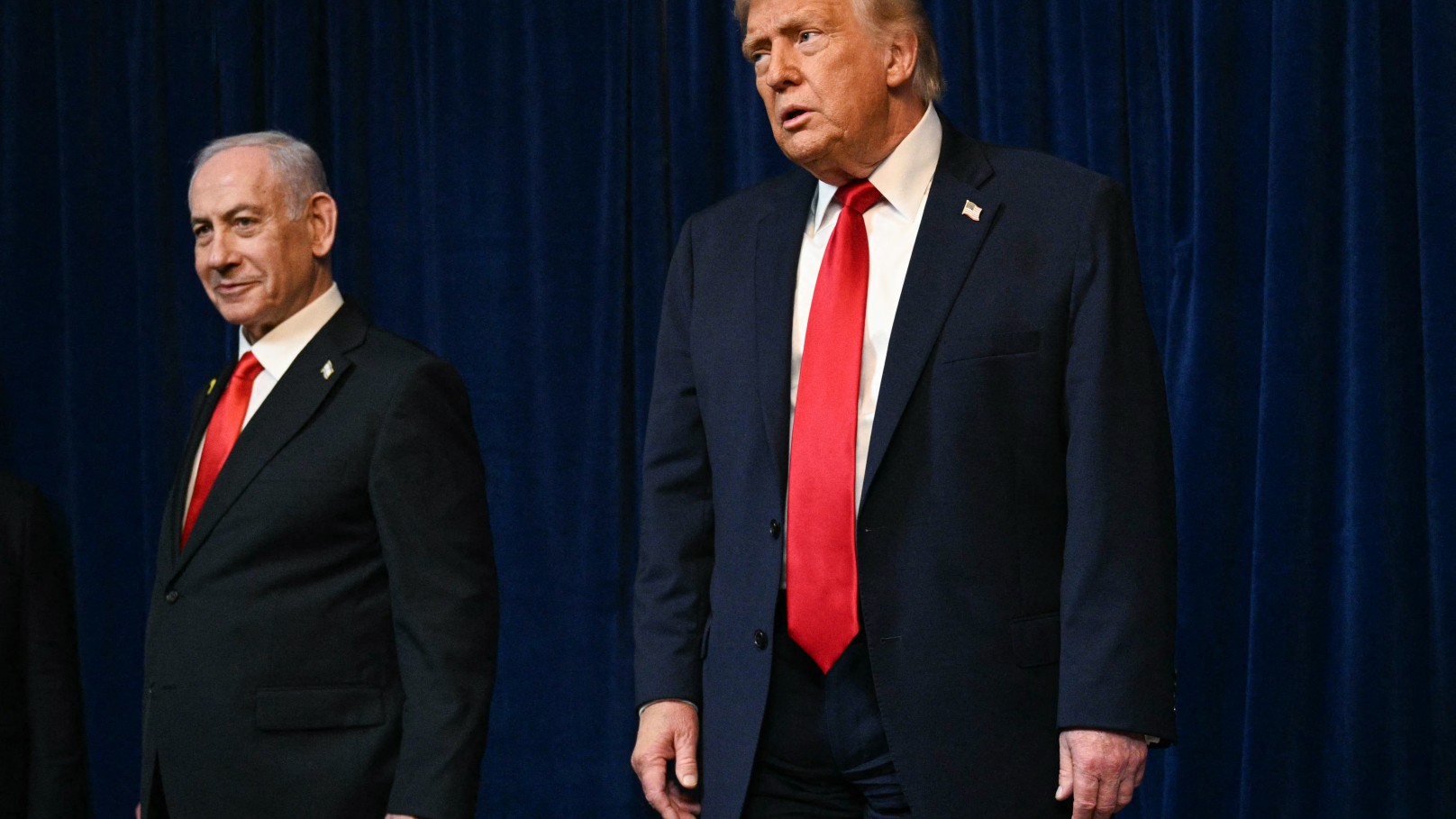
The United States stands at the edge of a catastrophic decision, one that could reshape the Middle East, endanger millions of lives, and lock America into yet another long, costly war with no clear end.
Israeli Prime Minister Benjamin Netanyahu has once again intensified his campaign to pressure the United States into direct military action against Iran.
This is not a new strategy.
For decades, Netanyahu has argued that Iran poses an imminent, existential threat that can only be resolved through force.
Time and again, those warnings have been framed as urgent, unavoidable, and absolute. Time and again, the promised doomsday has failed to materialise.
New MEE newsletter: Jerusalem Dispatch
Sign up to get the latest insights and analysis on
Israel-Palestine, alongside Turkey Unpacked and other MEE newsletters
What has materialised – repeatedly – is regional chaos following military interventions sold as quick, decisive, and necessary.
An American attack on Iran would not be a limited strike. It would not be clean. And it would not be contained.
Regional instability
In 2003, the United States invaded Iraq on claims that Saddam Hussein possessed weapons of mass destruction. Those claims proved false.
The war resulted in hundreds of thousands of deaths, the displacement of millions, trillions of dollars in costs, and long-term regional destabilisation – while ultimately strengthening Iran’s regional position.

Trump’s plan to force Iran to surrender is a fatal error
Read More »
In 1964, misrepresented reports of attacks on US destroyers in the Gulf of Tonkin were used to justify US entry into Vietnam, a war that claimed nearly 60,000 American lives and three million Vietnamese.
In 2011, a Nato intervention in Libya, described as limited and “humanitarian”, contributed to the collapse of the Libyan state and ongoing regional instability.
Each of these conflicts was framed as urgent. Each was presented as unavoidable. Each became a lasting lesson in the cost of premature war.
On Wednesday, Netanyahu, who is accused by the International Criminal Court (ICC) of war crimes and crimes against humanity, specifically citing the use of starvation as a method of warfare in Gaza; as well as murder, persecution, and other inhumane acts, and who is expected to be indicted of genocide by the International Court of Justice (ICJ), will be given another opportunity to beat the drums of war in the White House.
He has warned for nearly three decades that Iran is on the verge of acquiring a nuclear weapon, beginning with public statements in the mid-1990s, reiterated before the US Congress in 2015, and repeated consistently since.
The deadline has always been “months away”. The proposed solution has consistently been military force.
Iran is not Iraq nor Venezuela. It is a nation of nearly 90 million people, with advanced military capabilities and regional alliances spanning Lebanon, Iraq, and Yemen.
Any US attack would not be limited or contained.
Tens of thousands of innocent people will be killed and many times that number will be seriously injured. American troops stationed across the region would face retaliation.
Global energy markets would be shaken as the Strait of Hormuz, through which roughly 20 percent of the world’s oil supply passes, becomes a point of conflict.
The economic consequences would be immediate and global – fuelling inflation, market volatility, and hardship far beyond the battlefield.
Permanent confrontation
Most critically, war would undermine its stated objective. Military strikes do not eliminate nuclear knowledge. An attack on Iran would likely end inspections, accelerate weaponisation, and lock the region into permanent confrontation.
US foreign policy must be guided by US interests, international law, and the hard-earned lessons of history – not by fear-driven narratives or external pressure
Diplomacy, by contrast, has demonstrated results.
The 2015 Joint Comprehensive Plan of Action (JCPOA) significantly reduced Iran’s enriched uranium stockpile, extended breakout timelines, and subjected Iran’s programme to the most intrusive inspection regime ever negotiated.
War would replace verification with uncertainty and restraint with escalation.
Allies have the right to advocate for their security interests. They do not have the right to determine when Americans fight and die.
US foreign policy must be guided by US interests, international law, and the hard-earned lessons of history – not by fear-driven narratives or external pressure.
Humanity today needs peace not war. And if there is a sincere desire to protect humanity, the world should be completely free of weapons of mass destruction.
The United States of America should listen to the voices of wisdom in the Middle East that have warned against the catastrophic results of any attack on Iran.
It certainly should never listen to the voices of genocide perpetrators.
The views expressed in this article belong to the author and do not necessarily reflect the editorial policy of Middle East Eye
