

The abduction of Venezuelan President Nicolas Maduro by the US earlier this month is but the latest attempt by Washington to bring about regime change on foreign soil.
The methods deployed have ranged from propaganda campaigns, through sponsored military coups and assassinations, to invasions and occupations. Justifications have included economic interests, threats to security and bringing individuals to the US to stand trial.
In 1823, President James Monroe issued the Monroe Doctrine, which viewed any interference by other powers in the Western Hemisphere as a threat to US security. From this grew the notion of intervention overseas if US interests are at risk, including threats to economic assets and security.
In the 19th century, military force was used to annex land to the existing US, including Texas from Mexico during the 1840s and the Kingdom of Hawaii in the 1890s.
Since 1945, the US, as the world’s foremost superpower, has had the unequalled capacity to bring about regime change and shape the course of geopolitical events to its liking.
New MEE newsletter: Jerusalem Dispatch
Sign up to get the latest insights and analysis on
Israel-Palestine, alongside Turkey Unpacked and other MEE newsletters
In some instances, the US has become drawn into existing civil conflicts to achieve its aims, including Vietnam during the 1960s and 1970s, Somalia in the 1970s and Libya from 2011 onwards.
Yet attempts at regime change have not always been successful. Fidel Castro, for example, ruled Cuba from 1959 until 2008, despite multiple attempts to remove him from office, including invasions and assassinations. Toppling a regime is also markedly easier than what then follows, as the invasions of Iraq, Afghanistan and elsewhere have shown.
Here, Middle East Eye looks at just some of the ways the US has brought about regime change since the 1950s.
1953: Iran
In August 1953, Mohammad Mosaddegh, the democratically elected prime minister of Iran, was overthrown in a coup covertly arranged by the US and UK.
It came after Mosaddegh nationalised the Iranian assets of the Anglo-Iranian Oil Company, now known as BP, which had been effectively controlled by the UK in agreement with Iran’s monarch, Shah Mohammad Reza Pahlavi.


The UK, and later the US, led a disinformation campaign against Mosaddegh’s government, including bombing the homes of religious leaders, which were then framed as attacks by Mosaddegh’s communist allies.
The US and UK also covertly supported the Iranian military, which backed anti-government street mobs in fighting that killed hundreds and eventually toppled Mosaddegh.
Mosaddegh was convicted of treason and placed under house arrest until he died in 1967. Many of his supporters were executed.
After the coup, oil nationalisation was scrapped, and the shah ruled a pro-Western, one-party state until he himself was overthrown in 1979. The CIA admitted its role in the coup in 2013; the UK has yet to do so.
1954: Guatemala
In Guatemala in 1944, pro-US dictator Jorge Ubico was overthrown in a democratic uprising. The decade that followed became known as the Ten Years of Spring.
By 1954, President Jacobo Arbenz had introduced socially progressive reforms, including land distribution that benefitted the mostly indigenous Guatemalan peasantry at the expense of the country’s elite and the American United Fruit Company (now Chiquita).
But Washington feared the emergence of a communist state on its doorstep. Seeing its commercial interests threatened, it authorised Operation PBSuccess through which the CIA embarked on the training of anti-Arbenz paramilitaries. The agency also launched a campaign of “psychological warfare”, according to declassified CIA documents.

In June 1954, Arbenz fell amid a US-supported coup and was driven into exile. He was replaced by US ally Carlos Castillo Armas, a general who restored land and concessions to foreign investors.
For Guatemala, Armas was the first in a line of US-backed military dictators who, until the 1990s, oversaw a decades-long genocide during which hundreds of thousands of indigenous Maya people were raped, tortured and killed.
1960: Congo
Congo (now the Democratic Republic of Congo) gained independence from Belgium in June 1960, electing Patrice Lumumba, a pan-Africanist, as its first prime minister.
Declassified CIA documents have revealed that Washington wanted a pro-Western government in Congo, given its size and natural resources, but feared that the new leadership might ally itself with the USSR.
Lumumba, while wishing to remain neutral, sought logistical assistance from Moscow during the Congo Crisis that followed independence.

This alarmed the US to the extent that President Dwight Eisenhower ordered Lumumba’s assassination. The CIA also funded anti-Lumumba propaganda, demonstrators and military officials.
In September 1960, Lumumba was deposed in a coup led by one of these officials, Army Chief Joseph Mobutu (later known as Mobuto Sese Seko): whether the CIA was directly involved, or simply encouraged Mobutu, is uncertain.
In January 1961, Lumumba was executed by firing squad, overseen by Belgian military officers, with tacit support from the US and alleged involvement from the UK.
Afterwards, the US continued to support Congo’s military, including Mobutu, who seized full power in a second coup in November 1965. He ruled as an anti-communist dictator until his death in 1997 as head of a regime characterised by human rights abuses and corruption.
1963: Vietnam
The US escalated its involvement in what is now Vietnam during the late 1950s, supporting the South Vietnamese government of Ngo Dinh Diem against the Viet Cong communist insurgency backed by North Vietnam.
But as the war progressed, Ngo (a Catholic) launched a repressive crackdown on Buddhism that made him increasingly unpopular among the South Vietnamese, with some Buddhist monks self-immolating in protest.

By now, Ngo was regarded by the US as a liability and an untenable bulwark against the Viet Cong. Eventually, the government of US President John F Kennedy covertly supported his assassination during a coup on 2 November 1963, bringing General Duong Van Minh to power.
Having brought about regime change, Washington expanded its presence in Southeast Asia for the rest of the decade during what grew into the Vietnam War.
More than 58,000 US troops and an estimated three million Vietnamese were killed before the US withdrew, defeated, in 1975.
1964: Brazil
In March 1964, Brazil was led by Brazilian President Joao Goulart, commonly known as Jango, a left-wing nationalist who supported modest land reform and tolerated communist participation in unions and government.
Concerned that Brazil could fall under communist influence, Washington covertly began Operation Brother Sam, encouraging Brazil’s military to launch a coup with US naval backing.

The US also, with Britain, supported an anti-communist propaganda campaign that helped undermine Goulart’s government.
Goulart fell swiftly amid a military rebellion in April 1964 with US military support as planned. General Humberto Castelo Branco then became the first of several right-wing military dictators who led Brazil until 1985.
The economy underwent rapid economic growth during the early 1970s. But there were also the state-sanctioned assassinations of hundreds of political dissidents and the torture of an estimated 20,000 people.
CIA documents declassified in 2018 revealed that Washington was aware of the abuses for much of this period but continued its support. Goulart died suddenly in 1976, suspected by many to have been poisoned.
1965: Indonesia
The US worked to displace Indonesian President Sukarno during the bloody transition to the “New Order” government of President Suharto.
Sukarno was the founding father of Indonesian nationalism. He led the country during its war of independence against Dutch colonial control (1945-1949) and as a liberal democracy until 1959, when he declared martial law and suspended elections.
On the international stage, he was the key voice within the Non-Aligned Movement of 29 newly independent states, which sought to remain neutral amid the Cold War and first met at the Bandung Conference in 1955.

Washington, however, was troubled by Sukarno’s longstanding tolerance for Indonesia’s Communist Party (PKI), his cautious alliance with communist China and moves to nationalise former colonial businesses.
Early US attempts to undermine Sukarno’s government included arming rebel groups, and bombing commercial shipping tankers via Civil Air Transport, a nationalist Chinese airline controlled by the CIA. Alongside Britain, Washington also backed a campaign to discredit Sukarno, which, according to some historians, included a fake sex tape.
The end of Sukarno’s rule began after six Indonesian generals were assassinated on 30 September 1965. The killings were pinned on the PKI but remain highly contentious.
Suharto, Indonesia’s army chief, used the murders as a pretext for widespread purges of communists, as well as ethnic minorities, including the Chinese. It resulted in between 500,000 and one million killings during a period which was to become known as the Indonesian Genocide.
Declassified documents revealed that the CIA backed the killings, supplying lists of alleged communist sympathisers to death squads.
During the next two years, Suharto gradually became Indonesia’s acting leader, taking power from a weakened Sukarno in 1967, who was placed under house arrest.
Suharto led Indonesia as a pro-Western dictatorship until his fall in 1998. During his rule, atrocities continued, including mass killings during the occupation of East Timor.
1973: Chile
Chilean President Salvador Allende, a moderate within the country’s Socialist Party, came to power in November 1970 and soon nationalised the country’s copper industry, which was dominated by US conglomerates. This incensed US President Richard Nixon, who ordered the CIA to “make the [Chilean] economy scream”.
A senior CIA official wrote in a secret memo: “It is firm and continuing policy that Allende be overthrown by a coup… It is imperative that these actions be implemented clandestinely and securely so that the USG [US government] and American hand be well hidden”.

Over the next three years, the CIA spent more than $8m on an anti-communist propaganda campaign (it previously spent $3m to influence the 1964 Chilean election, which Allende lost).
On 11 September 1973, right-wing military officers, supported by the CIA, commanded their troops to attack Allende’s government, seizing the city of Valparaiso and bombing the Presidential Palace to which Allende had retreated (Nixon had prior notice of the plans). Allende died from suspected suicide during the coup, although the conditions of his death are disputed by some.
There followed 16 years of military dictatorship under Augusto Pinochet, who dissolved congress, declared a state of emergency and oversaw assassination, torture and murder.
Under the influence of the “Chicago Boys” group of Chilean economists, Pinochet also led influential neoliberal economic reforms, imposing severe austerity, deregulation and privatisation.
Chile became integral to Operation Condor from 1975 onwards, through which repressive regimes across South America coordinated human rights abuses, including overseas assassinations, with the knowledge of US and European governments.
1983: Grenada
Grenada had been a British colony until independence in 1974, after which it remained part of the Commonwealth.
But in 1979, Maurice Bishop, a revolutionary communist and black liberation activist, seized power in a coup that had widespread support. Bishop strengthened ties with the USSR and Cuba, including developing an airstrip that the US feared would host Soviet warplanes.

In 1983, Bishop was deposed and executed in a coup led by his own deputy, Bernard Coard. Paul Scoon, the governor-general, the Queen’s representative on the island, asked via diplomatic channels for “military action by friendly states” to restore peace to the island.
US President Ronald Reagan ordered the deployment of 8,000 troops, who were backed by troops from several Caribbean nations. The force took control within four days, by when more than 300 Grenadian troops and 24 civilians had been killed, including 18 at a hospital mistakenly bombed by the US.
The invasion angered UK Prime Minister Margaret Thatcher, who was not informed in advance of the US plans, despite Grenada’s Commonwealth status (Reagan later apologised by phone).
1989: Panama
In 1989, the US alleged that Panamanian President Manuel Noriega, a former ally, was involved in criminal activities, including drug trafficking. Washington had also long seen Panama, which hosts the Panama Canal, as strategically important.
In December 1989, the US invaded and besieged Panama City, killing 514 Panamanians, mostly civilians, according to US figures (local sources put the number higher). Twenty-three Americans were killed.

Guillermo Endara was sworn in as president at a US military base on the first night of the invasion.
Noriega sought refuge in the Vatican’s Panama City diplomatic mission, surrounded by US troops who blasted loud music to drive him out. He eventually surrendered after 11 days on 3 January 1990 – 35 years exactly before the US abducted Venezuela’s President Nicholas Maduro.
In the US, Noriega was found guilty of drug trafficking, racketeering and money laundering, and was imprisoned until he died in 2017.
In his January 2025 inaugural speech, US President Donald Trump said: “China is operating the Panama Canal and we didn’t give it to China, we gave it to Panama, and we’re taking it back.”
2001: Afghanistan
After al-Qaeda’s attacks on the US on 11 September 2001, President George W Bush demanded that Afghanistan’s Taliban government close al-Qaeda’s camps in the country and extradite the group’s leader Osama bin Laden.
The US has history with the Taliban: two decades prior, it, along with MI6, effectively armed the group to fight the Soviet invasion of Afghanistan from 1979 onwards.
But when the Taliban refused Bush’s request, the US invaded in October 2001 and drove it from the country’s north. It installed an interim government under President Hamid Karzai from 2002 until 2014, and stationed troops in the country.

But by 2003, the Taliban had regrouped and launched a successful insurgency. In the coming decade, the military involvement of the US and its Nato allies in Afghanistan deepened, to little effect.
A peace deal was signed in February 2020, and a full withdrawal occurred the following year.
By then, an estimated 200,000 Afghans and 3,600 members of the US-led coalition had died during the previous two decades.
In the absence of the US, the Taliban rapidly took back the remaining parts of the country, including Kabul, in 2021, where it is still in power.
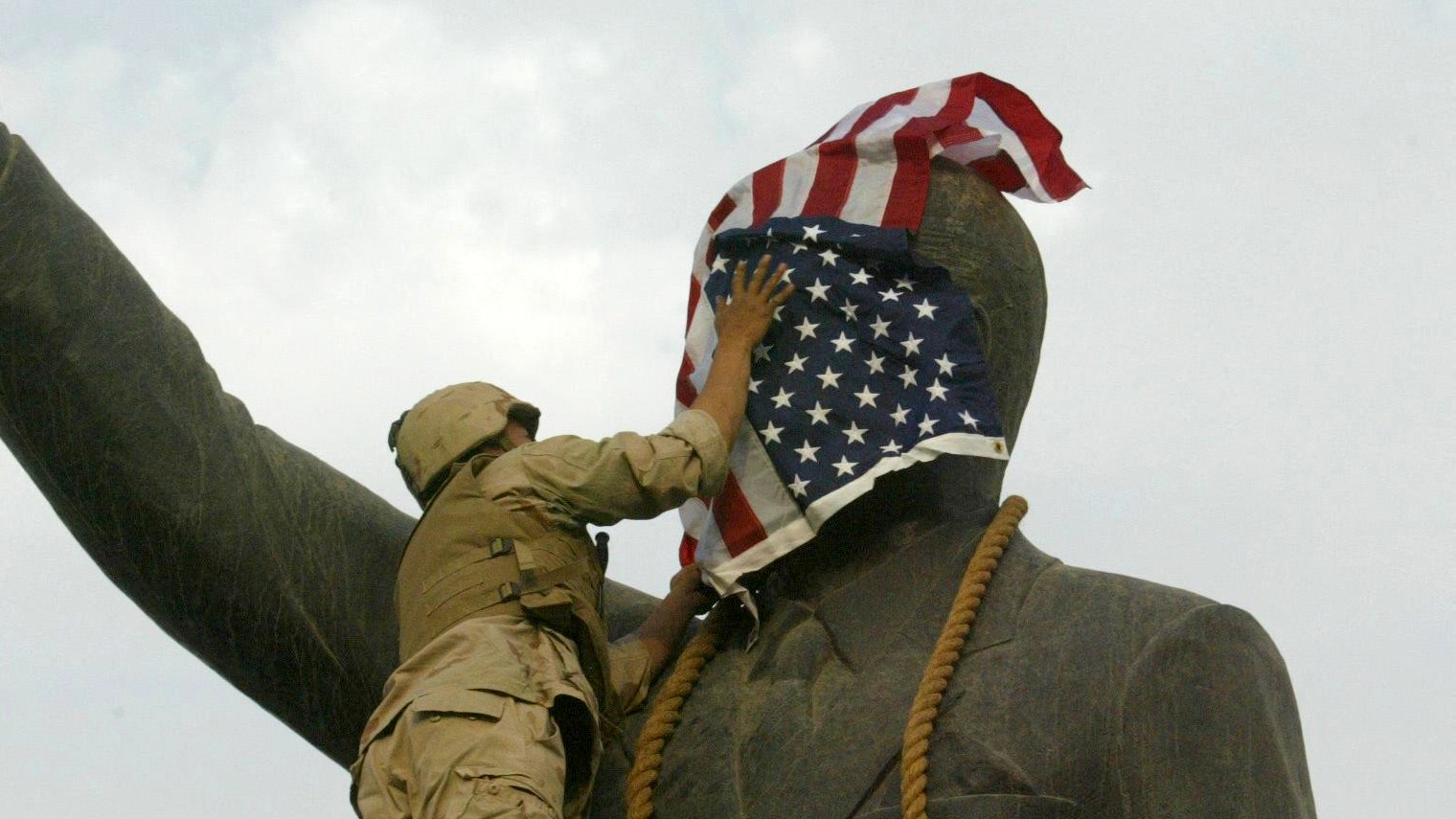
2003: Iraq
In 1991, a US-led coalition defeated Iraq, under one-time ally Saddam Hussein, following its invasion of Kuwait. But Saddam remained in power. For the next decade, Washington and London raised concerns about Baghdad’s military intentions.
After 9/11, Iraq was accused of links with al-Qaeda as well as possession of weapons of mass destruction. A UN inspection team found no evidence of such weaponry.

The US wanted to take direct action but was opposed by allies such as France, Germany and Canada as well as UN Secretary-General Kofi Annan.
Nevertheless, the US and its “coalition of the willing” invaded Iraq on 20 March 2003 and overthrew Saddam within a month (he was captured by the end of the year and executed in 2006).
But as in Afghanistan, a widespread insurgency followed, which also saw the emergence of Islamic State (IS).
The US officially left in 2011, although it increased its numbers of troops in late 2014 to deal with IS. The US still retains small numbers of troops and bases in Iraq in support of the Iraqi government.
2004: Haiti
Haiti has been subject to US-led regime change several times, including during the occupation of the country from 1915 until 1934.
In 2004, the CIA was again covertly involved in a coup: this time, removing from office Haitian President Jean-Bertrand Aristide, a Liberation Theology priest turned leftist politician who had organised free elections and disbanded the Haitian military, which had long committed human rights abuses.
Arisitide, a pro-democracy figure, was previously president during the 1990s, when the CIA covertly funded Fraph death squads, which murdered hundreds of his supporters.

By 2004, to US anger, Aristide had to invest in education and healthcare and raised the minimum wage, in defiance of World Bank austerity measures. He also demanded $21 billion in reparations from France, the island’s former colonial power.
The coup against Aristide was arranged by the US and France, according to Theirry Burkard, the French ambassador to Haiti at the time (the US has denied this).
Reports, rejected by the US, alleged that the coup’s perpetrators were trained in the neighbouring Dominican Republic by US Special Forces.
Amid several weeks of violence, Aristide was overthrown on 29 February 2004. He said that he was effectively forced to resign at gunpoint before he was abducted by the US military to the Central African Republic, where he was exiled for seven years.
Since the 2004 coup, Haiti’s instability has continued. It remains the poorest country in the Western hemisphere.
2026: Venezuela
Venezuela has the largest proven oil reserves in the world. The US invested heavily in extraction in the 1960s and, since Caracas nationalised its oil in the 1970s, has spent decades pressuring Venezuelan leaders for greater access.
Relations between the US and Venezuela have long been tense. Washington was widely suspected to have been behind a failed coup against Maduro’s left-wing predecessor, Hugo Chavez, in April 2002.

In 2019, Washington attempted to install opposition figure Juan Guaido to replace Maduro, but the operation failed, while another foiled plot in 2020 using mercenaries aimed to capture Maduro and bring him to the US.
In March 2020, Trump first accused Maduro of supplying drugs into the US.
In 2024, the US granted diplomatic recognition to exiled Venezuelan presidential candidate Edmundo Gonzalez, citing reports from US-based monitors that Maduro’s election victory had been fraudulent.
On 3 January 2025, the US raided Caracas, bombing aerial defences and abducting Maduro and his wife. Trump has said he wants Venezuela to hand over $2.8bn of oil, which he has since claimed was “stolen” from the US.
Maduro faces US charges of “narco-terrorism” and conspiracy to possess machine guns and destructive devices against the US, among others.
