

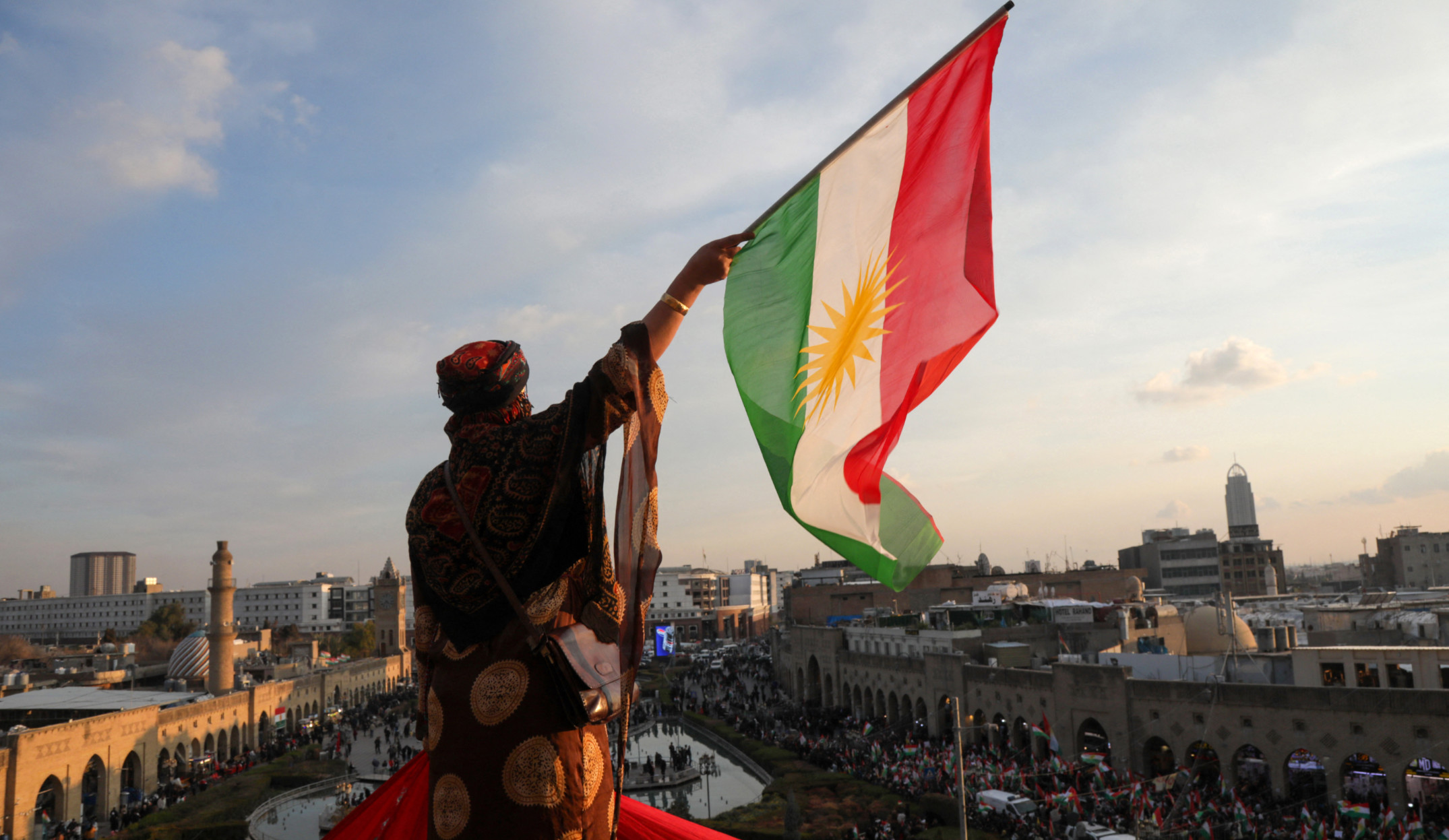
After crossing the Semalka border bridge between Iraq and Syria, travellers are met by protests and hundreds of Kurds waving Kurdish and Syrian Democratic Forces (SDF) flags.
The crowd gather to welcome arrivals from Iraq’s Kurdistan Region, answering a call to stand together against Damascus in a show of cross-border solidarity.
The protests come as Kurdish authorities have lost large swaths of territory in recent days amid a sweeping military operation aimed at bringing all of Syria under government control.
“We are here welcoming our Kurdish nation, the brothers from Kurdistan. They want to annihilate us, but they will never be able to do that. The Kurdish people are all one,” Dijwar, a Kurdish protester, told Middle East Eye.
“Long live the brotherhood of the Kurdish people,” several chanted behind him.
New MEE newsletter: Jerusalem Dispatch
Sign up to get the latest insights and analysis on
Israel-Palestine, alongside Turkey Unpacked and other MEE newsletters
The day before, thousands marched on the US consulate in the Iraqi Kurdish capital Erbil to protest against Syria’s military offensive and what they see as Washington’s failure to support the Kurds, their main allies in northern Syria over the past decade.
In Turkey, meanwhile, more than 1,000 people marched through the town of Nusaybin, towards the border, ending in a confrontation with police, who fired tear gas and used water cannon to disperse them.
On Tuesday evening, Damascus announced a four-day ceasefire with Kurdish forces and a deadline to agree on integrating into the central state.
The rapid government takeover of Kurdish-controlled areas marks the most significant shift in control since President Ahmed al-Sharaa came to power in December 2024.
Before the government offensive that began earlier this month, the SDF controlled large parts of northern and eastern Syria – territory it had seized while fighting and defeating the Islamic State group (IS) with the support of a US-led coalition.
The SDF has now pulled back from the predominantly Arab provinces of Raqqa and Deir Ezzor.
Baz Mawati, a protester outside the consulate, told MEE on Monday that the “Kurds were the main force on the ground in the fight against the Islamic State… but now, we are the ones being killed”.
Four-day deadline
Washington’s relationship with the SDF has changed since Donald Trump returned to office last year, redirecting support towards Sharaa.
On Tuesday the US president told reporters that while he liked Kurds, they “were paid tremendous amounts of money, were given oil and other things”.

Rapid unravelling of SDF removes ‘main irritant’ in US-Turkey ties
Read More »
“So, they were doing it for themselves, more so than they were doing it for us. But we got along with the Kurds, and we are trying to protect the Kurds,” he added.
In its ceasefire announcement, the Syrian presidency said the Kurds have been given “four days for consultations to develop a detailed plan” for integrating the Kurdish-majority areas of Hasakah province.
It said that if finalised, Syrian forces “will not enter the city centres of Hasakeh and Qamishli… and Kurdish villages”, and will remain on their outskirts.
The US envoy to Syria, Tom Barrack, said on Tuesday that the role of the SDF as the primary anti-IS force has “largely expired, as Damascus is now both willing and positioned to take over security responsibilities”.
On Tuesday, Syrian forces seized al-Hol camp, which holds relatives of suspected IS fighters, after Kurdish forces withdrew from the site.
‘Colonial minset’
Many Kurdish civilians fear the ceasefire could collapse during the four-day period and have denounced the US for aligning with Damascus.
Some are planning to pack their belongings and move to Iraqi Kurdistan.
In Derik, one of the towns closest to the border, an exchange shop was seen removing its cash from the premises.
The SDF, meanwhile, reported that last night a drone strike and a suicide bombing targeted Kurdish-held Qamishli.
“The US has destroyed the Kurdish nation in the most dirty way. Kurds showed humanity, democracy and goodness, but America chose terrorism for the Middle East,” said Hoger, a Kurdish resident.

Syrian Kurds seek constitutional recognition after rights decree
Read More »
“I feel sad, hopeless, broken, afraid and angry when I look at my children, when I hear their laughter, and when I see the troubles America has chosen for their lives.”
Polat Can, one of the founders of the Kurdish People’s Protection Units (YPG), said that in future, “when the world needs their help to fight terrorism, the Kurds will not be ready to save it again”.
“Terrorism is not over,” he said. “Terrorist networks are spread across the world, and Syria will become a hotbed for them. The international community will soon regret supporting al-Qaeda’s control over Syria and betraying the SDF and the Kurdish people.”
Can, who worked closely with US forces in operations against IS, singled out US envoy Barrack for criticism for supporting Syria’s new government, now led by former members of Hay’at Tahrir al-Sham (HTS), a former al-Qaeda affiliate that was officially dissolved in January 2025.
“He [Barrack] completely supports the HTS and Turkish policies in the region,” said Can.
However, Can added that many coalition soldiers remain loyal to the Kurds.
“It is the policymakers,” he said, “who continue to think with colonial mindsets about the Middle East and the Kurdish people.”
