

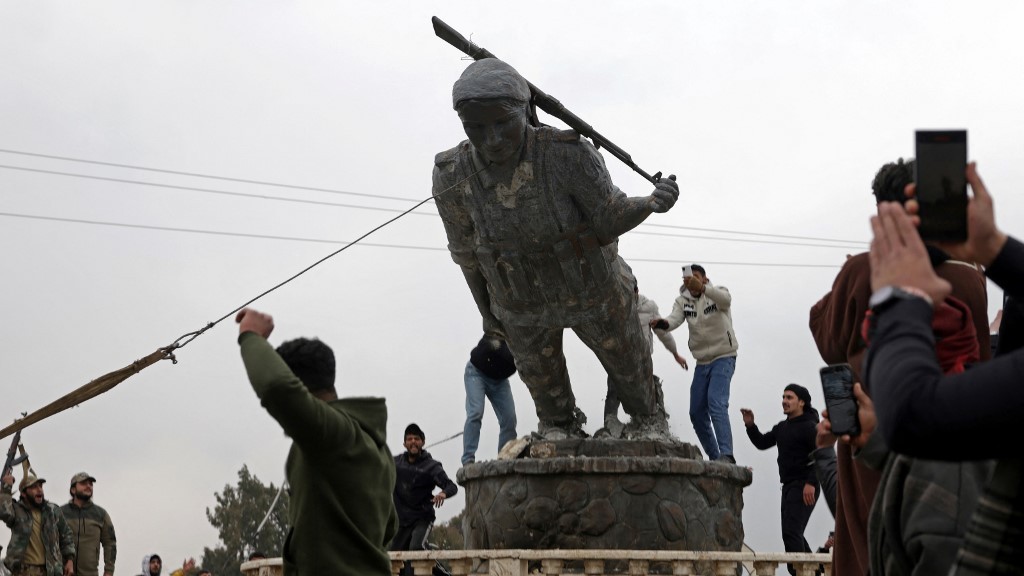
The Syrian government and the Kurdish-led Syrian Democratic Forces (SDF) agreed on Sunday to an immediate ceasefire after weeks of intermittent fighting that ended with the SDF losing significant territory and strategic assets, sharply weakening its position.
The deal is not unprecedented. Damascus and the SDF have signed similar understandings before.
But what made this latest agreement different was the timing.
The 14-point accord, released late on Sunday by Syria’s information ministry, followed two days of rapid advances by government forces into areas the SDF had controlled for years, including Arab-majority districts where its grip had long appeared fragile.
Government forces also seized the country’s largest oil field early on Sunday, extending state control across large swathes of northern and eastern Syria.
New MEE newsletter: Jerusalem Dispatch
Sign up to get the latest insights and analysis on
Israel-Palestine, alongside Turkey Unpacked and other MEE newsletters
The battlefield shift stripped the SDF of both revenue and leverage before talks even began, analysts told Middle East Eye.
Under the agreement, the SDF accepted the “full and immediate administrative and military handover” of Raqqa in the north and Deir Ezzor in the east, leaving it with only northeastern Hasakah.
For those who followed the talks closely, the contrast between earlier negotiations and the current agreement was stark.
SDF on the backfoot
In early January 2026, the SDF rejected a proposal that would have allowed the incorporation of three regional divisions spanning Hasakah, Deir Ezzor and Raqqa, alongside shared control of border crossings.
Under the new deal, the balance has shifted decisively. The SDF will hand full control of border crossings to Damascus, and its fighters will enter the Syrian army as individuals rather than as organised units.
State institutions in the previously semi-autonomous, Kurdish-dominated northeast will now fall under central government authority.
‘Damascus has the upper hand now and wants to transform the military success into a political gain. The agreement is meant to achieve that’
– Fadil Hanci, Syria analyst
Point four of the deal makes the balance of power explicit.
The Syrian government “shall take control of all border crossings, oil fields, and gas fields in the region, with protection secured by regular forces to ensure the return of resources to the Syrian state, while considering the special case of Kurdish areas”.
The agreement also addresses international concern over ISIS detainees held by the SDF, stating that Damascus “assumes full legal and security responsibility for them” and will continue operations against remaining ISIS elements.
Omer Ozkizilcik, a nonresident senior fellow at the Atlantic Council, said the terms looked strikingly familiar.
He told MEE that the deal largely replicated what Ankara and Damascus offered the SDF a year ago as an “olive branch to not engage in escalation and to resolve this peacefully”.
In March last year, the SDF agreed in principle to integrate its civilian and military structures into the state.
That announcement prompted celebrations in several cities, with many Kurds hoping it would deliver equal citizenship and constitutional recognition. But implementation stalled with the SDF largely forgoing implementation.
Damascus regains initiative against SDF
In December, Turkey’s Foreign Minister Hakan Fidan warned that the SDF was “in coordination with Israel” to obstruct Syria’s stabilisation.
“The SDF stalled and did not implement the offer from Ankara and Damascus, and now we are seeing them agreeing to the same offer as last time,” Ozkizilcik said.
According to Sunday’s agreement, another central clause requires foreign SDF elements linked to the Kurdistan Workers’ Party, designated a “terrorist” organisation by Turkey, the European Union and the United States, to leave Syria.
Remaining fighters will enter state forces on an “individual” basis “following necessary security vetting, granting them military ranks, financial entitlements, and logistical requirements accordingly,” the accord said.
Syria analyst Fadil Hanci told MEE that the agreement was “more precise” and reflected “Damascus’s interpretation of the March agreement and leaves less room for the SDF to make its own interpretation of the framework”.


“Most importantly, it defines the way of the integration as individual-based, which the SDF had rejected before the operation,” he said.
“Damascus has the upper hand now and wants to transform the military success into a political gain. The agreement is meant to achieve that,” he added.
Blow to SDF leader
The personal implications are also striking.
“The only difference from the proposal a year ago is that the SDF leader Mazlum Abdi will become the governor of Hasakah,” Ozkizilcik noted.
Abdi had been widely rumoured to harbour ambitions for senior national posts. Instead, “in this position, he will be subordinate to Asaad al-Shaibani, Syria’s foreign minister, and will serve as one of several governors within the Syrian state,” Ozkizilcik said.

Senior Assad commander reveals plan to destabilise Syria to ‘fake Israeli agent’
Read More »
The SDF’s retreat also exposes a deeper vulnerability: eroding local support. Arab tribes in SDF-held areas, long uneasy with Kurdish dominance and limited economic investment, backed the government’s advance.
The Syrian government had been engaging Arab tribes for months and combined with recent battle filed advances seemed to have laid the groundwork for collapse of most of what was tentative Arab backing of the SDF.
The result, Ozkizilcik said, is “basically an acknowledgement of the fragility of the SDF”, pushing it “to be more reasonable and to stop the maximalist demands and their goals to control Syria’s oil and gas”.
From Ankara’s standpoint, the outcome is decisive, for a group it has long perceived as a threat to its national security.
Gokhan Cinkara, the director of the Center for Global and Regional Studies (Neu Sam) called the ceasefire “a significant step has been taken towards Syria’s territorial integrity”.
“From Turkey’s perspective, the SDF has been rolled back as a long-term security threat,” he said, pointing to a wider regional understanding involving Turkey, the United States and Saudi Arabia.
