

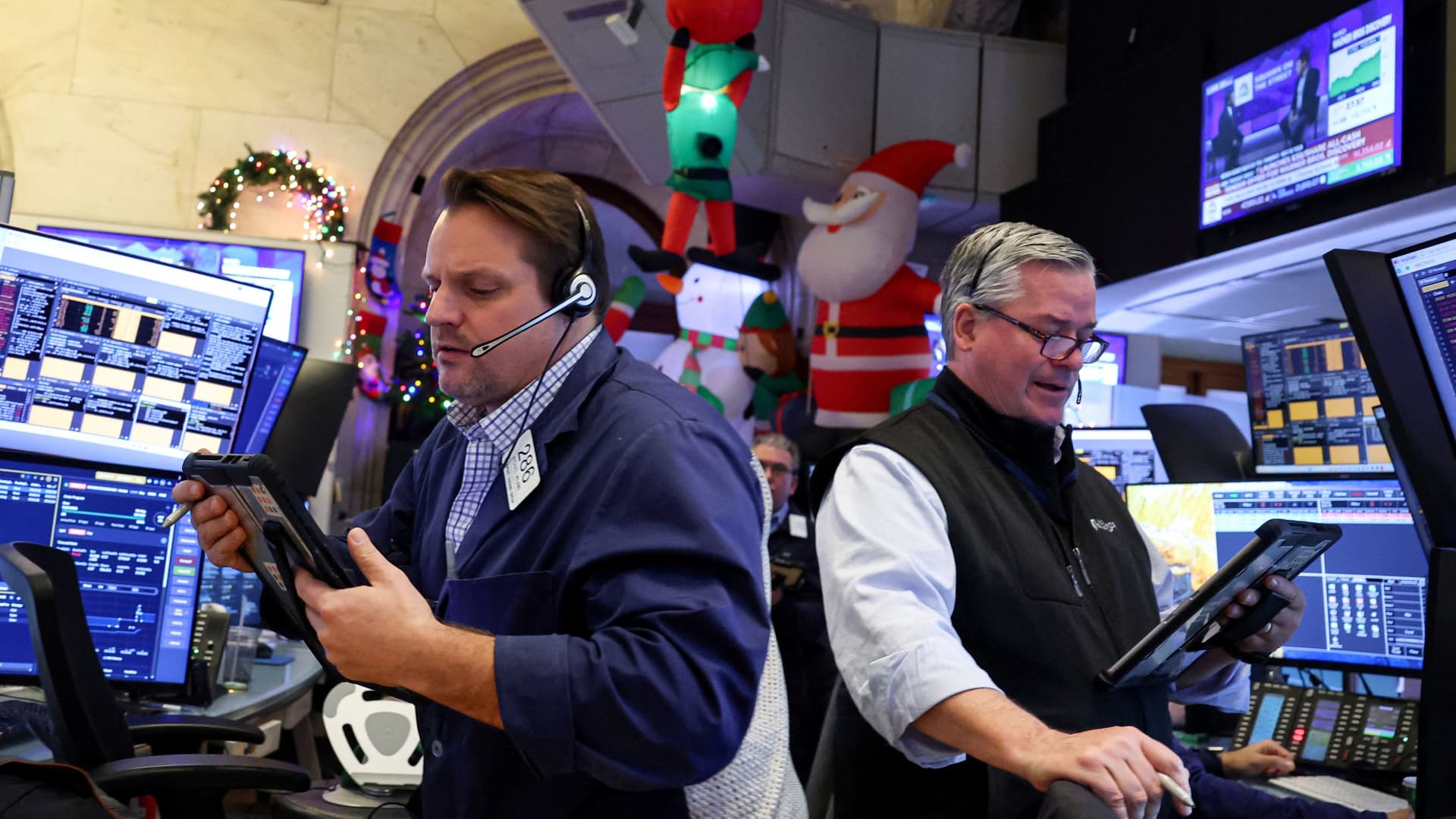
Traders work on the floor at the New York Stock Exchange (NYSE) in New York City, U.S., Dec. 8, 2025.
Brendan McDermid | Reuters
Stock futures are little changed ahead of the Federal Reserve’s interest rate decision expected Wednesday.
Futures tied to the Dow Jones Industrial Average fell 19 points, or 0.03%. S&P futures and Nasdaq 100 futures hovered below the flatline.
Stocks have been teetering between slight gains and losses in recent sessions as investors await this week’s key Fed meeting, which is the final one of the year. The Fed is widely expected to deliver its third straight interest rate cut of a quarter percentage point, with fed funds futures suggesting a roughly 87% chance of a decrease, according to CME’s FedWatch tool.
Sentiment among members of the rate-setting Federal Open Market Committee remains divided, however, as some favor cuts to stave off further labor market weakness and others believe another cut could worsen inflation. Investors are looking to gauge members’ sentiment from the post-meeting statement and Chair Jerome Powell’s highly anticipated news conference Wednesday afternoon.
The previous session saw lackluster moves in the broader market. The S&P 500 closed down 0.1% on Tuesday while the Dow Jones Industrial Average lost nearly 0.4%, weighed down by losses in JPMorgan shares. The tech-heavy Nasdaq Composite added about 0.1%, lifted by gains in Broadcom, Tesla and Google parent Alphabet.
A sector rotation has emerged, however. The Russell 2000 index of small-cap companies hit a fresh all-time intraday high on Tuesday, strengthened by the prospect of upcoming rate cuts. Smaller companies tend to benefit from rate cuts because their borrowing costs are more linked to market rates, and could therefore boost their profit margins.
Wells Fargo Investment Institute global equity strategist Doug Beath noted that the Russell 2000 is underperforming the S&P 500 this year, but has rallied since Nov. 21 and outperformed the broad-market index since that date.
“The favorable change for small-cap equities is consistent with our view that equity market breadth is widening,” Beath said. “We believe investors are looking beyond the current economic soft patch in anticipation of accelerating economic growth through 2026 because of positive secular trends already in place — tax cuts that will deliver what should be the largest refunds since 2021, deregulation, more Fed rate cuts, and continued technology capex growth.”
