

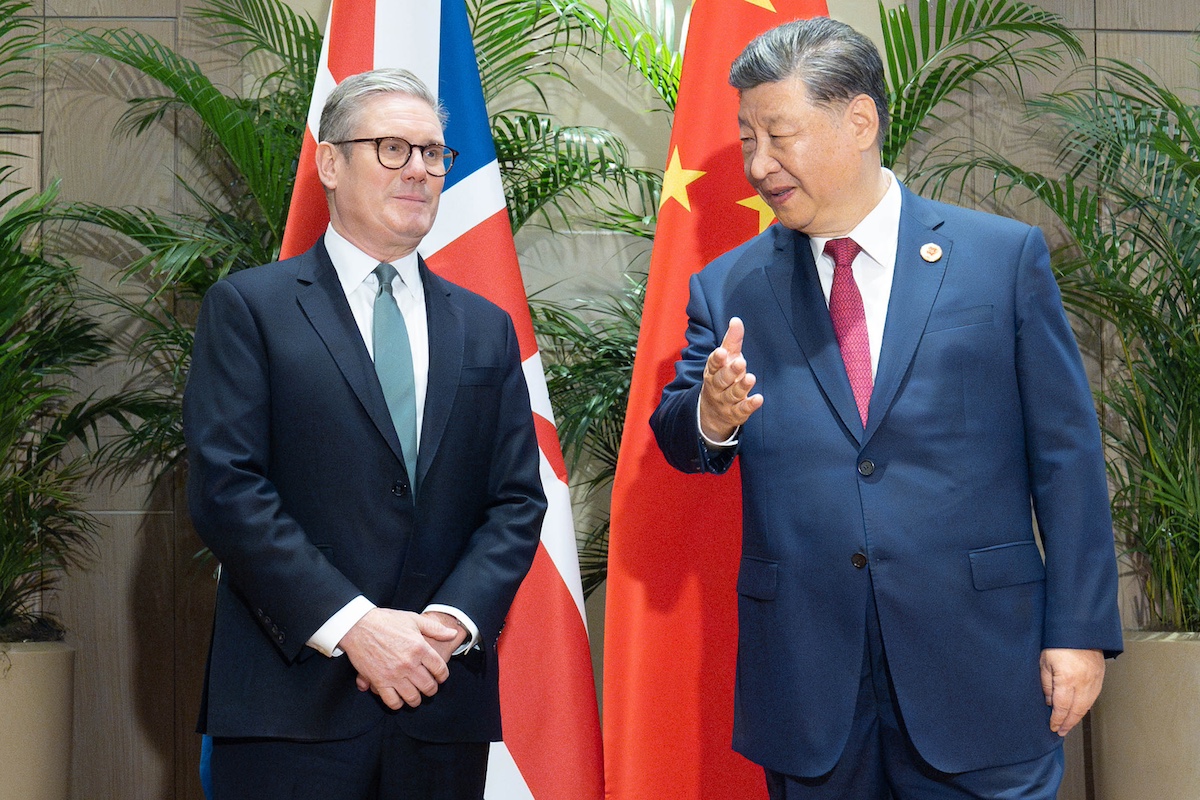
Keir Starmer has arrived in Beijing this week with a message designed to unsettle Washington and intrigue global capital: Britain will not choose between the US and China.
Investors should read that line as a declaration of strategy. Britain is attempting to monetize the coming era of geopolitical fragmentation.
US President Donald Trump’s tariff threats following Canada’s recent outreach to China underscore how quickly economic diplomacy can turn into economic warfare. Starmer is moving in the opposite direction, signaling commercial pragmatism in a world where ideology is hardening into policy. Between those forces lies a lucrative space for capital, and London wants to own it.
Globalization has not ended; it’s splintered. Trade, tech and capital now move through competing political channels. Governments are shaping supply chains, currencies are responding to diplomatic signals, and investors are forced to “price politics” with the same intensity as earnings and inflation.
Starmer’s Beijing trip is, it would seem, a bet on multipolar capitalism. Britain wants to act as a hinge economy, so it’s deeply tied to the US financial system while maintaining economic engagement with China. This is pure leverage.
London’s ambition is clear. Financial centers that maintain access to multiple power blocs can capture cross-border investment, currency demand and corporate structuring activity. It appears that Number 10 believes that in a world divided into spheres of influence, intermediaries become the power brokers.
Britain sits in a rare position. It hosts one of the world’s deepest capital markets, a global currency, and a legal system trusted by multinational firms. A UK that trades with Washington and Beijing, regulates predictably and courts foreign capital becomes a geopolitical arbitrage hub.
Markets already reward this behavior with countries that preserve optionality attracting multinational production, sovereign wealth flows, and venture capital. Ideological purity carries a premium in politics, but, as history teaches us, a discount in markets.
The pound could become an unexpected beneficiary if the strategy succeeds. Currencies backed by deep markets and institutional credibility tend to attract capital during geopolitical stress. A UK positioned as a conduit rather than a combatant can be expected to fit that profile.
The broader shift is structural. Supply chains in semiconductors, AI and tech hardware, energy infrastructure, and defense are being duplicated across regions. Tariffs accelerate fragmentation, yet fragmentation creates demand for intermediaries, hedging instruments, and financial services.
Britain’s challenge is execution. Symbolic diplomacy must translate into regulatory reform, industrial policy clarity and aggressive capital attraction. Without that, the trip becomes a photo opportunity. With it, London could reassert itself as the central marketplace for multipolar capital.
History favors intermediaries. Switzerland, Singapore, and Hong Kong built global roles by engaging multiple power centers during periods of geopolitical rivalry. Britain is attempting a similar pivot in the 21st century, armed with scale, language and financial infrastructure.
Middle powers benefit when giants clash. For example, Mexico, Vietnam, India, parts of Africa and Gulf economies are already absorbing diverted manufacturing and capital. Britain aims to capture the financial layer of this redistribution.
Financial services may be the biggest prize. Cross-border listings, bond issuance, M&A advisory, asset management, currency trading and dispute resolution all flow toward jurisdictions perceived as stable and open. Britain is signaling its intention to remain open to both camps.
Starmer’s assertion that the UK does not need to choose is a direct challenge to binary geopolitics. Trump’s rhetoric insists on alignment. Beijing seeks influence through economic integration. Investors prefer access without allegiance.
A fragmented world raises risk premiums but expands opportunity sets. Defense spending rises. Energy infrastructure becomes strategic. AI and tech ecosystems multiply. Capital shifts toward jurisdictions that offer legal certainty and market depth.
For decades, London thrived as a global hub during periods of integration. The next phase rewards hubs that manage disintegration. Acting as a financial Switzerland between Washington and Beijing could define Britain’s economic trajectory.
Markets will judge results, not rhetoric. Capital flows, foreign direct investment, currency stability and deal volumes will reveal whether Britain can turn ambiguity into advantage.
Starmer’s Beijing trip should be seen as a signal to investors: Britain intends to compete in the age of multipolar capital. Trump’s tariff threats guarantee volatility. Volatility feeds financial markets, hedging strategies and speculative capital.
Geopolitics is no longer a background variable. It’s a primary driver of asset allocation. Countries that position themselves as indispensable intermediaries can extract disproportionate economic value.
