

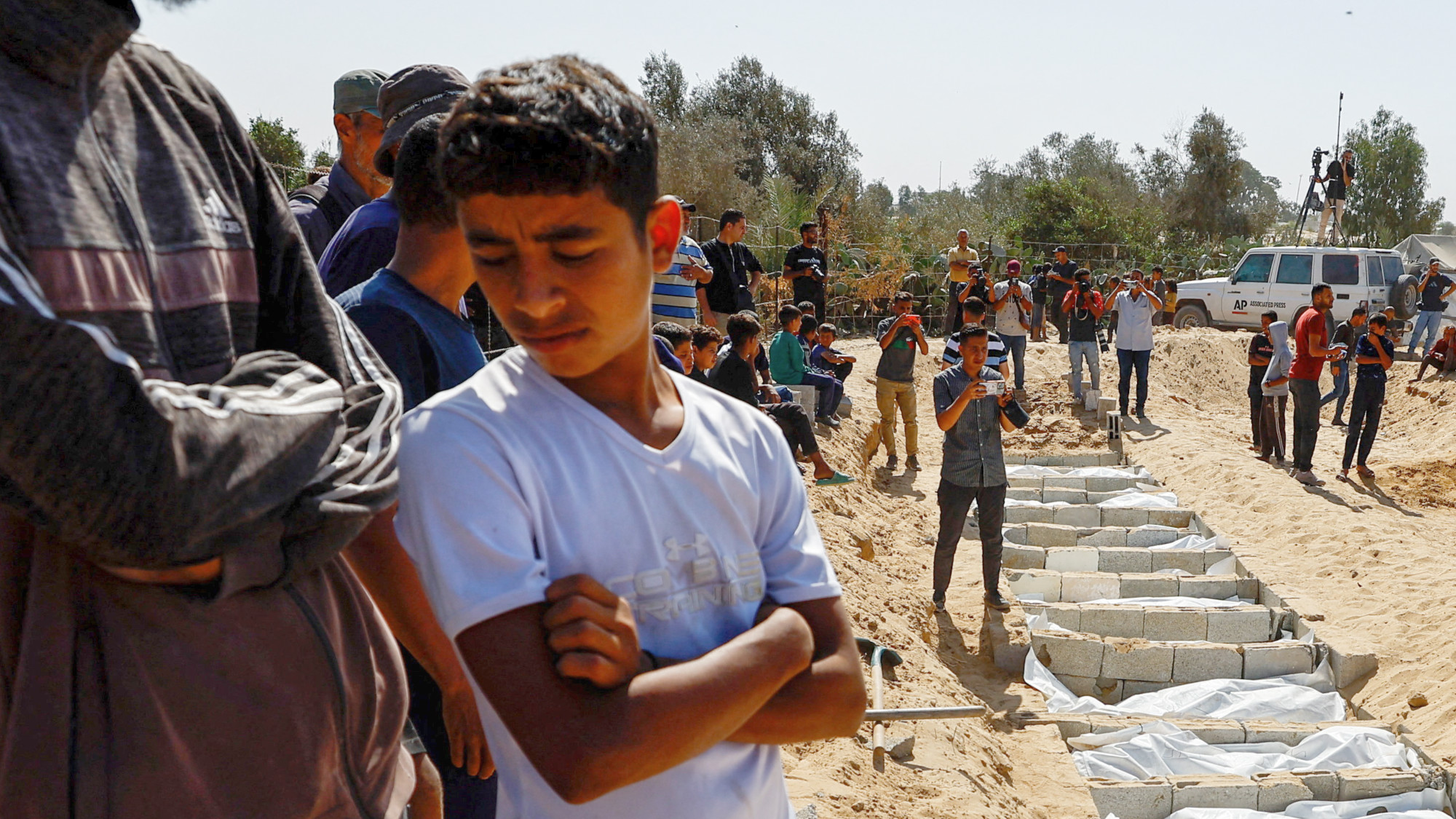
The bodies handed over by Israel arrived in Gaza frozen, numbered and silent.
Palestinian families hoped their arrival would finally answer their two-year-long questions about the fate of their missing relatives.
But with these answers came new questions, leaving many families in limbo even after they were finally able to bury their loved ones: what had happened to their bodies?
Many of the remains delivered to Nasser Hospital in Khan Younis were difficult to identify – some with severed parts, others bearing long-stitched incisions.
This has led families to suspect that vital organs or body parts were taken while their relatives were in Israeli custody.
New MEE newsletter: Jerusalem Dispatch
Sign up to get the latest insights and analysis on
Israel-Palestine, alongside Turkey Unpacked and other MEE newsletters
Yet forensic doctors in Gaza say they cannot confirm or refute these claims, as the Ministry of Health lacks the equipment needed for full examinations.
“My brother Ahmed went missing on the first day of the war,” Muhammed Ayesh Ramadan, a resident of Deir al-Balah in the central Gaza Strip, told Middle East Eye.
“We did not know anything about him, or how he disappeared, but I kept saying he was missing and kept searching for him, hoping to find him.”
When bodies were returned from Israel as part of the ceasefire signed with Hamas in October, the Palestinian Ministry of Health displayed photos of them at Nasser Hospital for families to inspect.
Ramadan searched for three days without success. On the fourth day, he finally spotted the clues he had been looking for.
“I identified him with around 70 percent certainty from his face,” he recalled.
‘There was a stitched incision running vertically from his chest downward; it looked like they had opened his body’
– Muhammed Ayesh Ramadan, Gaza resident
When Ramadan further inspected the body, he also found distinctive marks he recognised on the torso, and ultimately confirmed his 37-year-old brother’s identity.
“The body was burned, and there were around six to seven bullets in his body. It was extremely stiff and completely frozen,” he explained.
Ramadan noticed that one of his brother’s toes had been cut off. Forensic doctors, however, say this was the case with almost all the bodies they received, apparently due to DNA examinations conducted in Israeli custody.
“There was also a stitched incision running vertically from his chest downward; it looked like they had opened his body,” he added.
“My brother had never undergone any surgery, and he had never had stitches before the war. I even asked his wife, and she confirmed that he had never had any stitches and his abdomen had never been opened.”
‘Many remain unidentifiable’
Doctors and forensic teams in Gaza are often unable to determine whether organs are missing due to a lack of equipment and essential materials.
Khalil Hamada, director general of forensic medicine in Gaza, told MEE that bodies handed over by Israeli authorities can only be examined externally, with no possibility for internal inspection.
“The bodies arrive in such extreme freezing conditions that we sometimes leave them for a day or two until the ice melts and their details become visible. Some bodies even arrive partially decomposed,” he said.

Gaza cannot heal while its dead go unnamed
Read More »
“Handling the bodies is extremely difficult. What we do is not a full forensic examination, as we lack the necessary capabilities. The process is limited to documenting individual distinguishing features so families can identify their loved ones.”
Hamada added that proper examinations would require DNA testing and 4D CT scans, which are not available in Gaza.
“This severely limits our ability to conduct precise forensic examinations and fully identify bodies. Many remain unidentifiable, and we are forced to bury them without names,” he said.
Israel has returned the bodies of 345 Palestinians to Gaza. Only 99 have been identified so far.
The rest were mostly buried in mass graves without identification.
Hamada also confirmed that Israeli authorities amputate certain body parts, such as thumbs on hands as well as feet, before returning the bodies.
“They may take just the tip of a finger or the first phalanx, but they often remove the entire thumb. In most cases, these fingers are amputated for DNA purposes before the body is handed over to us,” Hamada said.
Hands and feet bound
In the handover process, Israel does not provide names, forensic reports, condition‑reports or cause-of-death information to Palestinian authorities or families.
After each batch of bodies arrives, the Ministry of Health invites families to Nasser Hospital, where photos of the remains are displayed on a large screen, each marked with a number.
Families who recognise a relative report the number before viewing the body in the morgue and arranging burial.
Because some relatives cannot attend and the viewing period is short, the ministry also maintains an online page showing images of unidentified bodies, with details such as date received, gender, and body number.
The photos include close-ups of body parts, such as the jaw, skull, fingers and toes, as well as distinctive marks that relatives may recognise, in addition to the clothing worn by the missing person.
‘It was clear that he was martyred while restrained’
– Zeinab Ismail Shabat, sister of deceased Palestinian
Zeinab Ismail Shabat, from Beit Hanoun in the northern Gaza Strip, was browsing the page when she identified her 34-year-old missing brother, Mahmoud Shabat.
“As soon as we saw his hair and eyes, his upper features, we recognised him,” Shabbat told MEE.
“The next day, my mother, father, my brother’s wife, and my uncle went [to Nasser Hospital], and they recognised him.”
Mahmoud’s family confirmed his identity to the hospital by recognising a head injury he had sustained during the 2018 Great March of Return protests against the Israeli blockade of Gaza.
“One of his index fingers was severed. His hands were tied behind his back. His legs were also bound, and the marks of the metal restraints had left dents in his feet,” Shabat said.
“It was clear that he was martyred while restrained. He was completely stripped of clothing. There was a gunshot in his thigh, and there were small pieces of wood on his chest.”
According to Mahmoud’s mother, his face appeared to have been struck so violently that his skull was fractured, and his neck bore marks suggesting he had been hung.


Independent medical personnel in Gaza report that many of the bodies received bore clear signs of torture, fractured bones, and, in some cases, were bound at the hands and feet with their eyes blindfolded.
Nagah Ismail al-Jabari, a sister and mother of two missing Palestinians whose bodies were handed over by Israel recently, said she could mainly identify them by their clothes.
“My brother, Fahd, was 35, and was martyred at the beginning of the war. He was among those who went out to watch [on the aftermath of 7 October attack], and he was killed,” she told MEE.
“I recognised him by his sandals and clothes. Some of his features and teeth were not heavily decomposed. I recognised him from the photos, then went with my brother, and they brought the body out of the freezer so we could identify him further.”
As with nearly all the bodies received, Jabari said that her brother’s left index finger and big toe were amputated.
“There was also a tooth that was missing. But there were no incisions or stitches on his body. This is mainly because my brother was killed immediately, so I don’t think they would attempt to take organs from someone already dead.” she added.
“As for my son, he was 20 years old. I identified him by his clothes and underwear,” she recalled.
“Two of his teeth were missing and he had a wound in his left thigh. There were also shrapnel fragments in his back.”
