

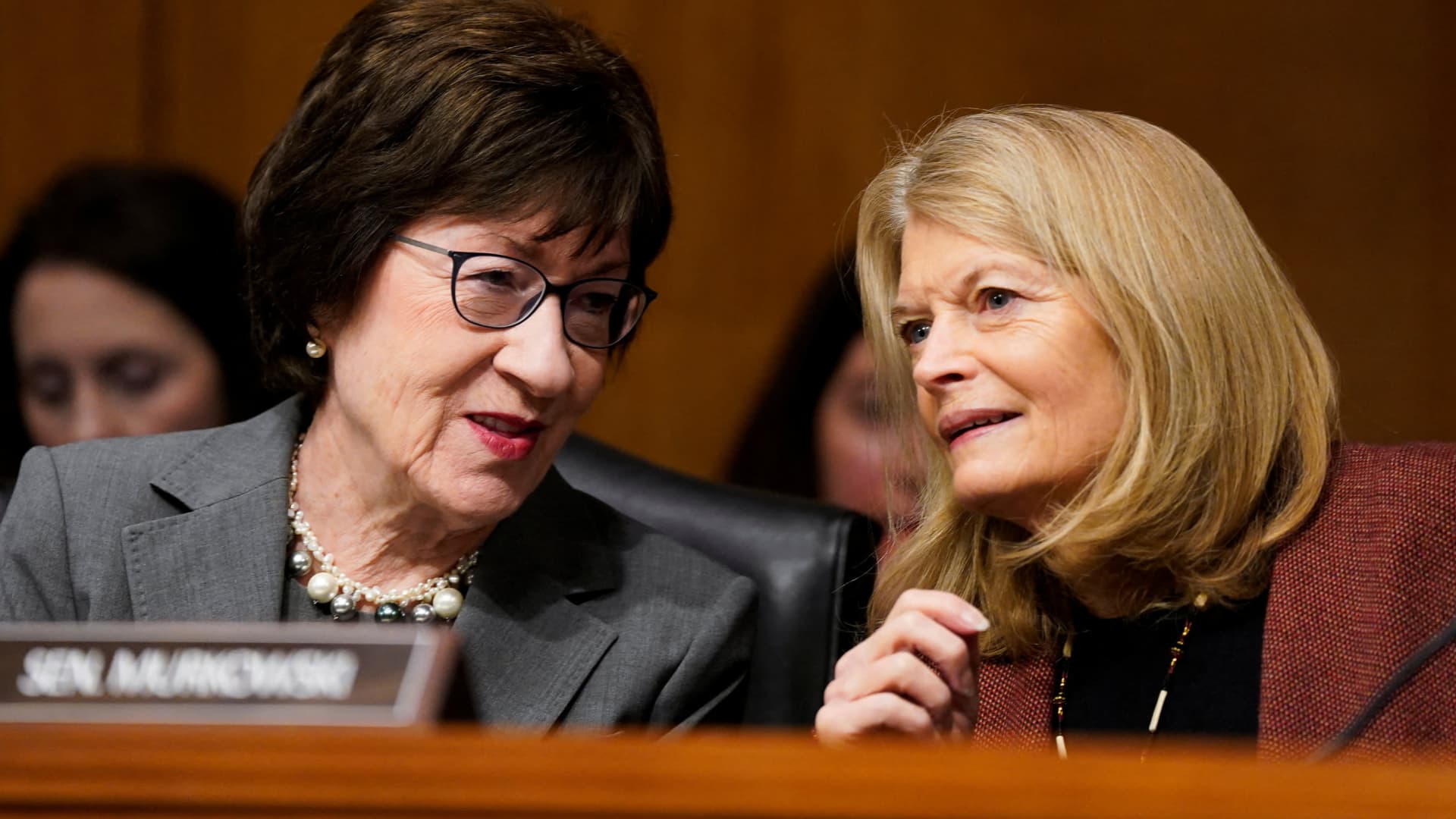
U.S. Senator Susan Collins (R-ME) speaks with Senator Lisa Murkowski (R-AK), as Lori Chavez-DeRemer, U.S. President Trump’s nominee to be secretary of labor testifies before a Senate Health, Education, Labor, and Pensions (HELP) Committee confirmation hearing on Capitol Hill in Washington, D.C., U.S., February 19, 2025.
Kent Nishimura | Reuters
The Senate on Thursday voted 52-47 to block President Donald Trump from further military action in Venezuela.
The move came less than a week after Trump authorized a strike that captured the country’s leader, Nicolás Maduro.
The measure, known as a War Powers Resolution, only needed a simple majority to pass in the Republican-controlled Senate and would require Trump to seek the approval of Congress before using the U.S. military again in Venezuela. The measure was brought by Democratic Sen. Tim Kaine of Virginia and Republican Sen. Rand Paul of Kentucky.
The vote in the Senate was procedural, but it indicates that the measure has the votes to pass when it comes to a final vote in the Senate. It would then go to the House, where Republicans have a razor-thin majority.
Later Thursday, Trump railed against the five Republicans who helped Democrats pass the measure.
“Republicans should be ashamed of the Senators that just voted with Democrats in attempting to take away our Powers to fight and defend the United States of America,” Trump wrote on Truth Social.
The five GOP senators — Paul, Susan Collins of Maine, Alaska’s Lisa Murkowski, Josh Hawley of Missouri and Indiana’s Todd Young — “should never be elected to office again,” Trump wrote.
Collins, responding to Trump’s post, told reporters on Capitol Hill, “I guess that means he would prefer to have [Maine’s Democratic Gov. Janet] Mills or somebody else with whom he’s not had a great relationship.”
“Make no mistake, bombing another nation’s capital and removing their leader is an act of war plain and simple. No provision in the Constitution provides such power to the presidency,” Paul said in a statement.
The Constitution vests Congress with the authority to declare war.
Trump and his allies in Congress have contended he did not need to consult Congress on the strike that captured Maduro, which they say was a law enforcement operation. Maduro is now facing drug-related charges in New York.
The Senate shot down a similar resolution in November, after only two Republicans — Paul and Murkowski — joined all Democrats in voting for it. Trump engaged in a monthslong military buildup around Venezuela before the action that captured Maduro.
Collins, in a statement after the vote, said, “While I support the operation to seize Nicolas Maduro, which was extraordinary in its precision and complexity, I do not support committing additional U.S. forces or entering into any long-term military involvement in Venezuela or Greenland without specific congressional authorization.”
— CNBC’s Justin Papp and Kevin Breuninger contributed to this report.
