

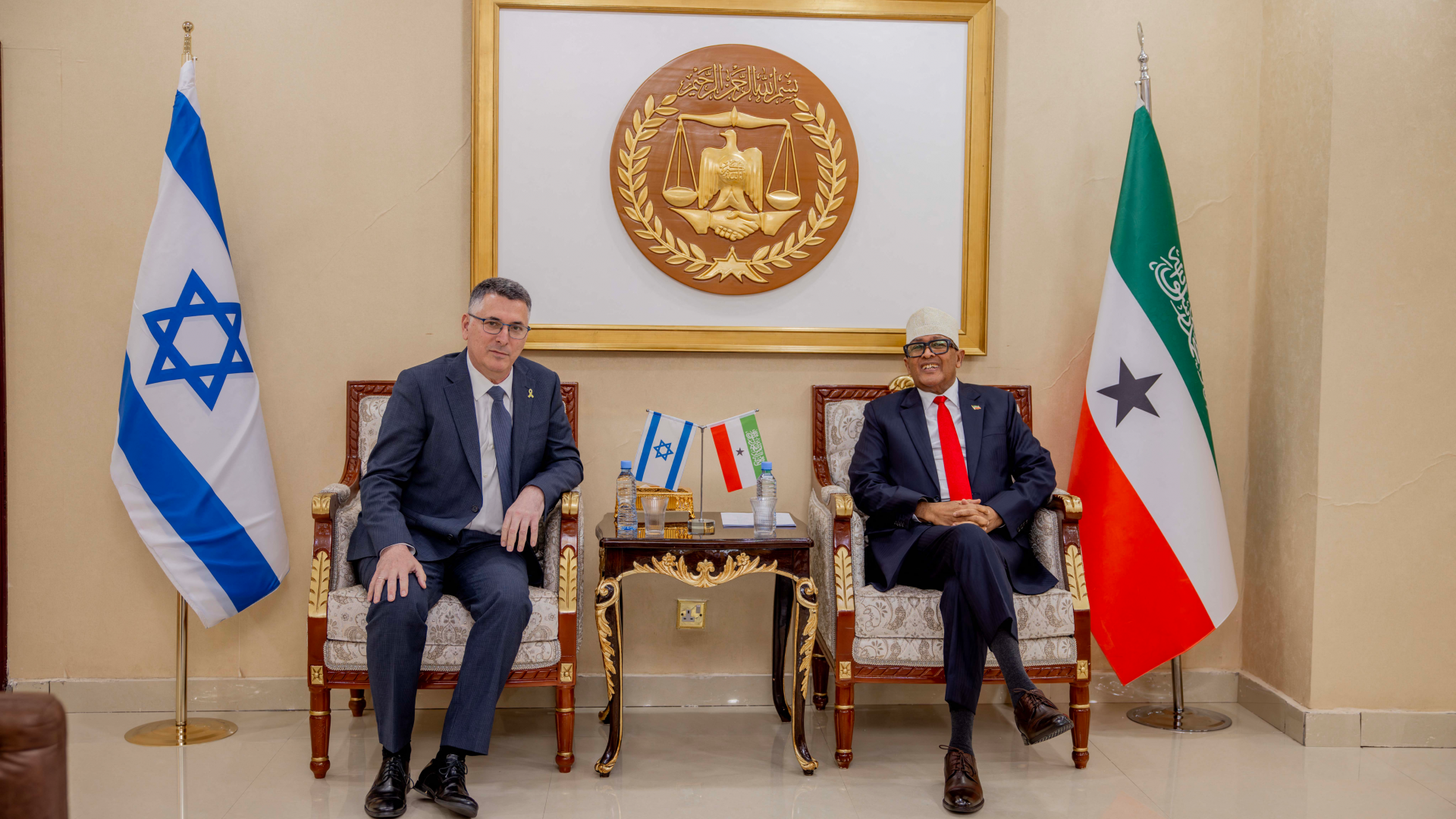
Several Muslim-majority countries strongly condemned what they described as an “illegal” Israeli state visit to Somalia’s breakaway region of Somaliland in a joint statement released on Thursday.
The visit by Israeli Foreign Minister Gideon Saar on Tuesday followed Israel’s official recognition of Somaliland as a state last month, making it the first country to do so.
Among the signatories to the statement were Saudi Arabia, Egypt, Algeria, Qatar, Iran, Turkey, Pakistan, Nigeria, as well as the Organisation of Islamic Cooperation (OIC)
The visit “constitutes a clear violation of sovereignty and territorial integrity” of Somalia and “undermines established international norms and United Nations Charter”, the statement read.
The countries stressed the need to respect “international law” and uphold the principle of “non-interference in the internal affairs of sovereign states” to maintain stability in the region.
New MEE newsletter: Jerusalem Dispatch
Sign up to get the latest insights and analysis on
Israel-Palestine, alongside Turkey Unpacked and other MEE newsletters
“Encouraging secessionist agendas are unacceptable and risk exacerbating tensions in an already fragile region,” the statement added.
Somaliland has been part of the unified Somali Republic since 1960, but declared independence in 1991, establishing a de facto state. It established its own currency and built its own military and other state institutions.
Although it has maintained unofficial diplomatic relations with several countries, its sovereignty had not been recognised by any permanent UN member state until last month.
Experts have said Israel’s decision contravenes principles enshrined in the United Nations and African Union charters, which emphasise respect for the sovereignty and territorial integrity of member states, including Somalia.
Israeli Prime Minister Benjamin Netanyahu said the recognition was in “the spirit of the Abraham Accords”, referring to the US-led normalisation agreements signed between Israel and several Arab states in 2020.
Israel’s strategic base in the region
During his visit to the port city of Berbera, Saar was pictured meeting Somaliland’s president, Abdirahman Mohamed Abdullahi.
The Israeli foreign minister said in a statement that “unlike ‘Palestine’, Somaliland is not a virtual state”, adding that it was “pro-western and friendly to Israel”.
Saar confirmed plans for Israel and Somaliland to cooperate on strategic partnerships in medical, defence, education and water sectors.

How Israel’s recognition of Somaliland risks destabilising the region
Read More »
Despite past denials, Israeli media reported on Thursday that discussions were under way over the possibility of Somaliland hosting an Israeli military base.
Samira Gaid, a Horn of Africa security analyst, told Middle East Eye that Israeli involvement in Somaliland “would be interpreted as part of a broader posture aimed at projecting power against surrounding Arab states”.
“It is precisely Israel’s recognition that creates this vulnerability, as it risks transforming Somaliland into a forward operating environment for Israeli interests,” Gaid said.
Somaliland is a key strategic base along a major maritime corridor linking the Gulf of Aden and the Red Sea, through which around 30 percent of global trade passes. The area has come under attack over the last two years by Yemen’s Houthi movement, acting in opposition to Israel’s genocide in Gaza.
The Horn of Africa has also become a focal point of global power struggles with China, which has a base in Somalia’s neighbouring country of Djibouti, which was also a signatory to the statement.
Former Israeli peace negotiator Daniel Levy told Al Jazeera that Netanyahu’s government may be seeking to benefit from an agreement with Somaliland to take in Palestinians forcibly displaced from Gaza.
However, Lvy said Israel may also be angling to increase its value to its chief sponsor, the US, by securing an ally in a strategically important region – just ahead of a meeting between Netanyahu and US President Donald Trump on 29 December.
“We’ve seen before that Israel can put something on the table and the Americans follow later,” said Levy. He added that Israel may be signalling to Washington: “We’re active, and we’re positioned in a way that helps out. Having us there helps you”.
