

Saudi Arabia has bombed an alleged Emirati shipment in southern Yemen, and for the first time directly called out the UAE’s role in backing southern separatist forces in the country.
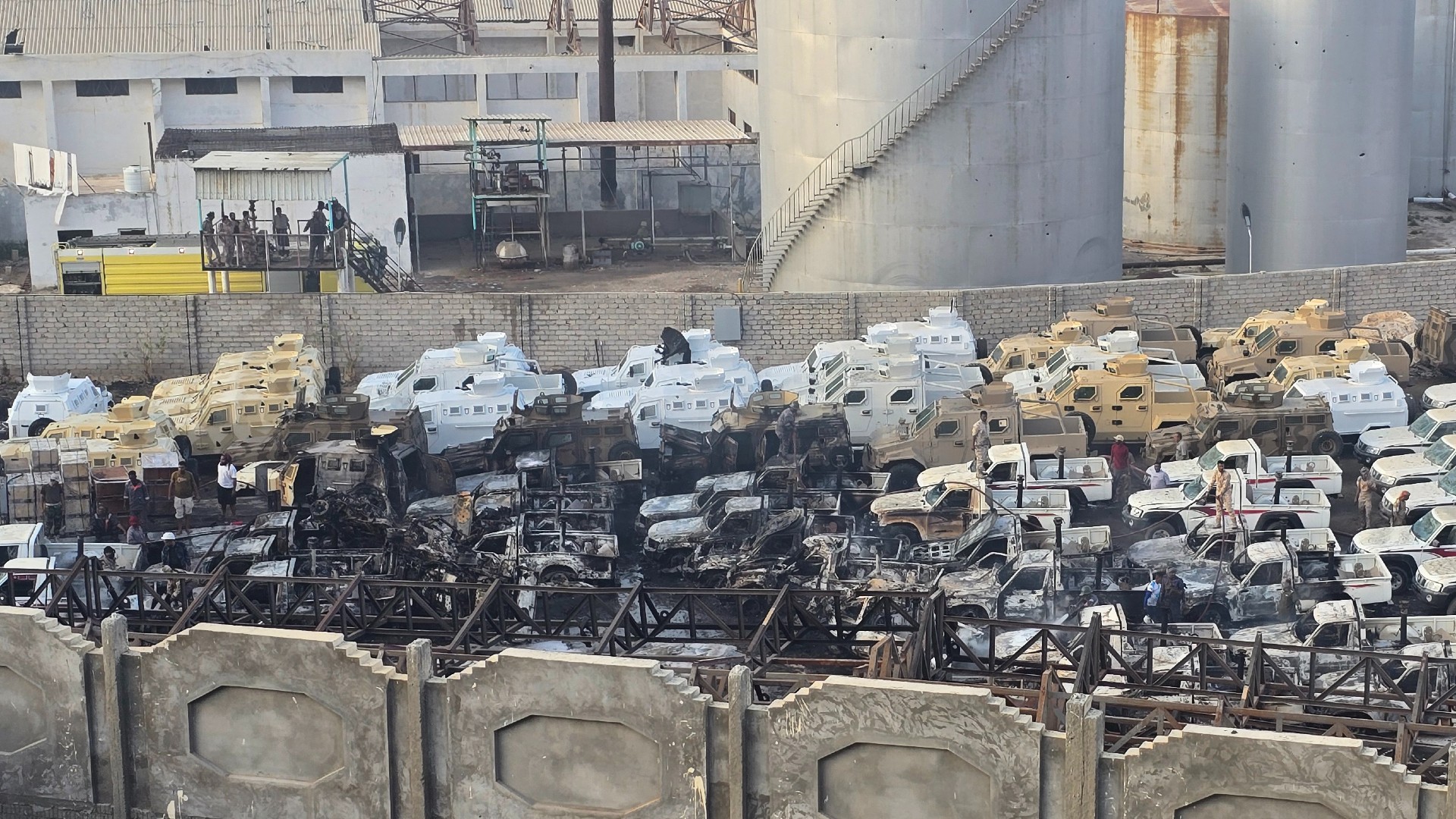
On Tuesday morning, Riyadh said it targeted weapons and vehicles that had arrived in the Yemeni port of Mukalla on vessels originating in Fujairah, a port city on the east coast of the UAE.
“The ships’ crew had the disabled tracking devices aboard the vessels, and unloaded a large amount of weapons and combat vehicles in support of the Southern Transitional Council’s (STC) forces,” a Saudi military statement read.
It added that the weapons “constituted an imminent threat”, and therefore Saudi-led forces conducted “limited air strikes” targeting shipments offloaded from two vessels.
Saudi state media said there were no casualties from the air strike, and that the raid was conducted in accordance with international humanitarian law.
New MEE newsletter: Jerusalem Dispatch
Sign up to get the latest insights and analysis on
Israel-Palestine, alongside Turkey Unpacked and other MEE newsletters
An official at Mukalla port told AFP that a warning to evacuate was received at 4am local time, with the strike conducted 15 minutes later. Footage showed several vehicles burned out and smouldering.
Later on Tuesday, Riyadh published a strong statement criticising the UAE’s role in Yemen.
The Foreign Ministry said that it was disappointed by actions taken by the UAE “pressuring” the STC’s forces to conduct military operations on Saudi Arabia’s southern border, in the Yemeni regions of Hadhramaut and al-Mahrah.
‘The steps taken by the UAE are considered highly dangerous’
– Saudi Arabian Foreign Ministry
It said such actions were a threat to Saudi Arabia’s national security, and the security and stability of Yemen and the wider region.
“The steps taken by the UAE are considered highly dangerous,” the ministry stated, adding that they went against the principles upon which a coalition was set up – backed by both Abu Dhabi and Riyadh – to support Yemen’s internationally recognised government.
“The Kingdom stresses that any threat to its national security is a red line,” it said. “[We] will not hesitate to take all necessary steps and measures to confront and neutralise any such threat.”
It marks the strongest statement made by the Gulf kingdom since the STC seized control of swathes of territory in southern Yemen earlier this month. It is also the first time Riyadh has directly blamed the UAE for backing the separatists’ offensive.
Following the Yemeni war and the takeover of the capital, Sanaa, and other areas in the north by the Houthis in 2014, the Aden-based STC – which advocates for southern independence – has emerged as a key player among anti-Houthi elements.
Southern Yemen has for years been overseen by the Presidential Leadership Council (PLC), an executive government body that initially had both Saudi and Emirati support.
However, the body has long been riddled with internal disagreements and jostling.
On Tuesday, Rashad al-Alimi, the head of the PLC, called for an immediate withdrawal of Emirati forces in Yemen.
Alimi announced that he had cancelled a joint defence agreement with the UAE, and demanded Emirati forces withdraw from Yemen within 24 hours.
Tuesday’s strike was the second alleged Saudi attack on the STC in a few days.
The southern group said on Friday that Riyadh had targeted its elite forces in the central Yemeni region of Hadhramaut. Saudi Arabia did not comment.
South Yemen became an independent country following British withdrawal in November 1967, until Yemeni unification in 1990.
After STC forces made huge advances in the country’s southeast a few weeks ago, the flag of historic South Yemen was hoisted above buildings and waved by fighters and residents.
