

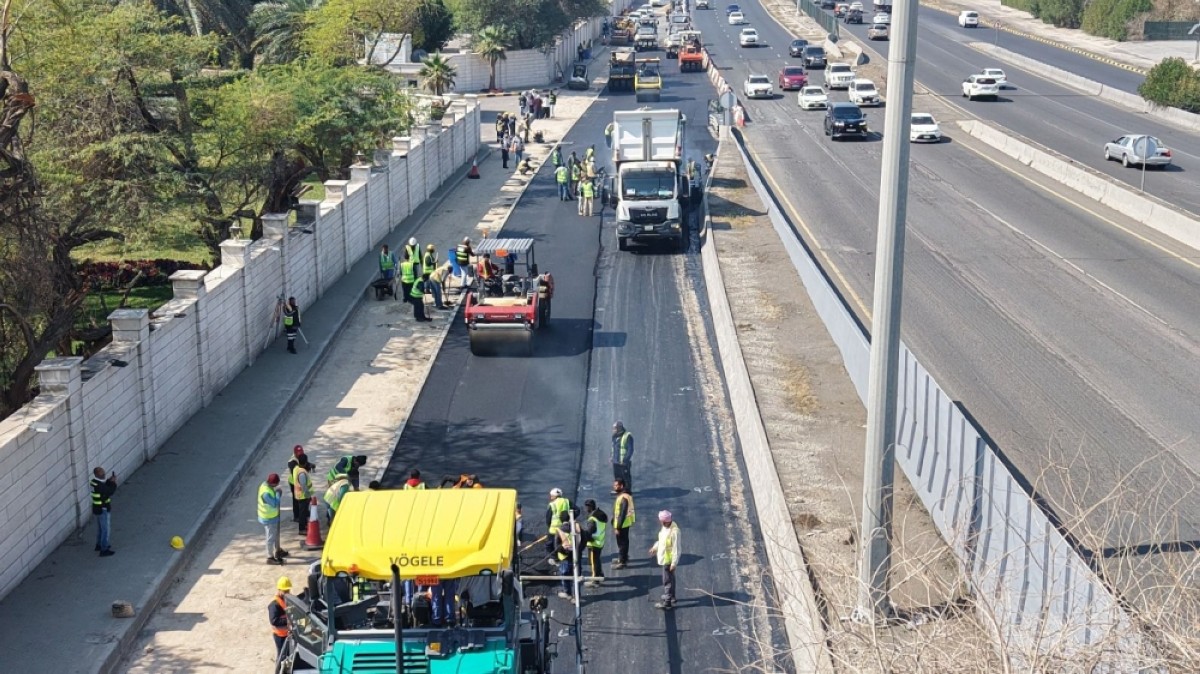
Surveys, traffic flow and infrastructure age determine speed, scope of repairs: Official
KUWAIT: If you’ve ever wondered why roadworks in one neighborhood wrap up quickly while another drags on for years, the Ministry of Public Works says the answer lies in the road itself.
Road maintenance has been the talk of Kuwait throughout 2025. This year, the Ministry of Public Works began implementing 18 major tenders covering road maintenance projects in all six governorates, with a total value of nearly KD 400 million.
“We start with the oldest and most deteriorated roads,” said Engineer Ahmad Al-Saleh, the ministry’s spokesperson, in an interview with KTV’s Nabd Al-Share’.
Some areas had not seen major maintenance for more than a decade, he said. In Surra, for example, the last major infrastructure work dates to the 1970s.
After years of complaints about deteriorating roads, commuters finally see change on the horizon. But the long-awaited maintenance comes with a cost: road closures. Rerouted traffic and bottlenecks have worsened Kuwait’s chronic congestion.
Observers have questioned how the ministry prioritizes work, as some areas seem to progress faster than others.
“When we began work in Surra, some residents asked why we started in one block instead of another. The reason was traffic flow direction toward the Fourth Ring Road,” Al-Saleh said.
Construction timelines depend on the road’s condition and its importance to the national traffic network. The ministry classifies roads into three categories: severely damaged, moderately damaged and new or still under warranty. Al-Saleh said this allows maintenance to be divided into two types of contracts, each with different scopes, timelines and levels of disruption.
Routine vs comprehensive
Routine maintenance contracts typically include replacing curbstones, inspecting asphalt, repairing worn layers and checking base layers. These contracts can involve full asphalt replacement. But they don’t automatically include sewerage, stormwater, lighting, or telecom upgrades. The work is targeted and usually completed quickly.
“Routine maintenance involves a defined scope. If asphalt is damaged, we assess its condition and the layers beneath it. If the base layer is sound, we mill and resurface. If not, we reach the soil layer and treat it,” he said.
The second type is comprehensive maintenance, which Al-Saleh said takes longer to complete. “Some people might ask why do you need three years to complete road works in Yarmouk, while in Adailiya it took three months,” Al-Saleh said. “It depends on the area.”
Qortuba, Yarmouk, and Surra face different infrastructure challenges than other neighborhoods, he said. Some areas have networks that have not been upgraded for decades. Housing density has increased since then, putting pressure on old systems. That led the ministry to introduce comprehensive maintenance contracts rather than simple repairs.
“When we enter an area under comprehensive maintenance, we fully overhaul the infrastructure. This includes asphalt, sewerage, stormwater, lighting networks, and installing new manholes where needed,” he said. “If there are known flooding points, we install additional drainage. We also address telephone lines and tertiary water networks”
Comprehensive contracts also change how water is delivered for public landscaping. “Previously, water was delivered only up to storage tanks,” Al-Saleh said. Under the new system, water is delivered directly within neighborhoods for landscaping between roads, making irrigation easier.
Comprehensive maintenance contracts are currently out for tender in Dhahiya, Nuzha, Shamiyah, and Shuwaikh’s industrial and residential areas. Roadworks in all areas in Jahra governorate are now in the design phase.
Before determining which areas require comprehensive maintenance, survey teams inspect streets, collecting detailed data on the condition of the roads and locations of damage. This is combined with reports of potholes and known trouble spots to build a national database that guides planning and timelines.
Unavoidable inconvenience
Once contractors begin work, Al-Saleh said, schedules are fixed and priorities are based on severity. “One of the biggest challenges you face is road closures,” said Al-Saleh. “Sometimes, work is carried out late at night, within a limited time window — six hours, for example — because there are schools, working hours.”
Al-Saleh said the closure of roads is not a unilateral decision by the Ministry of Public Works.
The Ministry of Interior’s General Traffic Department weighs in, especially near hospitals, fire stations and schools. For example, they look at ambulance movement, response times, and specific hours when congestion could be dangerous, he said.
Al-Saleh cited Bin Baz Street in Yarmouk, one of the area’s main arteries. “Some homes can only be accessed through this street,” he said.
Any closure requires a detailed plan that allows residents to enter and exit safely while work continues. “Our goal is not to inconvenience people,” he added. “But when you work on a road, some disruption is unavoidable.”
Responding to complaints about roads deteriorating a few years after maintenance, Al-Saleh said the ministry has tightened standards. “For highways and internal roads, we now use polymer-modified asphalt and anti-stripping agents,” he said. “These materials improve the mix, enhance bitumen properties, and improve asphalt quality.”
Quality control now begins at the asphalt plant and continues on site. An independent laboratory and the Government Center for Testing, Quality Control, and Research monitor materials, temperatures, equipment, and even the rolling process. “So today we have both quality control and quality assurance. Through this approach, the ministry guarantees quality from start to finish,” Al-Saleh said.
