

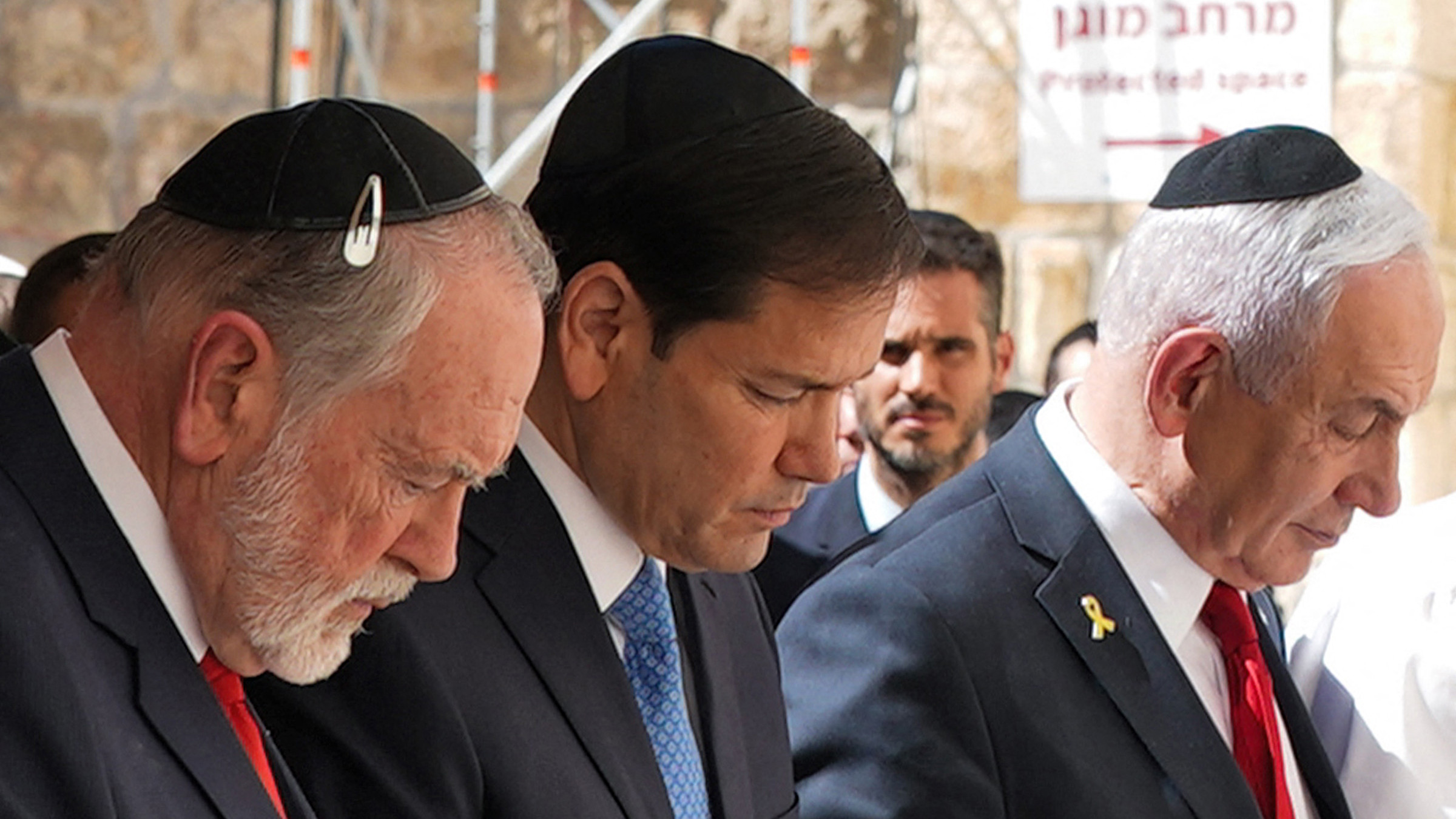
On Tuesday, US ambassador to Israel Mike Huckabee posted a defence of Christian Zionism after senior clergy in Jerusalem warned of the threat it poses to Christians in the land.
In a statement released last Saturday, the Patriarchs and Heads of the Churches in Jerusalem described Christian Zionism as a “damaging ideology” that misleads the faithful, sows confusion, and harms the unity of Christian communities in the Holy Land.
It cautioned against individuals who claim authority outside the communion of the church and undermine the pastoral responsibility entrusted to churches that have shepherded Christian life in Jerusalem for centuries.
Rather than engaging the substance of these concerns, however, Huckabee sadly chose to dismiss both the churches’ arguments and their moral authority.
As a Palestinian-American evangelical Christian whose family lives with the consequences of Huckabee’s distorted theology, I want to say plainly that he does not speak for me, nor for millions of Christians worldwide.
New MEE newsletter: Jerusalem Dispatch
Sign up to get the latest insights and analysis on
Israel-Palestine, alongside Turkey Unpacked and other MEE newsletters
Huckabee warned that no “sect” should claim exclusivity in speaking for Christians worldwide. But the authors of the Jerusalem statement are not random voices or ideological activists.
They are pastors, priests and bishops shepherding the oldest Christian communities in the world, communities that have endured occupation, displacement and repeated cycles of violence for generations. Invalidating their testimony reflects a detachment from reality.
More troubling still is Huckabee’s suggestion that Christians who do not share his understanding of God’s covenant with Israel are undermining Scripture itself. This is not the language of a diplomat.
It is the posture of a theological hawk, one who treats disagreement as disloyalty to God. Such absolutism leaves no room for humility or for the possibility that Scripture might challenge political conclusions already reached.
Huckabee insists, correctly, that God does not break His covenant. On this point, Christians broadly agree. But he does not tell the whole story.
Covenant without Christ
Christians have long believed that the covenant revealed in Jesus is directly connected to the promise God made to Abraham. It does not cancel that promise but fulfils it. And because Jesus established a new covenant, the old one is renewed and transformed through him.
At every stage of the biblical story, including in the Old Testament, covenant faithfulness meant responding to what God was doing in that moment.
In the New Testament, that same faithfulness is expressed by embracing Jesus as the Messiah. To omit this is not a minor oversight. It is a gospel distortion that relocates the meaning of God’s covenant away from Christ and into power, territory and exclusion.
For Huckabee, Christian Zionism is framed as an affirmation of biblical promise. But for Palestinian Christians like myself, its political outworking has meant dispossession
By collapsing covenant faithfulness into unconditional political support for Israel, Huckabee transforms this message into its opposite.
The covenant becomes a mechanism of reward and punishment; God is reduced to an enforcer of geopolitical loyalty; and scripture is no longer a moral compass but a shield against scrutiny.
For Huckabee, Christian Zionism is framed as an affirmation of biblical promise. But for Palestinian Christians like myself, and for Palestinians more broadly, its political outworking has meant dispossession, restriction, fear and loss.
This is not theoretical. It is the daily reality of Palestinian Christians and Muslims alike, including the congregations Jerusalem’s church leaders shepherd. Yet Huckabee shows little interest in listening to those who bear the cost of the ideology he blesses. Their suffering becomes theologically inconvenient.
Voices ignored
The weakness of Huckabee’s argument becomes clearer when viewed beyond Jerusalem. The church leaders he dismisses are not isolated voices.
In December, Andrea Zaki, president of the Protestant Churches of Egypt, publicly distanced Egypt’s evangelical denominations from Christian Zionism, describing it as a political ideology rather than a theological conviction.
He warned explicitly that Scripture must never be used to justify war, dispossession or domination.
Months earlier, prominent evangelical leaders from across the Middle East issued A Collective Call to the Global Church, rejecting all ideologies that baptise violence with religious language.
These leaders speak not from ideological distance but from pastoral proximity. They are addressing the real consequences of theology imposed without accountability.
Huckabee’s position places him at odds with Christian communities who live under the realities his theology sanctifies.
Faith as mandate
During a recent interview on Trinity Broadcasting Network, Huckabee’s exclusionary worldview was further exposed.
Asked for a Scripture verse that encapsulates his task as US ambassador, he cited Genesis 12:3, asserting that “God blesses those who bless Israel and curses those who curse Israel”.
In doing so, he altered the wording of the verse, which records a promise made to Abraham, not a mandate for contemporary foreign policy. He then applied this reworked version of the text directly to American political alignment.

How Zionist evangelicals seek to erase centuries of Palestinian Christianity
Read More »
In this logic, moral discernment disappears. Justice becomes secondary. The people harmed by policy choices do not factor into the equation.
This is not covenant theology as understood within Christianity’s own theological tradition, amounting instead to the instrumentalisation of faith to sanctify power.
Huckabee has said that this understanding guides his “day-to-day activity” as a diplomat. That admission should alarm anyone concerned with credible diplomacy. A foreign policy grounded in a highly contested reading of the New Testament rather than in justice, human dignity and accountability leaves no room for negotiation or peacemaking.
Huckabee presents his role in Israel as securing God’s blessing for America by ensuring that the US “blesses Israel”. This is where theology loses its ethics and where diplomacy loses its moral compass. A faith that invokes God while refusing to hear the cries of those crushed in God’s name betrays its own message.
At a moment when the US claims to seek stability and peace in the Middle East, such theology does the opposite. It undermines moral credibility, weakens diplomacy, and deepens the suffering of those already living under its consequences.
The views expressed in this article belong to the author and do not necessarily reflect the editorial policy of Middle East Eye.
