

Reforms tighten charity rules to boost transparency and crack down on misuse of donations
KUWAIT: Kuwait’s humanitarian contributions in 2025 spanned across Yemen, Syria, Gaza, Sudan and beyond, providing food, medical aid, housing and educational support to thousands affected by conflict and displacement.
Kuwait has also rolled out sweeping reforms for its charitable sector in 2025. New regulations aim to tighten oversight, improve transparency and align nonprofits with international standards against money laundering. Authorities have increased cross-ministry cooperation to monitor donations, particularly those crossing borders and to close inactive organizations. Earlier this year, the Social Affairs Ministry temporarily suspended all charitable fundraising following unauthorized donation drives on unofficial platforms, though the suspension has since been lifted.
Kuwait has since issued several comprehensive laws to regulate charitable work. The country is planning to create a dedicated governmental center overseeing humanitarian activity. All of this is part of a larger effort to improve transparency and align Kuwait’s charitable sector with international standards against money laundering after a report by the Financial Action Task Force (FATF) last November praised Kuwait’s legal framework but stressed the need for stronger enforcement.

Palestinians gather for a communal iftar, or fast-breaking meal, on the first day of Ramadan, amid building rubble in Rafah. The iftar was part of Kuwait’s Al-Najat charity relief campaign in the strip. — AFP

Trucks carry more than 250 tons of aid supplies and food to Syria as part of a campaign by Al-Khair Charitable Association.

The Kuwait Patients Helping Fund Society (North Darfur Office) provides urgent medical and humanitarian assistance to support people displaced from Al-Fashir to Tawila in western Sudan.
Unprecedented airbridges
The year began with the opening of the Kuwait Residential Village in southern Taiz, Yemen, featuring 40 housing units and supporting facilities, funded by the Sheikh Abdullah Al-Nouri Charitable Association. Shortly after, the association inaugurated the Abdulaziz Saud Al-Babtain School in Asilan, Shabwa Governorate, enhancing access to education in eastern Yemen.
The year saw an unprecedented scale of emergency relief logistics through organized airbridges. Kuwait maintained a continuous relief air bridge to Syria, dispatching more than 30 flights between January and February alone, carrying food, medical supplies, winter aid and mobility equipment. The Kuwaiti Red Crescent Society and other charitable associations also sent convoys and established mobile clinics to serve refugees and vulnerable communities. Syria received the highest documented volume of aid by weight, totaling at least 935 tons.
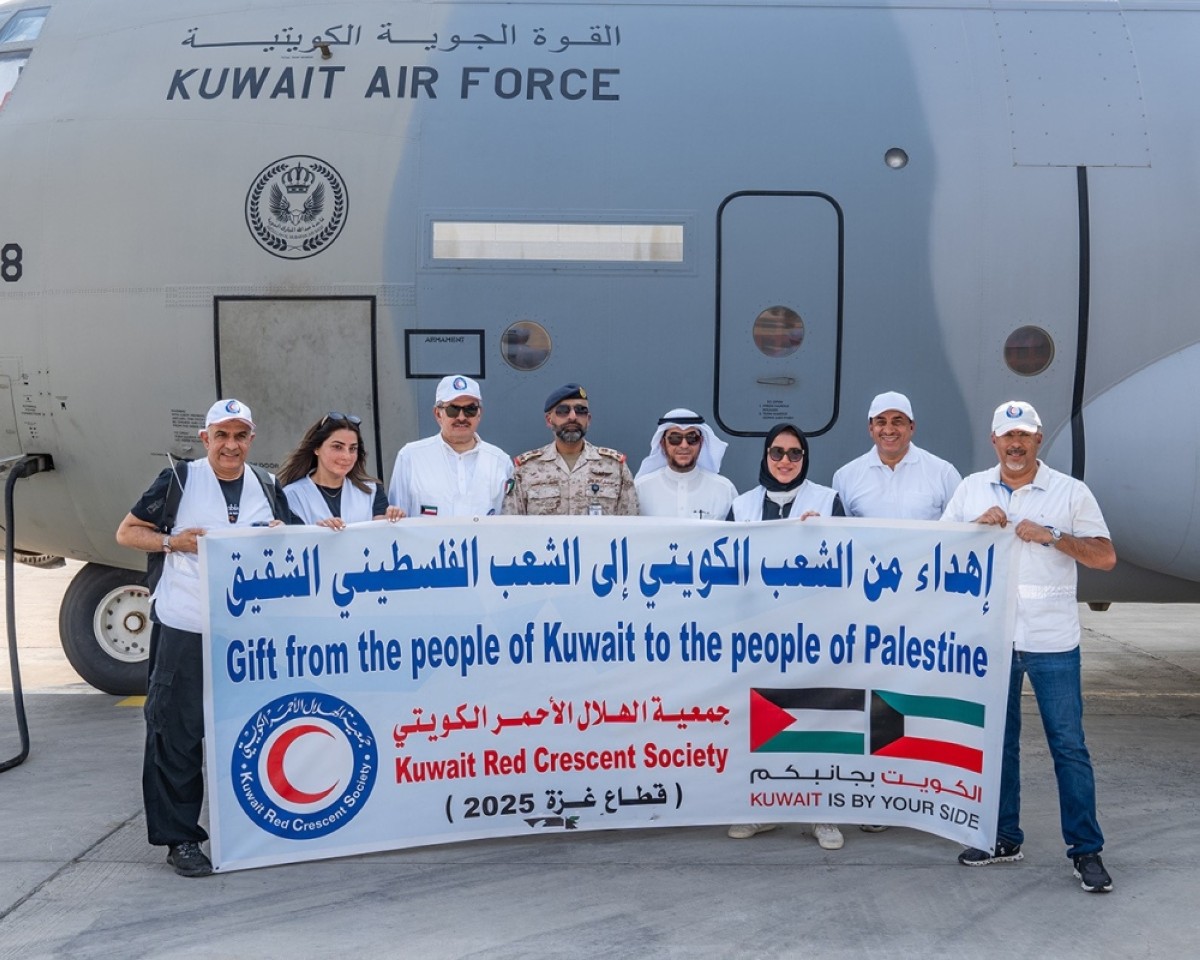
In Gaza, relief efforts intensified through the “Kuwait Beside You” campaign, which raised over KD 6 million over three days in August.
Palestine was supported with at least 740 tons of aid explicitly quantified by weight, in addition to several large truck convoys. An airbridge that operated from August through October delivered 380 tons of food and basic necessities via 18 flights landing in Egypt and Jordan. Furthermore, a land convoy of 15 trucks delivered 360 tons of food and relief materials through the Karam Abu Salem crossing in mid-October. Other major shipments included two separate convoys of 33 trucks each in late October, though the specific tonnage for these particular fleets was not publicized.
Sudan and Yemen also received significant aid shipments. Sudan was sent a total of 90 tons of aid across three relief flights: two flights carrying 40 tons each in March and July, followed by a 10-ton shipment of shelter and relief materials in August. Yemen received at least 40 tons of medical and relief supplies in late November specifically to address a cholera outbreak. While other aid was provided to these countries — such as dental clinics, water wells and residential units — the sources do not specify the weight of those particular contributions.
Global recognition
Medical support was a central pillar of Kuwait’s humanitarian strategy. The Red Crescent secured accreditation from the US Institute for Health and Safety to train volunteers in first aid and cardiopulmonary resuscitation. Field clinics were established in Sudan and Darfur to aid displaced communities and mobile dental clinics were sent to Yemen.
Kuwait’s efforts did not go unnoticed. In October, IICO Chairman Dr Abdullah Al-Maatouq was recognized by the Regional Network for Social Responsibility during the 7th GCC Humanitarian Work Award ceremony. This award was presented as part of the celebrations for World Social Responsibility Day to recognize his leadership and contributions to humanitarian efforts across the region.
Kuwait’s 2025 highlights also featured strategic international partnerships with major global organizations to address specialized needs. Kuwaiti charities signed a series of high-impact agreements, including The Sheikh Abdullah Al-Nouri Charitable Association and the Kuwait Global Charity Association for Development (Tanmeia). The two organizations partnered with the World Food Program to support breastfeeding mothers and infants in Gaza, providing hot meals and nutritional supplements, with donations valued at $1 million and $100,000, respectively. Additionally, the Kuwait Red Crescent Society secured a $2 million grant for the International Committee of the Red Cross to sustain healthcare in Sudan. — Agencies
