

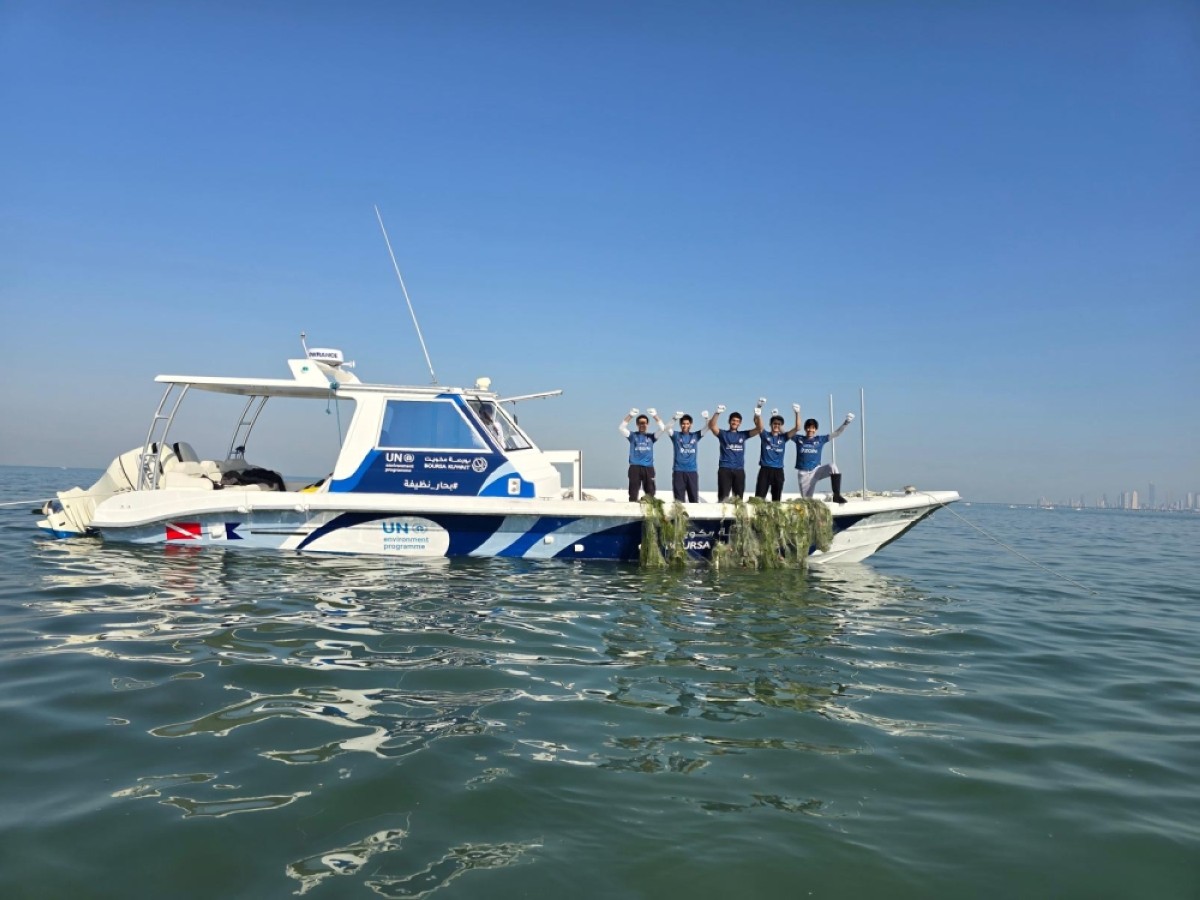
KUWAIT: The Kuwait Dive Team, affiliated with the Environmental Voluntary Foundation, announced the successful removal of abandoned fishing nets from Kuwait Bay and the implementation of a cleanup campaign on Umm Al-Naml Island, south of the bay, as part of its ongoing efforts to protect marine ecosystems.
Head of the team Walid Al-Fadhel told Kuwait News Agency (KUNA) on Wednesday that five fully equipped boats were allocated for cleaning operations in Kuwait Bay, with all the team’s logistical capabilities and advanced technical equipment mobilized to ensure the success of the field plan, clear the targeted sites of pollutants and safeguard the marine environment.
Al-Fadhel explained that operations in Kuwait Bay are particularly challenging due to strong water currents, shallow coastlines and continuous exposure to wind-driven currents, which are often accompanied by high waves. He said the campaign was carried out in coordination with the General Administration of Coast Guard, the Public Authority for Agricultural Affairs and Fish Resources and the Environment Public Authority.


Al-Fadhel noted that removing entangled fishing nets helps eliminate so-called “ghost fishing gear”, which poses a serious threat to marine life and obstructs maritime navigation. He added that the cleanup of Umm Al-Naml Island’s shores aimed to remove plastic waste and debris that negatively affect the island’s aesthetic appearance and environmental value.
He explained that Umm Al-Naml is the fourth-largest island in Kuwait after Boubyan, Failaka and Warba islands. The distance between the island and Ras Ashairij is approximately 650 meters, and a navigational light is located at its northeastern corner. The island is rich in crabs, shrimp and other marine species, and serves as a key stopover for large flocks of migratory birds traveling from North Asia to Africa.
Al-Fadhel stressed that the island’s location is a vital factor in the survival of these birds, as they rely on it during their long migratory journeys as a resting point and source of food. He added that the island’s shores and diverse habitats provide safe nesting areas for migratory birds along their route.
He expressed the Kuwaiti Dive Team’s appreciation for the government’s recently announced pioneering plan to preserve Kuwait Bay, affirming that efforts to halt pollution and address its causes are the cornerstone of restoring ecological balance. He emphasized that coordinated voluntary efforts alongside strict government oversight are essential to restoring Kuwait Bay to its former status as a clean and sustainable marine environment.
Al-Fadhel said the team’s field operations will continue, calling on the public to cooperate in protecting Kuwait’s marine environmental assets and ensuring that Kuwait Bay remains free of pollutants, safe, and sustainable. — KUNA
