

Interior ministry, prosecution launch awareness campaign for new anti-narcotics law
KUWAIT: The interior ministry and the public prosecution on Monday launched a national awareness campaign over the new tough anti-drug legislation which is due to be implemented on Dec 15. The two bodies issued statements explaining articles of the law and focusing on harsh penalties included in the law, in which the application of the death penalty has been expanded.
In statements posted on the interior ministry’s account on X, the ministry emphasized that the death penalty will be applied for the crime of trafficking in drugs and psychotropic substances in case the offender repeats the crime, the offender uses a minor or a mentally ill person in the crime and if the crime takes place in prisons, police stations or rehabilitation or addiction-treatment centers.
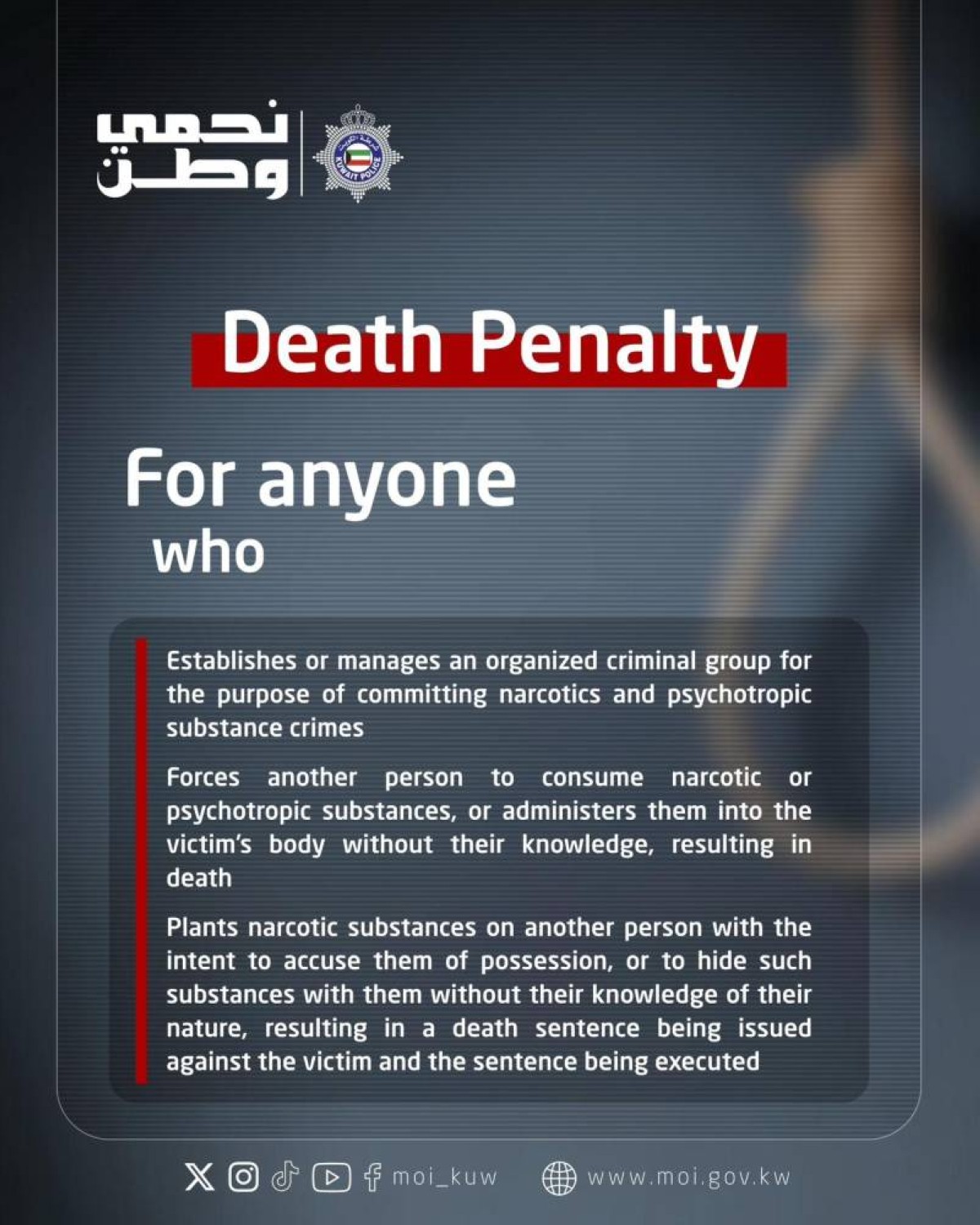
It also applies if the crime takes place in places of worship, educational institutions or sports clubs, and if the official exploits their position to facilitate the crime. The death penalty also applies to those who provide a minor with drugs and pills for personal consumption. The ministry added that the new law stipulates that the death penalty will be applied for offenders who establish or manage an organized criminal group with the purpose of committing crimes related to drugs and narcotic pills.
It said that the death penalty applies to those who force other people to consume drugs or pills or administer the drugs on their body without their
knowledge, resulting in their demise. The ministry said the campaign will continue until Dec 15 when the law takes effect, and then another campaign will be launched after implementation. The law includes 84 articles across 13 chapters that address punitive, preventive and therapeutic measures, alongside tighter controls on medical use and circulation of controlled substances.
Director General of the General Directorate for Drug Control Brig Gen Mohammed Qabazard said the legislation introduces stricter penalties — including the death penalty for the most severe drug crimes — in response to evolving trafficking networks and emerging drug types. He stressed full confidentiality for addiction-related reports, warning against unauthorized disclosure. Pharmacists are barred from dispensing controlled drugs without proper prescriptions, and only in quantities necessary for the patient, he warned.
Assistant Director General of the General Directorate for Drug Control Brig Gen Hamad Al-Sabah confirmed that several unlicensed farms were raided during 2025, resulting in the seizure of narcotic substances. He urged citizens to report suspicious activities via the department’s hotline 1884141, assuring that all reports are handled with strict confidentiality to protect informants’ identities.
Director General of the General Department of Public Relations and Security Media and official spokesperson of the ministry Brig Gen Nasser Bouslaib announced the national campaign titled “Safeguarding Our Homeland” to raise awareness about the dangers of drugs and the new law. The campaign begins with a two-week introduction phase before the law’s rollout, followed by year-round programs aimed at youth, parents and the broader community.
In its campaign, the public prosecution said it will explain to the public that the country will enter a new phase in the fight against narcotics, a phase characterized by deterrence and firmness. The prosecution said in a statement that the campaign will focus on enlightening the public that penalties against trafficking in drugs have been toughened in an unprecedented way to combat the menace. Directed by Attorney General Saad Al-Safaran, the campaign aims to explain the law’s provisions and its unprecedented penalties, stressing that enforcement will be strict and immediate once the law takes effect.
In its statement, the public prosecution said the campaign reflects a firm shift away from leniency, emphasizing that those who endanger society — particularly drug dealers and traffickers — will face severe consequences. The initiative targets two groups — drug users, who are encouraged to seek treatment to avoid prosecution, and traffickers, who are warned of harsh penalties, especially for exploiting minors.
