

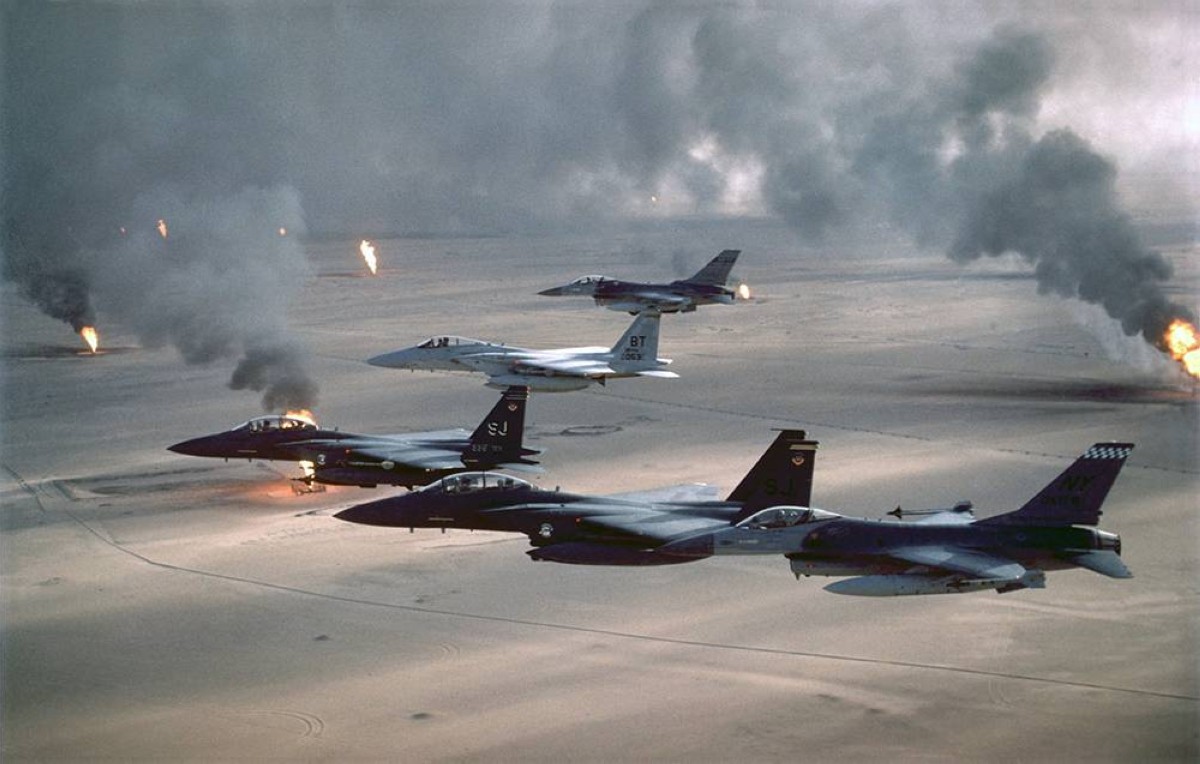
KUWAIT: An unforgettable chapter in Kuwait’s history and in the hearts of the Kuwaiti people is marked today (Saturday), as the first airstrike by the international coalition forces was launched on January 17, 1991, marking the start of the “Operation Desert Storm” to liberate Kuwait from the brutal Iraqi invasion.
The State of Kuwait marks this anniversary every year on January 17.The Iraqi invasion of Kuwaiti territory on August 2, 1990, represented a harsh and cruel challenge to the people of Kuwait and their steadfastness.
The invasion demonstrated, at the time, the long-standing and deep cohesion between the loyal people of Kuwait and their legitimate leadership.From the early hours of the Iraqi invasion, Kuwait and the UN called for an emergency meeting of the United Nations Security Council, which resulted in the issuance of Resolution No. 660.
The resolution condemned the Iraqi invasion of Kuwait and called on Iraq to withdraw all its forces from Kuwait without condition or restriction.On November 29, 1990, the UN Security Council issued another resolution, No. 678, which set January 15, 1991, as the final deadline for the withdrawal of Iraqi forces from Kuwaiti territory; otherwise, all measures to enforce Resolution No. 660 would be implemented.
On January 12, 1991, under UN Resolution No. 678, the US Congress authorized former president George HW Bush to use the US armed forces to expel Iraqi forces from Kuwait.President Bush decided to launch the operation at 11:00 am on January 15 after meeting with his senior national security advisors, stipulating that the decision would be implemented at a set time unless a last-minute diplomatic breakthrough occurred.
In mid-January 1991, then Saudi King Fahd bin Abdulaziz sent a message to the Iraqi president, calling for the immediate withdrawal of Iraqi forces from Kuwait and from the Saudi border, but received no response. At dawn on January 17, 1919, 16 hours and 55 minutes after the deadline set by the UN Security Council expired, the first airstrike of the Operation Desert Storm was launched, involving 1,800 aircraft from the international coalition, marking the start of the liberation campaign. US F-17 aircraft carried out airstrikes on several targets in Baghdad and destroyed communication centers, while British Tornado fighter jets ruined Iraq’s airports and French and Italian warplanes bombed Iraq’s missile sites.
Kuwait’s air forces played a key role in striking Iraqi targets inside Kuwait, as the operation paralyzed Iraq’s air defenses within two weeks, in addition to conducting electronic jamming of Iraqi radar, command, and control systems.
These fighter jets took off from an aircraft carrier in the Arabian Gulf, as well as from the Red Sea, the Turkish Incirlik Air Base, and airbases in Saudi Arabia and Bahrain.Some 400 fighter jets carried out 1,200 strikes, 302 of which by Kuwait and Saudi Arabia, on the first day of the operation which lasted over 240 minutes, resulting in the destruction of almost half of Iraqi jets.Over 750,000 soldiers participated in the coalition forces’ operations, including 500,000 Americans representing ground forces, marines, and air force, along 30,000 Britons, 13,000 French and some 200,000 troops of Arab units which joined the coalition.
Various types of warplanes took part in the operation, under the guidance of AWACS aircraft, while the US aircraft carriers fired 100 Tomahawk missiles on Iraqi targets in Iraq and Kuwait. Technology and war tactics dominated the conflict, as eight AH-64 Apache helicopters carried out a low-level raid to destroy radar systems using missiles and heavy artillery.
The Operation Desert Storm reshaped strategic and political thinking in the region, demonstrating that modern warfare largely depends on air force, which disproved the effectiveness of traditional fortification, trench, and fixed defensive line theories against advanced weapons technology.
On February 22, 1991, Iraq accepted a Soviet Union proposal for a ceasefire and withdrawal from Kuwaiti territory within three weeks under UN supervision. However, the proposal was rejected by the United States, which pledged to halt attacks on withdrawing Iraqi forces and granted a 24-hour grace period for a full and unconditional withdrawal from Kuwait without ground combat.
On February 24, coalition forces entered at dawn into Kuwaiti and Iraqi territories, and the ground forces were divided into three main groups: the first went to liberate Kuwait City, the second to surround the wing of the Iraqi Army west of Kuwait, while the third group was tasked with moving in the far west and entering South of Iraqi territory, to cut off all supplies to the army. On February 26, 1991, the Iraqi army withdrew from Kuwait, and president Bush announced on February 27 the liberation of Kuwait, 100 hours after the launch of the ground operations. — KUNA
