

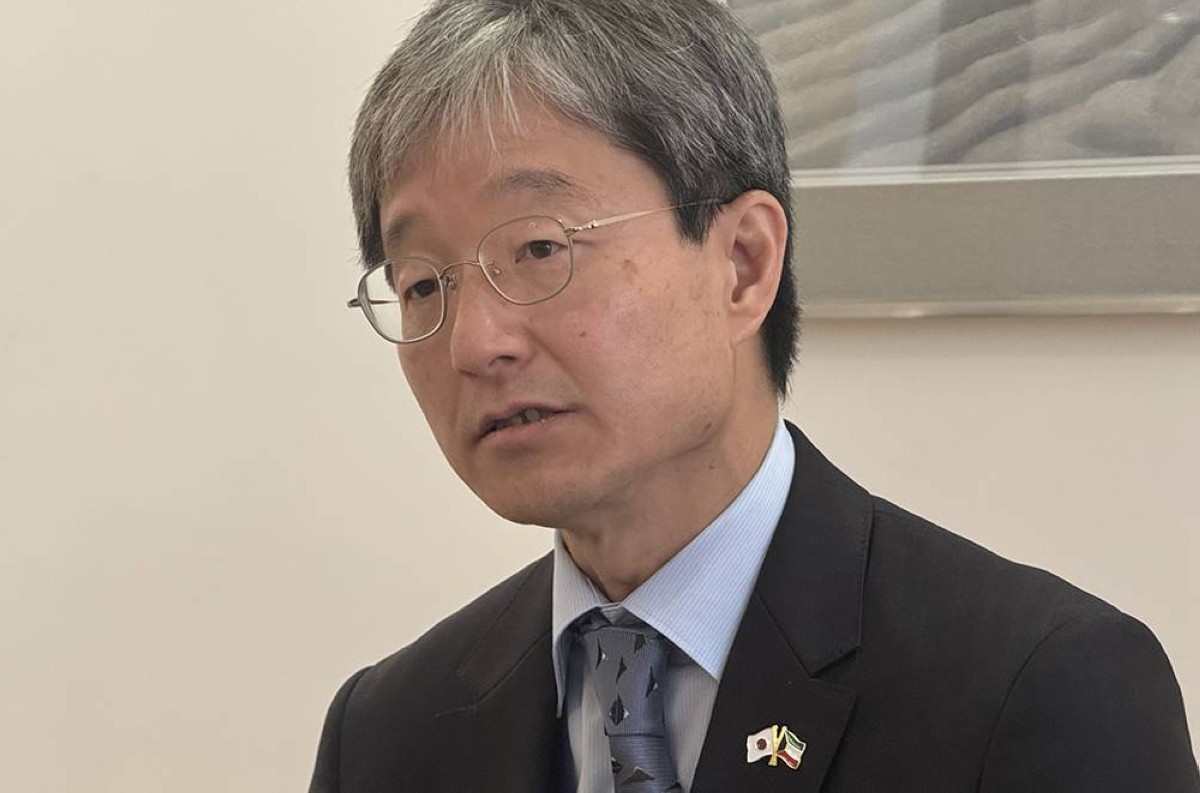
KUWAIT: Japanese Ambassador to Kuwait Kenichiro Mukai said that Japan and Kuwait achieved remarkable diplomatic, economic and cultural progress in 2025, culminating in the elevation of bilateral relations to a comprehensive strategic partnership and paving the way for expanded cooperation in 2026.
During a press conference, he highlighted His Highness the Crown Prince Sheikh Sabah Al-Khaled Al-Hamad Al-Sabah’s official visit to Japan in May 2025 as a major milestone. During the visit, His Highness met the Emperor of Japan and the Crown Prince, held talks with former Prime Minister Shigeru Ishiba and visited the Osaka Expo. “The visit resulted in the upgrading of our bilateral ties to a comprehensive strategic partnership and the signing of five agreements, including cooperation in water and electricity,” the ambassador said.
Ambassador Mukai said Japan and Kuwait are expected to deepen cooperation in power and water infrastructure, utilizing advanced Japanese technologies. “New collaboration is also emerging in clean energy and decarbonization,” he said, citing the ‘Road to Decarbonization’ workshop held in Kuwait on January 21, 2026, in cooperation with KISR and KFAS.
Ambassador Mukai noted that around 15 Japanese companies are currently active in trade with Kuwait, ranging from small enterprises to major corporations.
On those whose citizenship has been revoked, the Japanese ambassador said the embassy has received applications from individuals seeking to restore their Japanese nationality after their Kuwaiti citizenship was revoked. These applications are currently under review, and procedures are being carried out in accordance with the law. Regarding the mechanism for restoring Japanese nationality, the ambassador explained that Japanese laws allow individuals who relinquished their nationality to reclaim it within several years.
On tourism, the ambassador said that it is increasing, with approximately 8,300 Kuwaiti visitors to Japan in 2025, up from 7,000 in 2024. Ambassador Mukai said the Kuwait Pavilion at the Osaka Expo 2025 attracted wide attention among the Japanese public. “The pavilion, featuring desert sand exhibits and a planetarium, gained strong exposure on social media and significantly boosted interest in Kuwaiti culture at the grassroots level in Japan,” he said.
In the food sector, the ambassador added that cultural engagement continues to grow, with more than 150 Japanese restaurants now operating in Kuwait, reflecting rising public interest in Japanese cuisine and culture. He announced that exports of Japanese Wagyu beef to Kuwait have become possible for the first time, with the embassy planning promotional events. He also noted growing interest in matcha in Kuwait.
On education, discussions are ongoing with Kuwait’s Ministry of Higher Education to expand scholarships and increase the number of accredited Japanese universities from about 15 to 40-50 institutions. “Historically, 26 Kuwaiti students have studied in Japan, but currently only one or two are enrolled under Japanese government scholarships,” he said.
He emphasized that Japanese universities are highly ranked globally and increasingly offer English-taught programs, particularly in medicine, engineering, pharmaceuticals, AI and cybersecurity. At the same time, eight Japanese students are currently studying Arabic at Kuwait University under Kuwaiti scholarships.
Addressing regional issues, Ambassador Mukai reaffirmed Japan’s support for Palestine. “Japan has provided approximately $2.6 billion in humanitarian and reconstruction assistance to Palestine,” he said.
He added that former Foreign Minister Toshimitsu Motegi visited the Zionist entity and Palestine in early January, urging the protection of civilians, unimpeded humanitarian access to Gaza and an end to actions undermining a two-state solution.
“Japan remains committed to Palestinian state-building through initiatives such as CEAPAD and participation in Gaza reconstruction mechanisms,” the Japanese ambassador said.
