

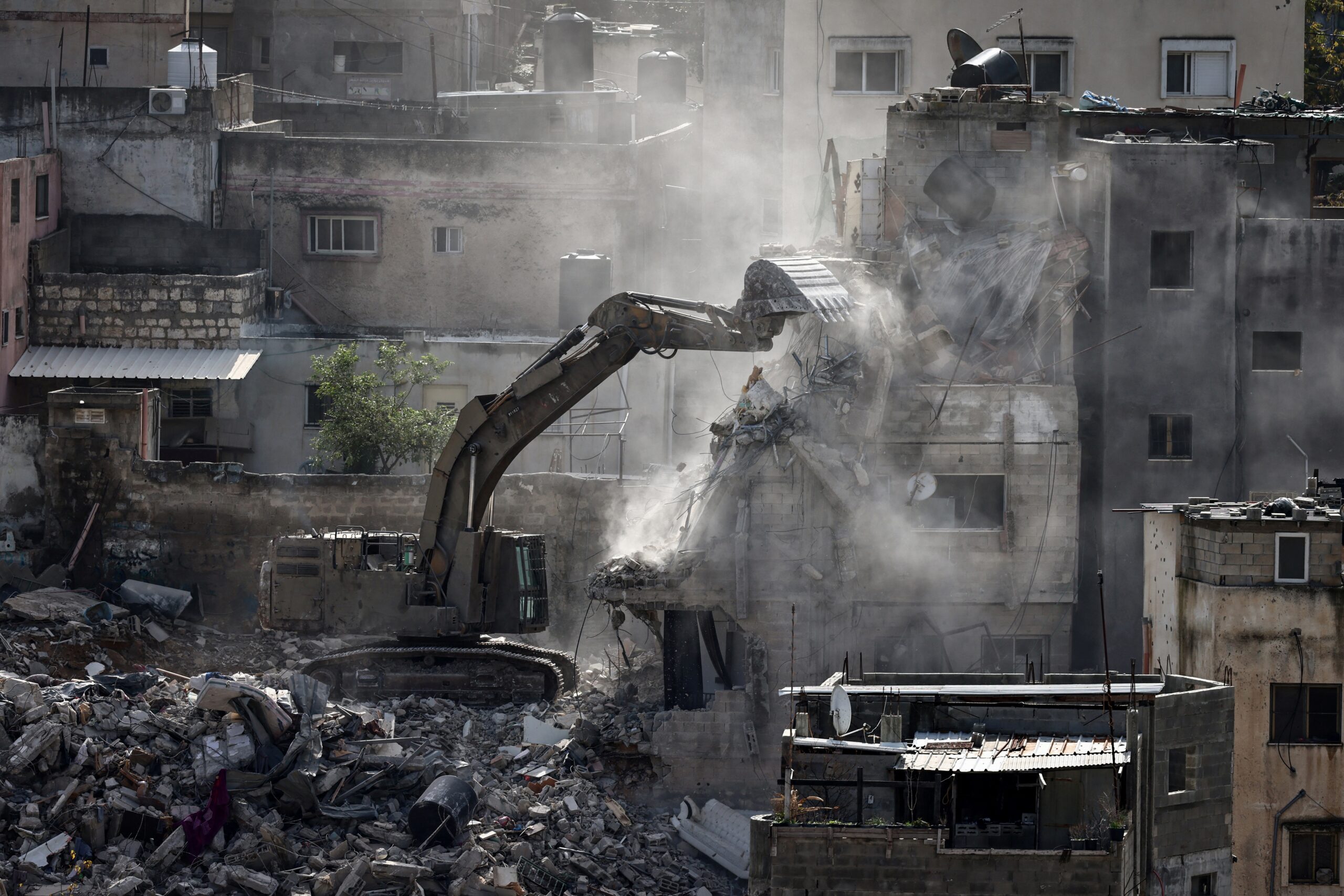
The Israeli military began large-scale demolitions of scores of houses in the occupied West Bank on Wednesday, displacing around 100 Palestinian families.
At least 25 buildings are being demolished in the Nur Shams refugee camp in Tulkarm, destroying about 100 flats and displacing 400 residents.
Israeli troops had already expelled families from the targeted buildings at the start of a major military assault on the northern West Bank earlier this year.
Yasser al-Sayes, one of those displaced, told Middle East Eye he remains without a home nearly a year later, watching Israeli bulldozers demolish his building remotely.
Sixteen people, most of them children, lived in the building, he said, and were forced out under military pressure at the beginning of the incursion.
New MEE newsletter: Jerusalem Dispatch
Sign up to get the latest insights and analysis on
Israel-Palestine, alongside Turkey Unpacked and other MEE newsletters
“We are still displaced,” said Sayes. “We move from one place to another, renting barely habitable rooms. Even after almost a year, we have no stability.”
He said residents were given just two weeks’ notice of the demolition and were briefly allowed back to collect belongings, managing to salvage only a few clothes.
‘There is no serious push for residents to return. We are living without any prospect or hope’
– Ibrahim al-Nimr, Nur Shams camp emergency committee
“Our things are now lying in the street because there is nowhere to put them,” he said. “We are all unemployed. It’s a nightmare. We woke up to a nightmare today.”
The demolitions came after Israel’s Supreme Court on 24 December rejected an appeal by Palestinians from the camp and surrounding areas against military orders to destroy the residential buildings.
Adalah, the legal centre that filed the petition, said the court based its decision on classified material submitted by the Israeli Public Prosecution in coordination with military intelligence.
The information was not disclosed to the petitioners or their lawyers but was deemed sufficient by the court to justify the demolitions.
No hope
The Israeli military launched a wide-scale assault in the northern West Bank in January, invading parts of Jenin, Tulkarm and Tubas.
During the operation, Israeli forces displaced about 40,000 people from their homes – the largest wave of Palestinian displacement in the West Bank since the 1967 war.
Israeli troops have since entrenched themselves in Palestinian residential areas, carrying out regular demolitions, tearing up infrastructure and constructing new military roads. Israeli officials say the army will stay for the foreseeable future.
In recent months, forcibly displaced residents have staged repeated protests demanding an end to the demolitions and a return to their homes, but Israel has so far refused.

Amid Gaza’s nightmare, a quiet genocide has been unfolding in the West Bank
Read More »
The Tulkarm Governorate said on Wednesday that the latest mass demolitions marked a “dangerous escalation” targeting refugee camps in the area, which it described as living symbols of the Nakba.
It said the policy amounted to collective punishment and violated international law and human rights conventions.
Governor Abdullah Kmail said the demolitions formed part of a systematic campaign that has emptied the Tulkarm and Nur Shams refugee camps, reducing large sections to rubble and worsening an already severe humanitarian crisis.
Ibrahim al-Nimr, a member of the Nur Shams camp emergency committee, told MEE that nearly 60 percent of the camp’s homes – about 400 residential units – have been burned or fully or partially destroyed, leaving all 11,300 residents displaced and without permanent housing.
“Even homes on the outskirts of the camp have been demolished, despite being more than 50 metres from the army’s route,” he said, adding that nearby houses have been used as military barracks for the past 11 months.
Displaced families are living in harsh conditions, particularly during winter, without stable housing, work or the means to pay rent.
“There is a clear lack of support from Unrwa, the Palestinian Authority and the Department of Refugee Affairs,” al-Nimr said.
“People have been given crumbs. There is no serious push for residents to return.
“Even if the army withdraws, no one can rebuild. We are living without any prospect or hope.”
