

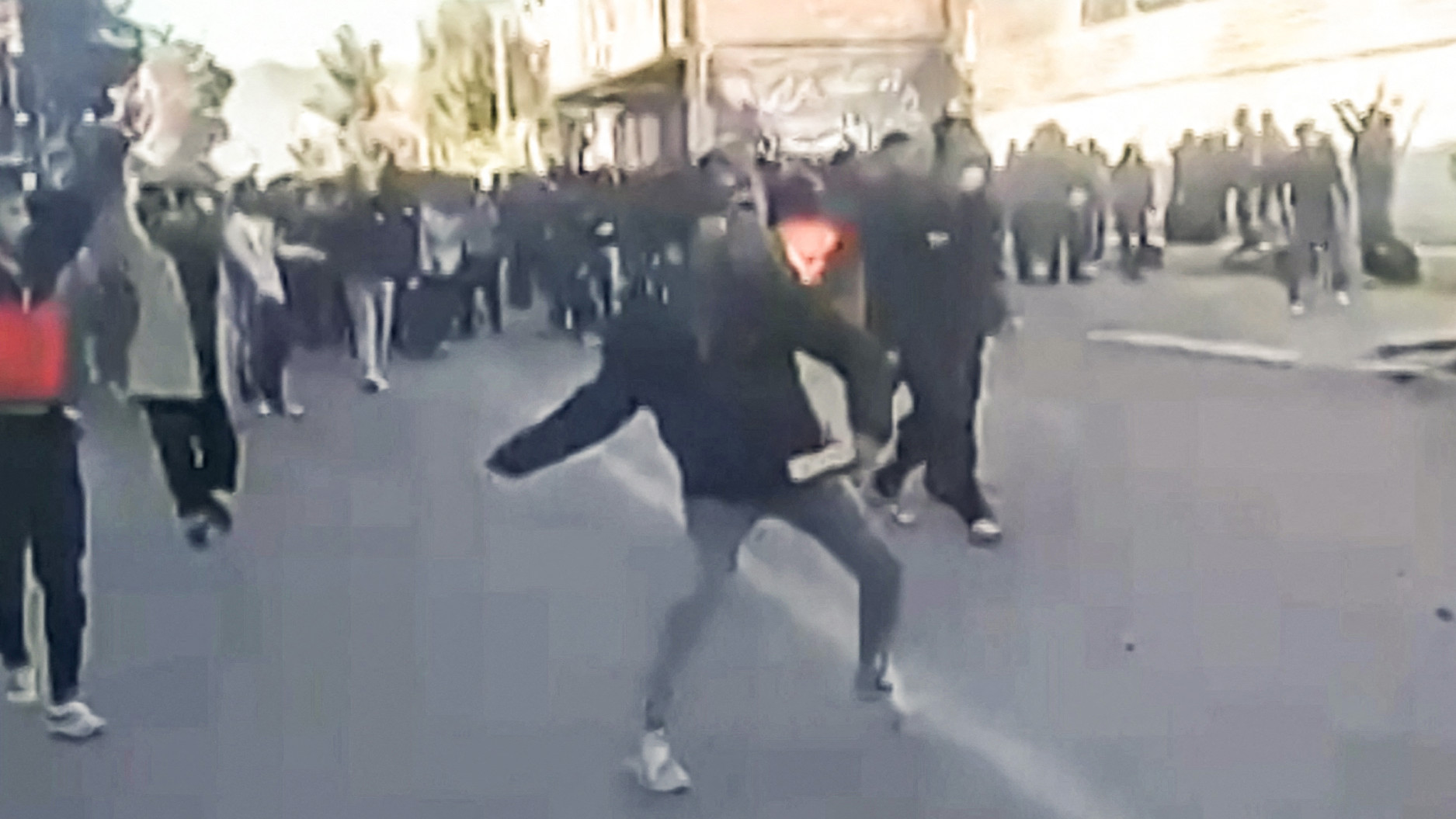
What began as a strike by merchants in Tehran has quickly escalated into nationwide protests and deadly clashes with security forces across Iran.
Since Sunday, demonstrators have taken to the streets in more than 30 cities, turning an economic protest into broader political unrest.
At least seven protesters have been killed and dozens more injured as demonstrations continue.
The strikes started in Tehran’s Grand Bazaar, a historic hub where merchants have long supported the country’s religious institutions and ruling authorities.
Their standoff with the government created space for other Iranians to join the streets and voice opposition to their rulers.
New MEE newsletter: Jerusalem Dispatch
Sign up to get the latest insights and analysis on
Israel-Palestine, alongside Turkey Unpacked and other MEE newsletters
Middle East Eye examines how the protests began, how they spread, and the authorities’ response.
Where did the protests begin and why?
Small protests began on Sunday in central Tehran, near the Alaedin mobile phone market and Sabzeh Meidan, the hub of Iran’s open currency market.
Shopkeepers in the Grand Bazaar, known locally as bazari, soon closed their stores in solidarity.
The demonstrations were sparked by sharp swings and instability in the exchange rate.

Plunge in Iran’s currency sparks strikes and protests: Press review
Read More »
The Iranian rial has been falling steadily against the US dollar for months, driving up inflation and prices.
By Sunday, one dollar was trading at around 1.45 million rials on the open market, compared with about 55,000 rials in 2018, when US sanctions were reimposed.
As shops closed, electronic exchange boards that usually display currency rates went blank. Traders in Tehran told customers: “We don’t trade.”
The dollar rate is a key indicator of Iran’s economic health, where the collapse of the rial has become part of daily life. Analysts point to US sanctions on Iran’s oil, gas and petrochemical exports, international banking restrictions and widespread corruption as the main drivers of the crisis.
The rial’s fall accelerated after Israel attacked Iran in June 2025, followed by US strikes on nuclear sites. By the end of the 12-day war, one dollar was trading at around 850,000 rials in the open market.
What other economic factors fuelled the strike?
The bazaar strike and the protests were driven by more than just the rial’s collapse. Two additional factors played a key role: rising petrol prices and the release of the next fiscal year’s budget.
Iran has some of the cheapest petrol in the world. The government provides 60L a month for 15,000 rials and 100L for 30,000 rials – prices set in November 2019 after mass protests over a fuel hike that left more than 321 demonstrators killed by security forces.
To avoid unrest, authorities had kept prices frozen despite mounting economic pressure.
In December, however, a third price tier was introduced for heavy users exceeding 160L a month, who must now pay 50,000 rials per litre.
The government also unveiled its new budget, which proposed higher taxes on business owners, merchants and large firms, while projecting lower revenue from oil and gas sales under sanctions.
This raised concerns that the state would struggle to supply sufficient foreign currency for trade.
Together, these pressures sparked the Sunday bazaar strike and the protests that followed.
What powers do the Tehran bazaar strikers have?
Strikes in Tehran’s Grand Bazaar are far from unusual.
The bazari – one of Iran’s most influential traditional economic groups – have long used shop closures to press their demands, often forcing the government to negotiate.
Their real power goes beyond daily retail in the narrow, roofed alleys. Many behind-the-scenes deals handled in offices across the bazaar are worth millions of dollars.


The tradition of shutting down the bazaar dates back to the early 20th century. During the Constitutional Revolution (1905-11), strikes in Tehran and Tabriz became a key source of support for revolutionary forces, often aligned with religious leaders.
In June 1963, bazaar merchants joined protests against the shah’s dictatorship.
Their alliance with religious authorities grew stronger during the 1979 Islamic revolution, eventually earning them significant political influence in post-revolution Iran.
What was the government’s response?
Aware of the economic and political weight of Tehran’s bazaar, the government moved quickly, holding meetings with leading merchants and business figures.
The government offered tax breaks, a pause on tax fines and access to subsidised foreign currency for imports to calm traders.
On Tuesday, Mohammad Reza Farzin resigned as governor of the Central Bank of Iran. He took office in December 2022 after Ali Salehabadi stepped down following a sharp decline in the rial.
At the time, the dollar traded at 435,000 rials. The new governor, Abdolnaser Hemmati, promised to stabilise the foreign currency market.
To prevent the strike from spreading, the government also shut down state offices and commercial centres in Tehran, citing cold weather.
Universities in Tehran and other cities moved classes online. The measure aimed to stop protests from spreading to campuses, which have long been a key force in anti-government movements.
How did the protests spread?
Despite government measures, protests quickly spread beyond Tehran.
The unrest recalls the 2022 anti-government demonstrations sparked by the death of Mahsa Amini in police custody over her headscarf.
In previous mass protests, Tehran was often the main centre and frequently faced brutal suppression, as in 1999, 2009 and 2017.
This time, however, demonstrations have been concentrated in smaller cities outside the capital.

Iranian protests are not for ‘regime change’ but for relief from US economic war
Read More »
Western and southwestern regions – home to Kurdish, Luri, Arab, and Turk minorities – saw the earliest protests, with Hamadan among the first to report clashes on Tuesday.
On Wednesday, protesters in Kuhdasht stormed the governor’s office. At least one person was killed.
State media first identified the dead man, Amirhesam Khodayarifard, as a member of the Basij paramilitary, a volunteer-led force within the Islamic Revolutionary Guard Corps (IRGC).
His father rejected that claim at the funeral, saying he was a member of the protesters.
In Tehran and other major cities, riot police remained heavily deployed and Basij checkpoints returned to the streets. On Thursday, however, the fiercest clashes occurred in the city of Azna. At least three people were killed, and 17 were injured.
On Friday, protests also erupted in the southeastern city of Zahedan after Friday prayers. Supporters of Molavi Abdolhamid, a prominent Sunni anti-government cleric, took part in the demonstrations. During the 2022 movement, Zahedan and the Baluch minority were at the centre of the protests.
What happens next?
Past experience suggests authorities will not hesitate to use force against protesters. Yet demonstrations have continued despite a rising death toll.
The situation was further complicated by comments from US President Donald Trump on Friday, who said Washington would intervene if civilians were harmed.
“If Iran shoots and violently kills peaceful protesters, which is their custom, the United States of America will come to their rescue. We are locked and loaded and ready to go,” he said.
Pro-government officials and media quickly responded, accusing protesters of acting as US pawns – a statement some fear could be used to justify a harsher crackdown.
The pro-IRGC website Tabnak echoed this view, writing: “Trump and Netanyahu’s statements reflect their focus on regime change through domestic unrest.”
Despite these tensions, protests continue across multiple cities, with demonstrators showing persistent defiance amid a heavy security presence.
