

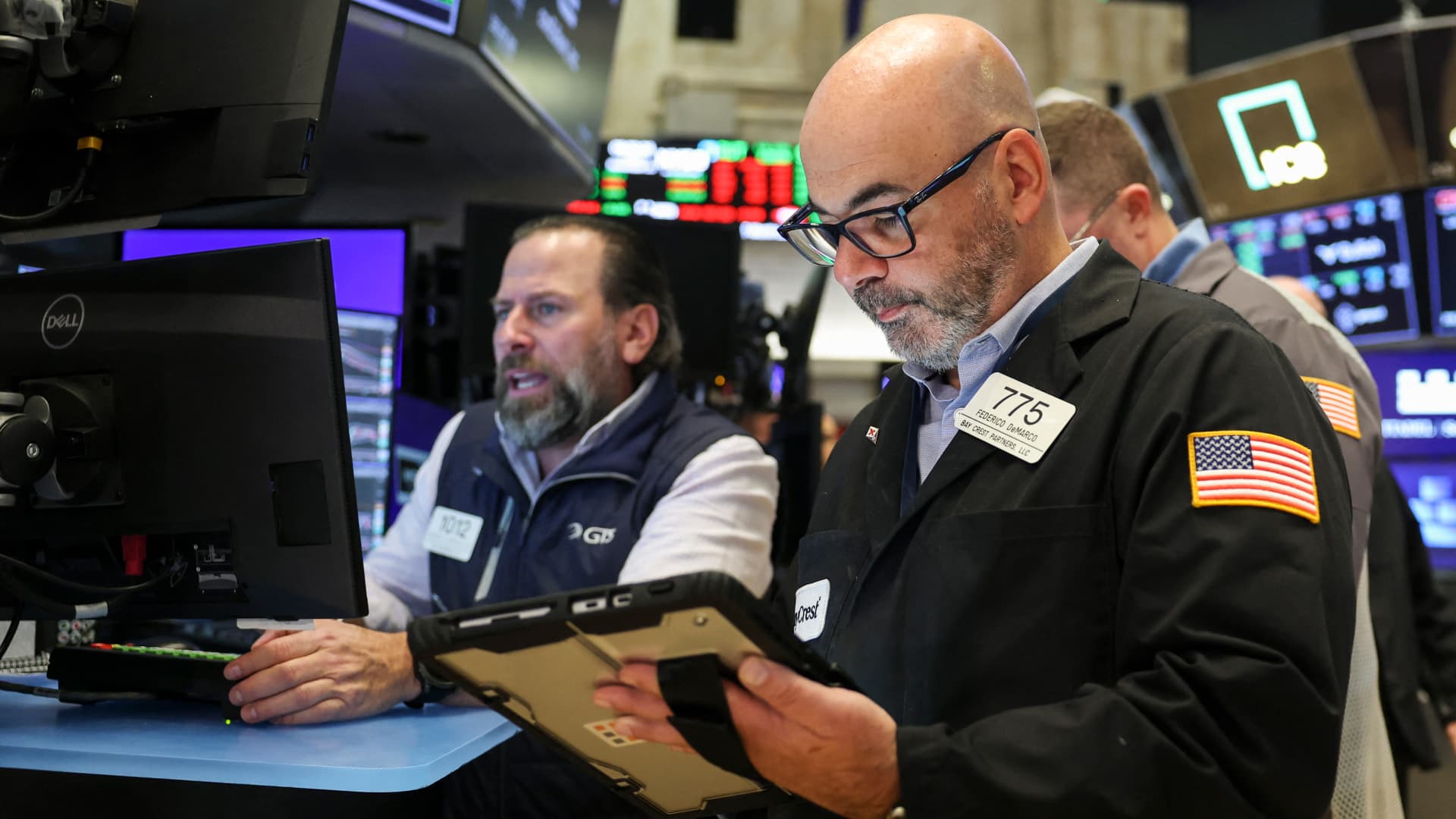
A Trader works on the floor of the New York Stock Exchange (NYSE) in New York on November 21, 2025.
Angela Weiss | Afp | Getty Images
U.S. Treasury yields ticked lower on Wednesday on the latest signs of a weaker jobs market as shown in private payroll data, reinforcing a conviction that the Federal Reserve will lower interest rates another quarter percentage point at its final meeting of the year next week.
The benchmark 10-year Treasury yield fell more than 2 basis points to 4.059%, while the 30-year Treasury yield fell less than 2 basis points to 4.727%. The 2-year Treasury yield, the security most sensitive to moves in short-term policy, fell 3 basis points to 3.486%.
One basis point is equal to 0.01% and yields and prices move in opposite directions.
A report Wednesday from payrolls servicer Automatic Data Processing showed that private payrolls dropped by 32,000 jobs in November. Economists polled by Dow Jones were expecting growth of 40,000 in the month.
November’s contraction also reversed an increase of 47,000 seen in October.
“The negative print on ADP jobs in November has put some pep in the bond market’s step,” said Christopher Rupkey, chief economist at FWDBONDS. Yields are lower “on anticipation of a third interest rate cut by Fed officials at next week’s meeting.” The Fed previously cut rates a quarter point in September and again in October. There was no meeting in November.
The ADP payroll report strengthened what was already a widespread conviction that the central bank will continue to ease monetary policy next week in an attempt to get in front of any looming labor market slowdown. Interest rate futures trading shows an 89% likelihood that the benchmark overnight fed funds rate will drop next week to 3.50% to 3.75%, according to the CME’s FedWatch tool. One month ago, market odds were at nearly 67%.
“It’s been an amazing shift from a 30% chance of a December rate cut to [approximately] 95%, all in the span of 2 weeks and this morning’s ADP data confirm what a lot of the doves are saying – it’s more important to focus on a weakening labor market than to worry about inflation in the 2-3% range,” said Chris Zaccarelli, chief investment officer at Northlight Asset Management, adding that “it is a sure thing” a quarter percentage point cut will be announced on on Dec. 10.
Beyond that is when the rate outlook gets a bit muddled, however, according to Zaccarelli.
“Our expectation is that the doves will win out and we will see a number of rate cuts next year, but we think they may be more spaced out (e.g. rates held constant at a number of meetings) and potentially less cuts will be made than are currently being forecast, which is why we are bullish into the new year, but more cautious once we arrive in 2026,” he said.
Following the ADP report, the ISM Services PMI for November provided some hope to investors that the U.S. economy was staying afloat, as it rose slightly to 52.6%. That’s just above the 52.5% Dow Jones estimate.
Other economic reports due to be released this week include the weekly initial jobless claims on Thursday and the delayed personal consumption expenditures index for September on Friday.
