

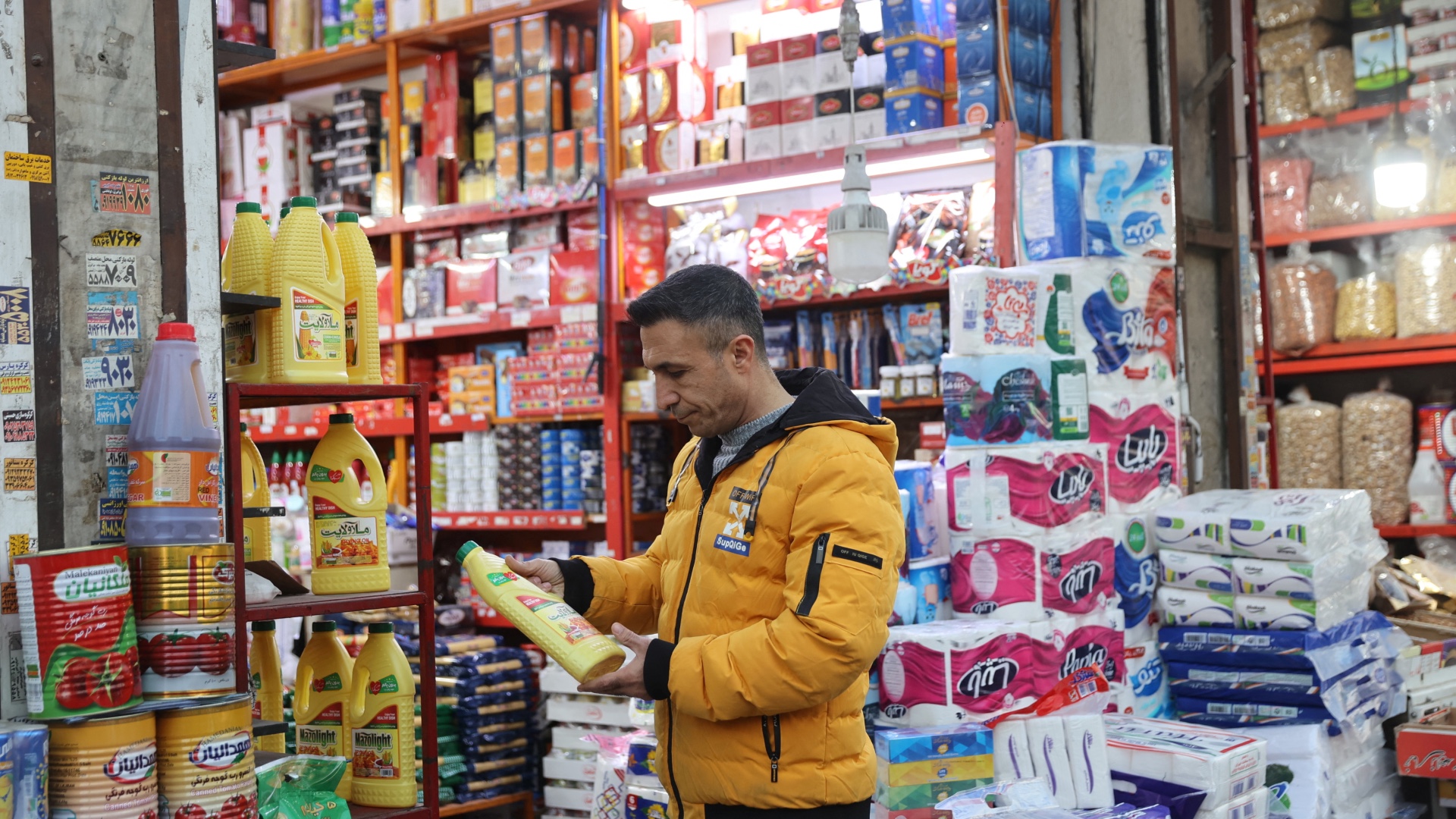
US Treasury Secretary Scott Bessent made the Trump administration’s sanctions policy clear in March 2025, when he spoke to the New York Economic Club and said the goal is “Making Iran Broke Again”.
“Watch this space,” he added. “If economic security is national security, the regime in Tehran will have neither.”
That blunt assessment goes beyond most of the stated goals of US President Donald Trump himself, both throughout his first presidency up until recent days, as well as those of his successor and predecessor, Democrat Joe Biden.
“The objective was to put significant pressure on the regime so it made nuclear concessions,” Richard Nephew, who was the principal deputy coordinator for sanctions policy at the US State Department between 2013-2015, and later became the deputy special envoy for Iran, told Middle East Eye.
“You can make the argument they also wanted to get regional proxy concessions. They also wanted to get missile concessions,” he said.
New MEE newsletter: Jerusalem Dispatch
Sign up to get the latest insights and analysis on
Israel-Palestine, alongside Turkey Unpacked and other MEE newsletters
“[The idea that if] Iran is broke, Iran will not be able to pursue the nuclear programme… that’s I think empirically false. At this point, they made the monetary investment in a lot of things, and Iran could have nuclear weapons without substantially more financial investment.”
US sanctions on Iran date back nearly five decades.
The first spate of trade and military sanctions followed the 1979 revolution, which toppled the US-backed shah. That Iranian government still stands today, though it may be at its weakest since.
It was in 2005 that the US began designating Iranian individuals, companies, and organisations for involvement in nuclear proliferation, ballistic missile development, support for terrorist groups, and human rights abuses, according to The US Institute for Peace, now known as The Donald J Trump Institute for Peace.
Trump’s “maximum pressure” campaign that began in 2018 – following his unilateral withdrawal from the joint comprehensive plan of action (JCPOA), otherwise known as the Iran nuclear deal – led to a significant shrinking of Iran’s economy by some six percent in 2018 and nearly seven percent in 2019, the International Monetary Fund’s figures indicated.
‘Unemployment has gone up. Inflation has gone up. The price of medical treatment, especially for cancer, has gone up’
– Sina Azodi, George Washington University
The longer the list of US designations, the more Iran’s GDP contracted, a 2020 analysis by the Center for a New American Security (CNAS) showed.
On a per capita basis, between 2012 and 2024, Iran’s GDP dropped a staggering amount, from $8,000 to $5,000, according to the World Bank’s data.
In 2025, as the Trump administration named Iran the “chief destabilising force” in the world per its National Security Strategy, the US designation list targeting sanctions evasion networks surpassed that of any year from 2017 to 2024. That includes 2018, when the first Trump administration reimposed sanctions previously lifted under the JCPOA, data released by CNAS on Thursday showed.
On Friday, the Treasury announced sanctions on six more Iranians, chief among them Minister of the Interior Eskandar Momeni Kalagari, “who oversees the murderous Law Enforcement Forces of the Islamic Republic of Iran (LEF), a key entity responsible for the deaths of thousands of peaceful protestors,” the statement read.
Middle East Eye has not been able to verify the exact number of protesters killed since mass protests erupted in late December.
Protests were spurred on by a local bank collapse late last year. And this week, Iran’s currency, the rial, hit a new low of 1.5 million to a single US dollar.
“Because the government is the main supplier or the main entity that has access to currency, [and] that currency pays for teachers, salaries of government workers, import of wheat, rice, everything is affected by how much the government has the currency [and access to] the US dollar,” Sina Azodi, assistant professor of Middle East studies at The George Washington University, told MEE.
“When you don’t have that, it injects uncertainty and instability into the Iranian economy,” he added.
“Unemployment has gone up. Inflation has gone up. The price of medical treatment, especially for cancer, has gone up.”
The impact of US sanctions, Azodi said, has been “devastating”.
‘Applying pain’
It’s no secret that sanctions are designed to have that effect.
“Sanctions are always a question of applying pain, right? I don’t flinch from that. Other people who sometimes advocate or work on sanctions policies get really nervous, and they don’t want to say that,” Nephew said.
‘Sanctions are always a question of applying pain, right? I don’t flinch from that’
– Richard Nephew, former coordinator for Sanctions Policy at US State Department
“You’ve got to come back to the question of justification, of proportionality, of those kinds of tests that have been applied to other forms of coercion,” he added.
Nephew cited North Korea, where “it doesn’t make a damn bit of sense” to apply pressure on the population, he said, since they have no pushback power, and cannot resist or influence policy.
Iran, on the other hand, which has posited itself as “speaking up for the poor and the disenfranchised and the discontented”, makes it so “there is a logic to basically confronting that government with choices”, Nephew explained.
“You need to have a very clear understanding of what your objectives are, and they need to be… proportional in terms of what is a reasonable set of harms that you’re trying to mitigate,” he added.
“Nuclear weapons pointed at my kids? That’s a pretty big harm.”
The Iranians maintain that their nuclear programme is for civilian purposes, but officials have also in the past framed the development of nuclear capabilities as a deterrent against Israeli attacks, which have in the past targeted nuclear facilities, scientists, and members of the Islamic Revolutionary Guard Corps (IRGC).
Israel’s policy is not to confirm or deny that it has nuclear weapons, but declassified documents and whistleblower revelations from the 1980s have indicated that it does.
Vicious cycle
Israel has carried out assassinations of top Iranian nuclear scientists, as well as helped plan the US attack on IRGC Commander Qassem Soleimani in January 2020.
Over the past two years, it has also assassinated the leadership of anti-Israel groups funded by Iran in the region, including Hezbollah in Lebanon and the Houthis in Yemen.
In June, a 12-day war began with Israeli strikes on Iran that killed 400 Iranians. This constant scenario of being under political and military siege pushes Iran into cycles that dig its economic hole deeper.
“Imagine that there was no geopolitical tension, and there was no budget cost on the military and on missiles – on proxies – then we could have had a better economy,” Mahdi Ghodsi, senior economist at the Vienna Institute for International Economic Studies, told MEE.

The foreign intervention Iranians want is the lifting of sanctions, experts say
Read More »
“In the first term of Donald Trump’s presidency, if [Iran’s leaders] were not as stubborn, and if they were negotiating on other issues, like regional issues, ballistic missile issues, and also Israel, then we wouldn’t be here,” he said.
“They didn’t do that. So that’s a pure blame on the government, and [Supreme Leader Ayatollah] Khamenei himself.”
Iran’s estimated 2024 defence budget is just shy of $8bn, figures from The Stockholm International Peace Research Institute (Sipri) showed. That is, however, a 10 percent drop from the previous year, given Tehran’s economic woes stemming from the drop in oil revenues, thanks to US sanctions, and high inflation, Sipri said.
“Government employees and the public economy is about 85 percent of GDP. So they need to have a huge budget, and because they cannot sustain it, they print money,” Ghodsi said.
Iran’s sometimes intentional devaluation of the currency to increase oil revenue, given its economic restraints at home, gives rise to hoarding foreign currencies, but they have become much more expensive to obtain for the average Iranian.
Iran’s oil exports saw a drop of well over 60 percent after US sanctions were reimposed in 2018, leading to tens of billions of dollars in annual revenue lost.
“People try to save their money in foreign currencies, so they buy more foreign currencies, and it depreciates [further] because Iran cannot sustain its budget, meaning that they cannot finance it, because they are selling oil in discounts [and] they cannot sell oil as much as they want, so they need to borrow from The Central Bank. And the Central Bank simply prints money, and it increases inflation further,” Ghosdi explained.
That vicious cycle is why he told MEE that he estimates that while the negative impact of US sanctions has been “enormous”, it may just be half the reason Iran’s economy has collapsed.
Resistance economy
While the human cost has been dire, Iran has tried to build up a sustainability infrastructure over the past 15 years that has helped it weather heavy US and European sanctions.
“I think the Islamic Republic knew, since it was established, that they were going to be enemies with the West, and it’s like a fundamental ideology that’s built within [the state],” Shirin Hakim, a senior fellow at The Center for Middle East and Global Order in Berlin, told MEE.
“It weaves in perfectly with their foreign policy. The Iranian foreign policies, like sanctions, kind of fortified the resistance economy model.”
‘Economic sanctions make authoritarian regimes more authoritarian’
– Sina Azodi, George Washington University
That resistance economy included a socialist government approach to basic needs such as water and housing; incentives for the local production of otherwise imported goods; and a barter-trade policy with friendly nations.
But Iran only grew more economically isolated after the JCPOA fell apart, and the West pressured its partners in the Global South to scale back trade dealings.
With a largely informal economy, families rely on Iranians abroad to bring them suitcases full of medicines that aren’t produced in Iran. There is also an internal banking system with debit cards “that look like toy cards… they’re not as sophisticated”, Hakim explained.
Still, “it’s interesting to see how independent [Iranians are] and how they’ve modernised,” Hakim said, referring to the creativity of manufacturers and merchants, and the expansion of some social freedoms relating to the use of public spaces, and access to platforms like WhatsApp.
Commercial aviation is especially impacted, after the International Court of Justice in 2018 ordered the US to ensure Iranian passenger aircraft can acquire parts for repairs, as a matter of safety.
“The US simply just ignored the order,” Azodi told MEE. “And so many of Iran’s airplanes, even the new ones that Iranians got, are now grounded because Iran cannot get spare parts for them.”

How Trump’s demands on Iran have shifted over time
Read More »
“Iran has been under sanctions for 20 years, and it hasn’t changed its behaviour. Its nuclear policy has not changed. Its activities in the region have not changed. Its human rights record has actually gotten even worse,” he added.
So what have decades-long US sanctions actually produced?
“Economic sanctions make authoritarian regimes more authoritarian,” Azodi responded.
“Authoritarian regimes – once under sanctions – give more financial resources to security forces, which makes perfect sense, because the government will start treating the citizens as a threat, not an asset.”
MEE previously reported that the foreign intervention most Iranians want is the lifting of sanctions, with Iranian political analysts in the diaspora urging room for organic, homegrown political change.
“Well, it’s not plausible right now,” Nephew told MEE.
“If you were to do a bunch of sanctions relief right now, where’s the money gonna go? It’s not going to go in the hands of reformers… That is thoroughly implausible,” he added.
But the combination of sanctions and, now, potential military force, still may not achieve its desired objective outside of making ordinary people’s lives harder.
“I don’t think it’s a good idea for the US to use force to try and collapse the regime in Iran. There’s a chance that works – I think that’s one in a million – and that the risk of all the bad downsides and consequences and things [only] going much worse.”
