

A year has passed since the fall of Syrian leader Bashar al-Assad. Many of the foreign players in Syria were attending the Doha Forum as Aleppo, Homs, Hama, and Damascus fell like a house of cards to advancing rebel forces.
I was watching Sergey Lavrov, the Russian foreign minister, as he took in the news from a television screen. Even the poker face of the world’s longest-serving foreign secretary could not hide what he was thinking. His face fell like a stone.
On stage as a “newsmaker”, Lavrov became irritably averse to being questioned about the news and demanded he talk about Ukraine instead.
No sooner had Abu Mohammad al-Jolani taken off his fatigues and become Ahmed al-Sharaa than the interim Syrian president was preaching peace.
Conscious of the fact that he had modelled his nom de guerre on his father’s history of being a refugee from the Israeli-occupied Golan Heights – and of the fact that as a fighter, he once said: “We will not only reach Damascus; Jerusalem is waiting for us” – Sharaa went out of his way to signal that his administration would pose no threat to Israel.
New MEE newsletter: Jerusalem Dispatch
Sign up to get the latest insights and analysis on
Israel-Palestine, alongside Turkey Unpacked and other MEE newsletters
The new governor of Damascus, Maher Marwan, went further in an interview with the American public broadcaster NPR.
“We have no fear towards Israel, and our problem is not with Israel,” he said. “And we don’t want to meddle in anything that will threaten Israel’s security or any other country’s security … We want peace, and we cannot be an opponent to Israel or an opponent to anyone.”
These statements were made at the height of the genocide in Gaza, and they dismayed Palestinians, who expected Syria to support them.
But the new regime reflected the genuine exhaustion of a people who had been through the bloodiest civil war in the region for the last 14 years.
Shifting mood
One year on, the mood of the Syrian people has changed dramatically.
At a recent military parade attended by Sharaa, troops chanted: “Gaza, Gaza, Gaza, our slogan, night and day, bombing and ruin. We are coming for you, our enemy, coming, coming for you, even if you were a mountain of fire, I will make from my blood ammunition, and from your blood rivers.”
Soon afterwards, an Israeli government minister hinted at a potential war with Syria.
Days earlier, a pre-dawn raid on a village south of Damascus had nearly turned into a military disaster. In late November, Israeli helicopters and artillery struck Beit Jinn, 50km southwest of Damascus, as soldiers stormed homes and seized three villagers, according to local media.
A firefight then developed, as the whole village joined the effort to repel the Israeli invaders. Fighter jets were deployed as the Israelis became surrounded. By the time they retreated, 13 Syrians had been killed and 25 others injured, while six Israeli soldiers were wounded, three seriously.
What happened in a year to change the mood in Syria?
Israel had a choice when Sharaa came to power: it could have embraced regime change and made a new ally in Syria, particularly had it offered to help Sharaa in Washington.
Israeli Prime Minister Benjamin Netanyahu had previously eased Mohammed bin Salman’s path to the White House, enabling him to seize the mantle of Saudi crown prince from his more experienced cousin. The same strategy could have been followed with Sharaa in Syria.
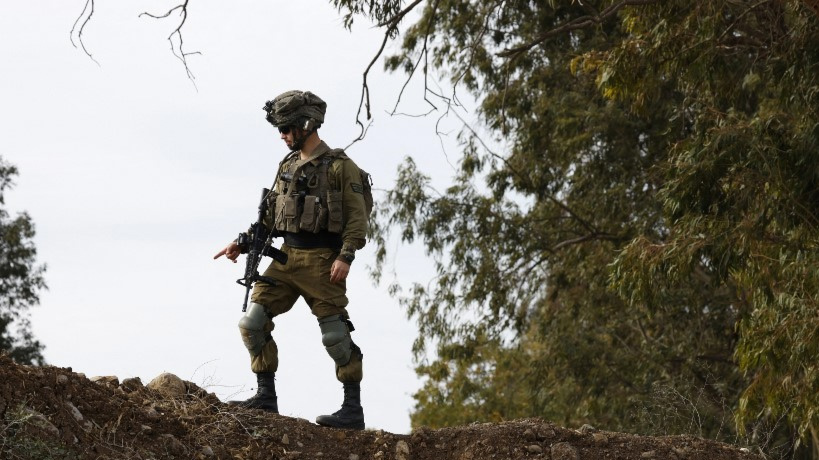
Instead, Israel launched a massive bombardment, which in a matter of days decimated Syria’s air force, sunk its fleet, and levelled its air-defence radars. Soon afterwards, Israeli forces began a ground incursion into southern Syria; its first objective was to seize Mount Hermon, but it later expanded to seizing control of an area larger than Gaza.
Weakening Syria
Israeli Defence Minister Israel Katz has defended the invasion as “necessary to protect the Golan and Galilee communities from threats”, citing the Hamas attack of 7 October 2023 as the primary driver. But such rationales are just for public consumption: Israel has long harboured plans to permanently weaken Syria by dividing it into cantons, turning the country into a version of Libya.
As I reported at the time of Assad’s fall last December, the speed with which his regime collapsed took friends and foes alike by surprise.
It thwarted Tel Aviv’s plans to establish military and strategic ties with the Kurds in the north and the Druze in the south, leaving Assad permanently weakened and under Emirati control.
This would have served four purposes: to cut the supply lines of Iranian weapons to Hezbollah, to weaken Syria permanently, to shut Turkey out of northern Syria, and to establish an air corridor over southern Syria and northern Iraq, through which Israel could regularly bomb Iran.
Turkey’s bark on Israel’s unprovoked military takeover of Sweida has been consistently louder than its bite
The plan was hinted at by Israeli Foreign Minister Gideon Saar a month before Assad’s collapse, when he said that Israel needed to reach out to the Kurds and the Druze in Syria and Lebanon, citing “political and security aspects” that must be considered.
“We must look at developments in this context and understand that in a region where we will always be a minority, we can have natural alliances with other minorities,” Saar said.
Playing the Druze card was a way of hiding Israel’s push for regional hegemony. The Druze themselves did not initially seek out Israeli occupation. Weeks into the reign of Sharaa, Druze leader Sheikh Hikmat al-Hijri told Middle East Eye: “The Israeli invasion concerns me and I reject it.”
The religious leader said that contacts between Syria’s Druze community and the new authorities in Damascus had been positive, but added: “We are waiting for accomplishments from the new government, not just positive words.”
This summer, however, after sectarian clashes between Druze and Bedouin fighters killed more than 500 people and forced government forces to withdraw, Hijri did a U-turn. He pushed an openly separatist agenda, calling Sweida by its Hebrew name, “Mount Bashan”, and appealing for the intervention of the United Nations and Arab League.
Hitting a wall
Israel’s occupation of southern Syria, and its bombing raids – it has bombed Syria more than 600 times since Sharaa came to power – have been met with total inaction from both Damascus and Ankara, whose military intelligence helped rebel forces seize Aleppo.
The epicentre of the jousting between Turkey and Israel over which neighbour should dominate Syrian airspace has been two sites north of Damascus: the T4 air base and Palmyra military airport, which Israel has repeatedly bombed to stop Ankara from installing advanced air defence systems.
In April, Turkey made moves to take over T4 as part of a defence pact with Damascus. But nothing happened, and Ankara decided instead to start deconfliction talks with Tel Aviv, which also hit a brick wall. The defence pact turned out to be little more than an agreement to train Syrian troops.

How Syria became the battleground for Israeli and Turkish influence
Read More »
There has been a flurry of visits by senior Turkish officials to the Syrian capital, and Ankara is currently in talks to deploy troops in an advisory role. But Turkey’s bark on Israel’s unprovoked military takeover of Sweida has been consistently louder than its bite.
The Istanbul prosecutor’s office has issued 37 arrest warrants for Israeli officials – including Netanyahu, Katz, National Security Minister Itamar Ben Gvir and others – for genocide and crimes against humanity in Gaza. But Ankara’s military posture has been characterised by extreme caution, allowing Israel to fill a vacuum and dictate the terms of peace afterwards.
Turkey, the military power that once shot down a Russian fighter jet over northern Syria, is not alone in being reluctant to confront force with force.
Sharaa’s first response to the Israeli threat was to turn to Saudi Arabia. Mohammed bin Salman responded, reportedly telling Sharaa that the kingdom had lost Syria once and would not do so again.
Mohammed bin Salman introduced Sharaa to US President Donald Trump, a meeting that paved the way for a trip to the White House and the lifting of the Caesar sanctions, allowing foreign capital to flow to Damascus again.
Relations tested
Trump’s ideas on Syria, and those of envoy Tom Barrack, have been firmly pro-Sharaa. Trump himself pushed hard for the lifting of the Caesar sanctions, saying the Syrian government was working hard “to build a real and prosperous state”.
This past weekend, Trump’s support for Sharaa came under a supreme test when two US soldiers and a civilian interpreter were killed in an Islamic State (IS) attack in central Syria. But Trump did not turn on the onetime al-Qaeda fighter, Sharaa. Instead, he acknowledged the Syrian leader’s anger at the shooting and the fact that Damascus did not control the area where it happened.
Trump vowed a harsh response – but against IS, and not, as it easily could have been, against Damascus.


Unopposed on the military front, Israel feels increasingly frustrated by Trump on the diplomatic front. A clear indication of Israeli military thinking was provided recently by Lieutenant Colonel Amit Yagur, who wrote in Maariv that Barrack was not to be trusted because he was too influenced by the country where he currently lives, Turkey.
Yagur said Syria was “not a historical state” but rather a “collection of sects brought together to serve the needs of the French mandate”. In practice, he said, Sharaa was the mayor of Damascus and its suburbs.
Yagur also said that Israel had four central interests: to ensure that Syria stops acting as a proxy for Turkey, to prevent Sharaa’s “jihadist militias” from reaching the Israeli border, to prevent another massacre of the Druze community, and to halt the transformation of Syria “into an Islamic state governed by Sharia law”.
‘Never-ending’ warfare
Sharaa has upped the rhetoric. At this year’s Doha Forum, the interim president said Israel was exporting crises to countries around the region to distract from its horrifying massacres in Gaza. But he is still relying on Trump to broker an Israeli withdrawal.
Netanyahu himself has vowed not to withdraw from southern Syria, and went further in a speech to the New York Times DealBook Summit, where he described the wars he has launched as “never-ending”.
“We won this war, but it’s never-ending. It’s like, you know, if you have cancer and you take it out, you know, it can still come back. With certain types of cancer, but if you don’t take it out, you die,” Netanyahu said.
Netanyahu’s prophecy could become self-fulfilling – and when it does, the situation will be out of his control
This is a revealing – but to say the least, unfortunate – metaphor for Netanyahu to use.
As any doctor will tell you, cancer can recur because the cancerous cells get stronger and more resilient to treatment, and the patient gets weaker. In the end, the treatment used to combat cancer can ultimately kill the patient.
In this analogy, Netanyahu is admitting that Israel will never win this conflict; it will eventually succumb to it.
In thinking it has defeated Hezbollah, Iran and now Hamas; in its open flouting of the ceasefire deals it has signed; and by dominating southern Lebanon and southern Syria, Israel’s military forces are clearly at the point of overstretching themselves – especially if all of these fronts are going to be permanently active.
Syria could yet prove to be the turning point of Israel’s increasingly aggressive military ambitions. Netanyahu’s prophecy could become self-fulfilling – and when it does, the situation will be out of his control.
The views expressed in this article belong to the author and do not necessarily reflect the editorial policy of Middle East Eye.
