

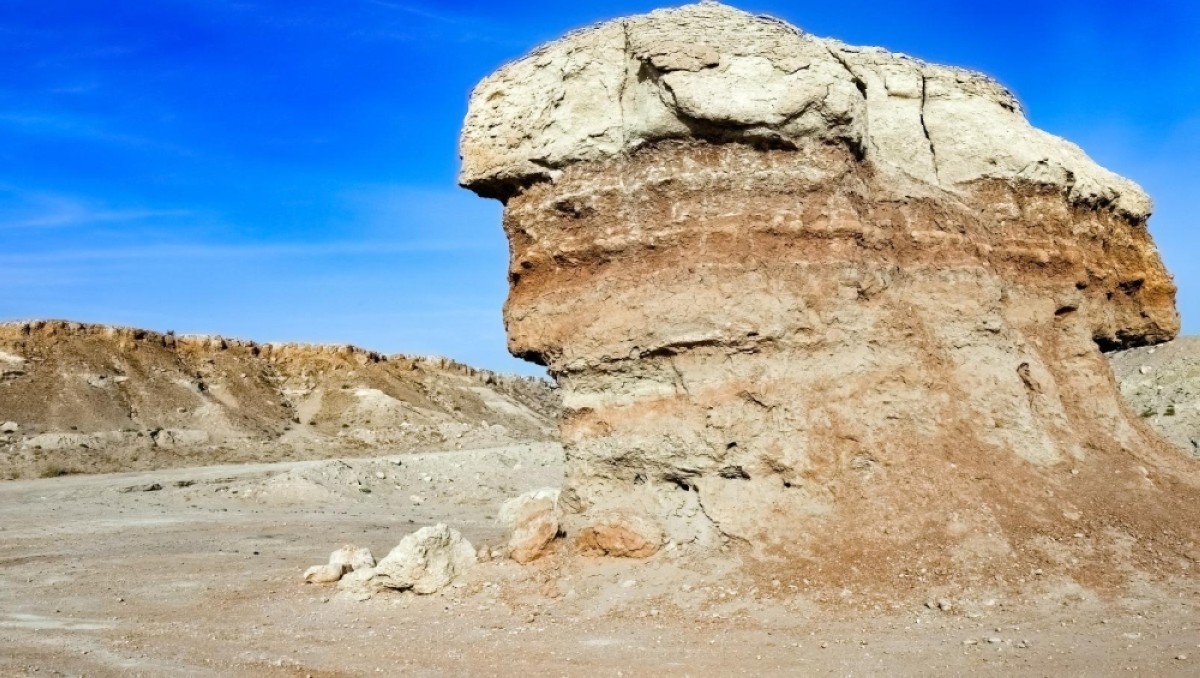
KUWAIT: For scientists in Kuwait, studying Mars doesn’t require a spaceship. The country’s newly opened Geopark features terrain strikingly similar to the Red Planet, offering an open-air laboratory for research in geology, archaeology and environmental science.
Mubarak Al-Hajeri, president of the Kuwait Geosciences Society, described the site as “the richest location in Kuwait in terms of natural, scientific and cultural value, where rare geological formations meet traces of ancient human settlement and diverse ecosystems.”
The park opens to the public on January 7, with the goal of registering the site with the UNESCO Global Geopark Network in the coming few years. According to the program’s website, there are 229 UNESCO Global Geoparks in 50 countries. A UNESCO Global Geopark uses its geological heritage, in connection with all other aspects of the area’s natural and cultural heritage, to enhance awareness and understanding of key issues facing society, such as using our earth’s resources sustainably, mitigating the effects of climate change and reducing natural hazard-related risks.

Mubarak Al-Hajeri

A site in an unnamed location in Kuwait features a mound of sandstone, formed from ancient fossilized sand dunes.

Internal layers of dunes in Kuwait’s desert reveal how weathering and erosion have shaped them over time.
Outdoor museum
Kuwait Geopark will function as an outdoor museum, tracing the region’s history over millions of years, said Al-Hajeri. Once submerged under the sea, the area experienced repeated climate shifts that gradually lowered sea levels, shaping the rocks and terrain visible today. “The geological formations here reflect changes in depositional environments and their connection to the last ice age about 10,000 years ago,” Al-Hajeri said. “They also show how climate shifts affected human settlement patterns more than 8,000 years ago.”
Geopark Kuwait preserves biodiversity, including native plants, wildlife and migratory birds. It also tells the story of Kuwait’s oil discovery and the start of its energy industry, marking a key chapter in the country’s modern history. The project began as a volunteer initiative by geologists and earth science enthusiasts, later becoming a project for the Kuwait Geosciences Society. The park also offers volunteer opportunities, with priority for society members.
“This project is a partnership between the Ministry of Information, Kuwait Oil Company, the National Council for Culture, Arts and Letters and the Kuwait Geosciences Society. “It’s a model of collaboration between government, private sector and civil society,” said Al-Hajeri.
Al-Hajeri highlighted the park’s research potential: “This site is an outdoor science laboratory. It offers opportunities for research in geology, environmental studies, biology, wildlife, archaeology and anthropology. Some areas resemble the surface of Mars, making it ideal for simulation studies.” — Agencies
