

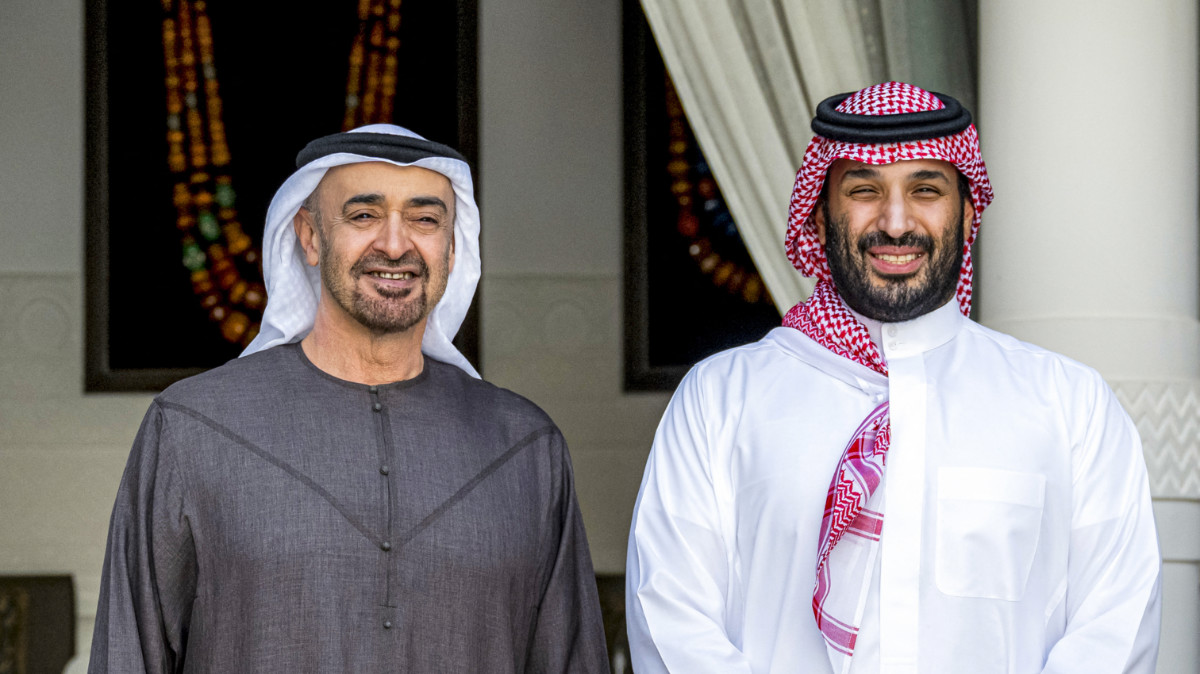
The US’s rich Gulf allies were at loggerheads in a nasty feud fuelled by divergent ideologies and old grudges. US President Donald Trump waded into the dispute and lambasted one of the participants from the White House podium.
That was 2017. The state that Trump trashed was Qatar, and it was done at the behest of the UAE and Saudi Arabia. Almost a decade later, the two erstwhile allies are now locked in their own spat whose battle lines stretch from Oman’s western border to the Nile River.
But this time, Trump has been unusually quiet.
“Trump should never have picked a side during the blockade of Qatar. That is one lesson he did learn. He knows a lot more now. The first Trump administration did not even know that the US had al-Udeid air base in Qatar. They were just listening to the UAE,” a former US ambassador to a Gulf country at the time told Middle East Eye.
The UAE and Saudi Arabia have fallen out in spectacular fashion. In early January, Saudi Arabia launched strikes on Yemeni secessionists backed by Abu Dhabi and subsequently evicted the Southern Transitional Council from a swath of southern and eastern Yemen.
New MEE newsletter: Jerusalem Dispatch
Sign up to get the latest insights and analysis on
Israel-Palestine, alongside Turkey Unpacked and other MEE newsletters
The two are also at odds in Africa. Riyadh is in talks with Pakistan to supply arms to Sudan’s military for use against the Rapid Support Forces (RSF), a paramilitary force supported by the UAE. Meanwhile, in Libya, Saudi Arabia and Egypt are lobbying warlord Khalifa Haftar’s family to break with the UAE and stop supplying the RSF with arms and fuel.
At times, it appears the spy games and military competition are failing to keep pace with an even more vicious social media war.

Prominent Saudi academic accuses UAE of being Israel’s ‘trojan horse’
Read More »
Last week, a Saudi newspaper published an opinion article claiming the UAE was serving as “Israel’s Trojan horse in the Arab world” and that its foreign policy was a “betrayal of God”.
The UAE is Israel’s closest Arab partner. Israeli and Emirati commentators have accused Riyadh of being “antisemitic” and seeking to undermine Trump’s Abraham Accords, normalisation agreements that he considers his premier major foreign policy achievement.
As in the blockade against Qatar a decade ago, each side is trying to shape the narrative, and Trump is the prize.
Some analysts say the catalyst for the split between the UAE and Saudi Arabia goes back to a decision by Crown Prince Mohammed bin Salman to lobby Trump against the UAE over its support for the RSF in Sudan in November. MEE was the first to reveal the Saudi plans.
“I am sure there is furious behind the scenes efforts by both sides to curry favour in order to tempt Trump out of his quiet corner. Each side or their supporters want to be the one who whispers in Trump’s ear last,” William Usher, a former senior Middle East analyst at the CIA, told MEE.
“But I haven’t seen any indication he is taking a side, and I don’t think choosing between them is strategically advantageous for the US,” Usher added.
‘Follow the money’
The most important factor for Trump to lean one way or the other is personal, current and former US and Arab officials tell MEE. The difference with 2017, when Trump intervened in the Qatar blockade, is that he and his family now have interests across the Gulf.
Trump’s family business unveiled $10bn in luxury developments in Saudi Arabia in January.
But Riyadh isn’t the only destination for the Trump brand. A luxury high-rise tower is going up in Dubai, and golf resorts in Qatar and Oman.
All of these deals, however, tie back to Dar al-Arkan, a sprawling development and construction firm with ties to the Saudi government.
Trump has three key advisors in the Middle East: his son-in-law, Jared Kushner, his billionaire golfing friend Steve Witkoff, and a Lebanese-American billionaire with a penchant for peak lapel suits and Ottoman history, ambassador Tom Barrack.

Pakistan’s arms deals position it squarely within growing Saudi-UAE rift
Read More »
Kushner received funds from Saudi Arabia, the UAE and Qatar for his private equity firm, Affinity Partners. Before joining the government, Witkoff cut business deals with Qatar. He has since cruised in the Mediterranean with Emirati national security advisor Sheikh Tahnoon bin Zayed al-Nahyan. The UAE invested $2bn in a crypto company started by Witkoff’s son, Zack, and Trump’s sons, Eric and Donald Jr.
In sum, Trump, his advisors and family have financial exposure across the Gulf, making it difficult to pick one side or the other. But for a president bent on dealmaking at a national level, Saudi Arabia offers more opportunities.
The UAE has pledged to invest $1.4 trillion in the US economy via AI, whereas Saudi Arabia’s investment promise reached around $1trillion when the crown prince last visited the White House.
Both countries are buying AI chips from Nvidia, helping juice the share price of tech stocks. But Saudi Arabia is the Arab world’s only G20 economy, and its GDP is double that of the UAE.
“The administration is hellbent to maintain good relations with both sides. I don’t think they are going to favour one brother over the other because the investment pledges are just too big from both,” Douglas Silliman, the president of the Arab Gulf States Institute in Washington and a former ambassador to Kuwait, told MEE.
Fights between Arab ruling families are nothing new. It was the job of British colonial administrators and later State Department Arabists to try to manipulate or mediate them, depending on the need of the hour.
But this does not just appear to be a fight between the ruling families of Saudi Arabia and the UAE. Experts say a tectonic shift is rippling through the region.
Islamic leader vs allies across globe
“Saudi Arabia has a bigger world vision in terms of its place in the Arab and Islamic world,” Silliman told MEE.
“The Emiratis have a tiny population with an economy half the size of Saudi Arabia’s. They are less willing to compromise with Islamists, and they are seeking a network of allies across the globe,” he said.
The UAE’s vision resonates with many in Congress and Washington’s think-tank circuit.
Abu Dhabi is at the centre of a pet project among pro-Israel voices in Washington to link India to Israel and Greece via the India-Middle East-Europe Economic Corridor. The UAE’s support for secessionist movements has been turbocharged by gold dealings in Sudan and port investments in the Red Sea.
At the Davos Economic Forum in Switzerland, Trump’s son, Eric, met the leader of the breakaway region of Somaliland, which Israel recognised and where the UAE has a military base.
Meanwhile, Saudi Arabia has signed a defence pact with Pakistan, the Muslim world’s only nuclear-armed state, and is in talks with Turkey, which has Nato’s second-largest army, on deepening defence ties.
The UAE’s hedging against the US has also upset many in the quieter corners of Washington. Former US intelligence officers often scoff at its moniker “Little Sparta”, which former US Defence Secretary James Mattis bestowed on it. “The UAE is a hotbed of intrigue,” one former intelligence official said.
MEE reported in November that defence and intelligence officials assessed that Chinese military personnel were deployed on a UAE military base in Abu Dhabi. US officials are still suspicious of Beijing’s activities at Khalifa Port, where China’s state-owned Cosco operates a terminal, and US intelligence has suggested the People’s Liberation Army was active.
When Trump returned to office this year, he made his first foreign visit to the Gulf region. Some Middle East watchers noted that Trump enjoyed full state dinners in Saudi Arabia and Qatar but a truncated trip in the UAE in May.
Several US officials attributed that to tensions over the UAE’s tech ties to China.
Stability and not secessionists
Alan Pino, a former CIA and National Intelligence Council officer for the Middle East, told MEE that Saudi Arabia’s broader approach to the region is more likely to appeal to Trump.
“By and large, Trump wants a Middle East he can give minimal attention to. The two issues he cares about are success in Gaza and Iran,” he said.
‘Israel does give the UAE an edge, but at the end of the day, I would say Trump leans toward Saudi’
– Alan Pino, former CIA and National Intelligence Council officer
“For stability, I think he will say we need to unify Yemen and not have secessionists. In Sudan, we need to support the government and not the rebels,” he added.
Trump has also taken a keen interest in Syria. He has welcomed President Ahmed al-Sharaa to the White House and credited Crown Prince Mohammed bin Salman, along with Turkey’s leader, for convincing him to drop sanctions on Syria.
The wild card for the Trump administration is, of course, Israel.
The UAE has emerged as its closest Arab partner. Saudi Arabia is much more sceptical of Trump’s plans for the Gaza Strip, experts and diplomats say, while the UAE has discussed reconstruction funding.
The main emissary between Palestinian technocrats and Trump’s “Board of Peace” in Gaza is Nickolay Mladenov, a former Bulgarian diplomat and United Nations envoy who taught at the UAE’s diplomatic academy.
“Israel does give the UAE an edge, but at the end of the day, I would say Trump leans toward Saudi. After all, MBS, got the big White House visit,” Pino said.
