

A plaque at the entrance to Robben Island highlights a quote from its most famous inmate, prisoner 46664.
“It is said that no one truly knows a nation until one has been inside its jails. A nation should not be judged by how it treats its highest citizens, but its lowest ones.”
Nelson Mandela’s words ring like a death knell over the state of Israel today.
The bodies of 345 Palestinians who “disappeared” when Israel invaded Gaza two years ago have now been returned to Nasser Hospital in Khan Younis. They are so disfigured that only 99 of them have been identified so far.
Maha Hussaini, who has reported for Middle East Eye from Gaza throughout the war, detailed the anguished identification process undertaken by relatives and forensic doctors, who don’t have the equipment needed to find out how these victims died.
New MEE newsletter: Jerusalem Dispatch
Sign up to get the latest insights and analysis on
Israel-Palestine, alongside Turkey Unpacked and other MEE newsletters
When Muhammad Ayesh Ramadan identified the remains of his brother Ahmed, who went missing on the first day of the war, he found that the body was burned, with six or seven bullet holes, and a vertical incision running from his chest downward. One of his brother’s toes had also been cut off.
Fingers and toes are routinely amputated by Israeli doctors to establish DNA, according to Palestinian doctors. Although they lack the necessary tools to confirm whether any of Ahmed’s organs were missing, the marks found on his body strongly suggest that it was used as an organ bank.
Other bodies showed clear signs of torture. Zeinab Ismail Shabat, from Beit Hanoun in the northern Gaza Strip, found that her 34-year-old missing brother, Mahmoud, had his index finger severed, while his hands were tied behind his back, and the marks of metal restraints left dents in his feet. His face appeared to have been struck so violently that his skull was fractured, and his neck bore marks of hanging.
“It was clear that he was martyred while restrained. He was completely stripped of clothing. There was a gunshot in his thigh, and there were small pieces of wood on his chest,” she said.
Rape and torture
Estimates vary of the number of Palestinians who have died in Israeli custody over the past two years. Data obtained by Physicians for Human Rights – Israel from the Israeli army and prison service put the number at 98, but the group said this was probably a significant undercount, with hundreds more detainees from Gaza still missing.
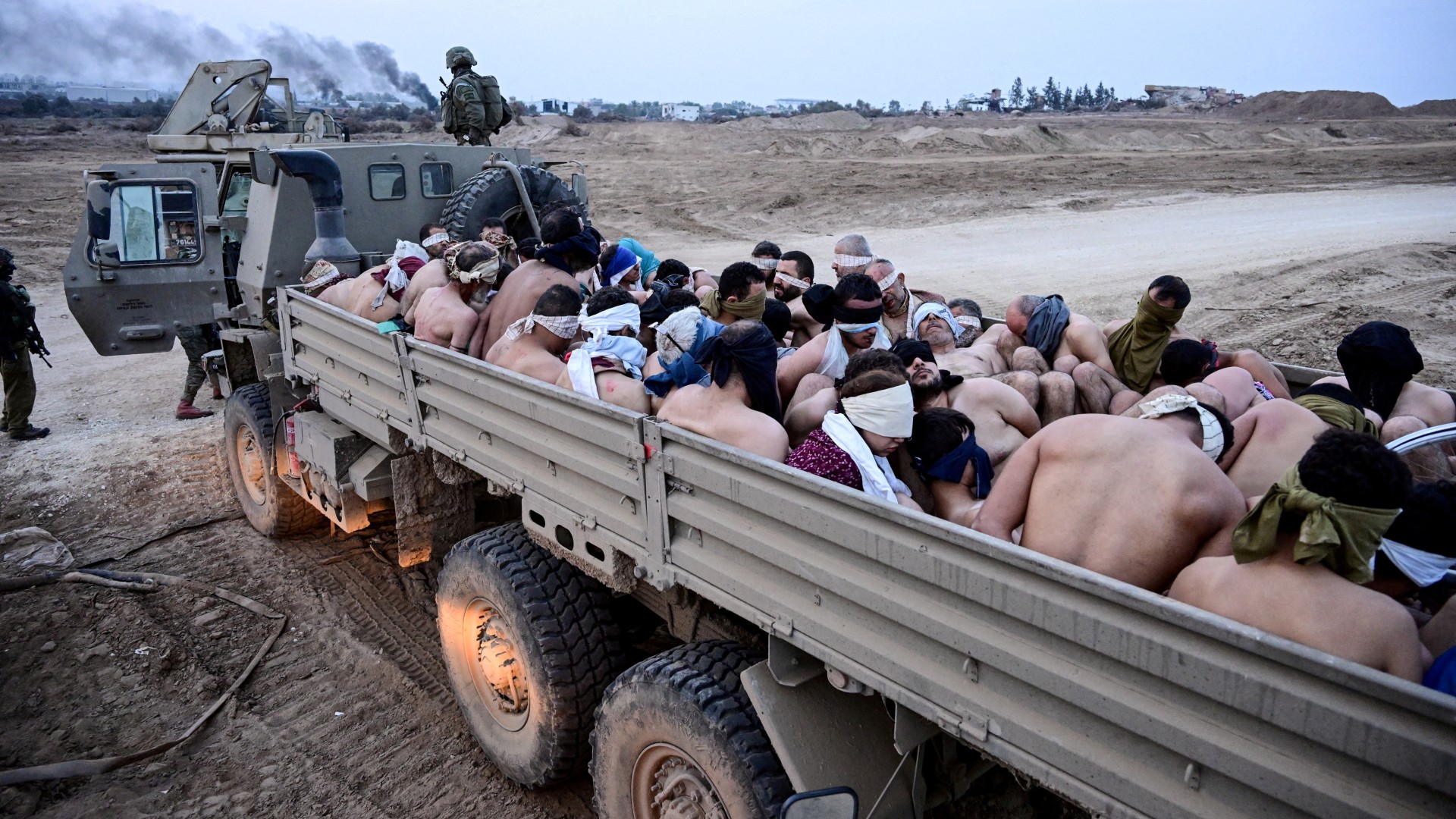
Prisoners who have survived detention describe the cruellest forms of torture. According to testimony from detainees received by the Israeli human rights organisation B’Tselem, special forces stormed a cell in Ketziot Prison in November 2023 and beat inmates with batons until they bled from their heads.
They concentrated their attention on Thaer Abu Asab, 38, until he collapsed. His body remained on the floor for an hour, bleeding and unresponsive, until he was removed from the cell and pronounced dead. The next day, the Shin Bet interrogated all the inmates and accused them of attacking Abu Asab and trying to frame the prison guards for it.
There are enough contemporary reports about the industrialised abuse of Palestinians in Israeli prisons and detention centres to fill a small library
One detention camp in particular, Sde Teiman, has established a reputation for rape, torture and deaths. Ibrahim Salem, who was released in August after nearly eight months of detention, described his 52 days at Sde Teiman as his worst nightmare.
“You stand on one leg for two hours, then they would tell you: ‘Do you want me to help you?’ And when you say yes, they tell you to say, ‘I am the son of a whore, I am the brother of a whore’, to say ‘Netanyahu fucked my sister, am Yisrael chai [the people of Israel live]. Now repeat after me, am Yisrael chai! Am Yisrael chai! A hundred times.’”
A chair was broken on his chest. He was electrocuted in the genitals. Other prisoners were raped by female soldiers.
In such cases, the prisoner would be bent over a desk with his hands placed in front of him, handcuffed. The female soldier, standing behind him, would insert her fingers and other objects into his rectum. When he reacted or moved back, the soldier standing in front of him would hit him in the head and force him to bend again.
There are enough contemporary reports about the industrialised abuse of Palestinians in Israeli prisons and detention centres to fill a small library.
Severe crisis
According to a November report from the United Nations committee on torture, Israel has a “de facto state policy of organised and widespread torture”, which they described as including “severe beatings, dog attacks, electrocution, waterboarding, use of prolonged stress positions [and] sexual violence”.
Israel’s own Public Defender’s Office, which is part of the justice ministry, found extreme overcrowding, hunger, and near-daily beatings for Palestinian prisoners, noting that conditions amounted to “one of the most severe detention crises that the state has known”.
Despite this avalanche of evidence, only one Israeli soldier has been prosecuted, receiving a seven-month sentence. Five other soldiers were charged with aggravated abuse and causing serious bodily harm at Sde Teiman, after footage was leaked.

The horrors of Israel’s prisons are further proof of Israel’s state of depravity
Read More »
That leak by an Israeli army lawyer, Yifat Tomer-Yerushalmi, caused outrage not because of the crimes themselves, but because of the damage done to the Israeli army’s public image. The lawyer was forced to step down, and the soldiers accused of rape recently held a news conference demanding compensation for “damage to their image”.
At the news conference outside Israel’s High Court, the accused soldiers – wearing balaclavas, in an apparent effort to avoid prosecution at the International Criminal Court – boasted about how they were still free, and declared: “We will prevail.”
“You tried to break us, but you forgot one thing: we are Force 100,” they said, referring to their counterterrorism unit.
Israeli Prime Minister Benjamin Netanyahu refused to denounce the assault. Instead, he called the leak “perhaps the most severe propaganda attack the state of Israel has experienced since its establishment. His concern was for Israel’s image, not for the man brutalised on screen.
According to Haaretz, the Israeli army’s top legal official deliberately avoided launching investigations into war crimes by Israeli forces, fearing a right-wing backlash.
Seeking the death penalty
Meanwhile, the number of Palestinians in Israeli prisons has steadily been growing. Advocacy groups put the number at 9,250 in November; of those, more than 3,300 were “administrative” detainees, held without charge or any form of due process.
To call these detainees prisoners is stretching the meaning of the word. They are hostages taken by Israel every night in raids – but no one in the international community takes any notice of that.
Not content with the starvation and beatings he instituted in prisons, National Security Minister Itamar Ben Gvir is now pushing a bill through the Knesset to impose the death penalty for “terrorists acting against the state”.
This is a form of words chosen to exclude Jews, because in the extreme right’s view, terrorism is practised only by Arabs. One of the bill’s sponsors, MK Limor Son Har-Melech, said: “There’s no such thing as a Jewish terrorist.”
Israel abolished the death penalty for murder in 1954, but capital punishment remained on the books for crimes related to the Holocaust and genocide. Israel has executed only one person in its history: Adolf Eichmann, the architect of the Holocaust, in 1962.
The death penalty was retained for military courts in the occupied West Bank, but was never used. This was often debated, and heads of the Shin Bet and the army regularly argued against it.
Today, all the brakes are off this debate. The Shin Bet now has at its helm a Religious Zionist, Major General David Zini, who supports the bill – and Ben Gvir’s rise to executive power has transformed the landscape.
What was once seen as right-wing provocation has now become establishment policy. Ben Gvir handed out sweets after the bill passed its first reading, and there is every expectation it will now become law.
Mandela’s legacy
As it was in South Africa, Israeli prisons also contain the key Palestinian leaders who could negotiate an end to the conflict.
There is Marwan Barghouti, a senior Fatah leader serving five life sentences, who is popular enough to replace Mahmoud Abbas as president. With him is Abdullah Barghouti, a Hamas military leader serving 67 life sentences.
Hamas commander Ibrahim Hamed is serving 54 life sentences, while Ahmad Saadat, secretary general of the Popular Front for the Liberation of Palestine, is serving a 30-year sentence. Other prominent Hamas figures in prison include Hassan Salameh, who is serving 48 life terms, and Abbas al-Sayed, who is serving 35 life sentences.
An international campaign has been launched to free Barghouti on the same principle that led to Mandela’s release, which was a central demand of the anti-apartheid movement. As Mandela himself stated: “Only free men can negotiate. Prisoners cannot enter into contracts.”
The direction Israel is taking under the de facto leadership of Ben Gvir is plunging the state into a permanent war
Mandela’s release was regarded at the time as a key step towards peace. He went on to lead negotiations that paved the way for the country’s first multiracial democratic elections in 1994, which his African National Congress won in a landslide.
Some former Shin Bet heads – now long out of power, and with next to no influence – see this. But the direction Israel is taking under the de facto leadership of Ben Gvir is plunging the state into a permanent war, with both the Palestinians and its regional neighbours.
At the same time, the nature of this war is changing from one based primarily on land to a religious crusade. This will have the same ending as all the other crusades that attempted to colonise Palestine.
If the international community truly wants to end this conflict now, before it escalates even further, a release of all Palestinian prisoners should become the central demand of the global boycott and divestment campaign.
The men and women who organise, conduct and rejoice in the daily beatings, rapes, electrocutions, torture, and deaths in custody should have the same trial that Eichmann was given – because they are truly his children.
The views expressed in this article belong to the author and do not necessarily reflect the editorial policy of Middle East Eye.
