

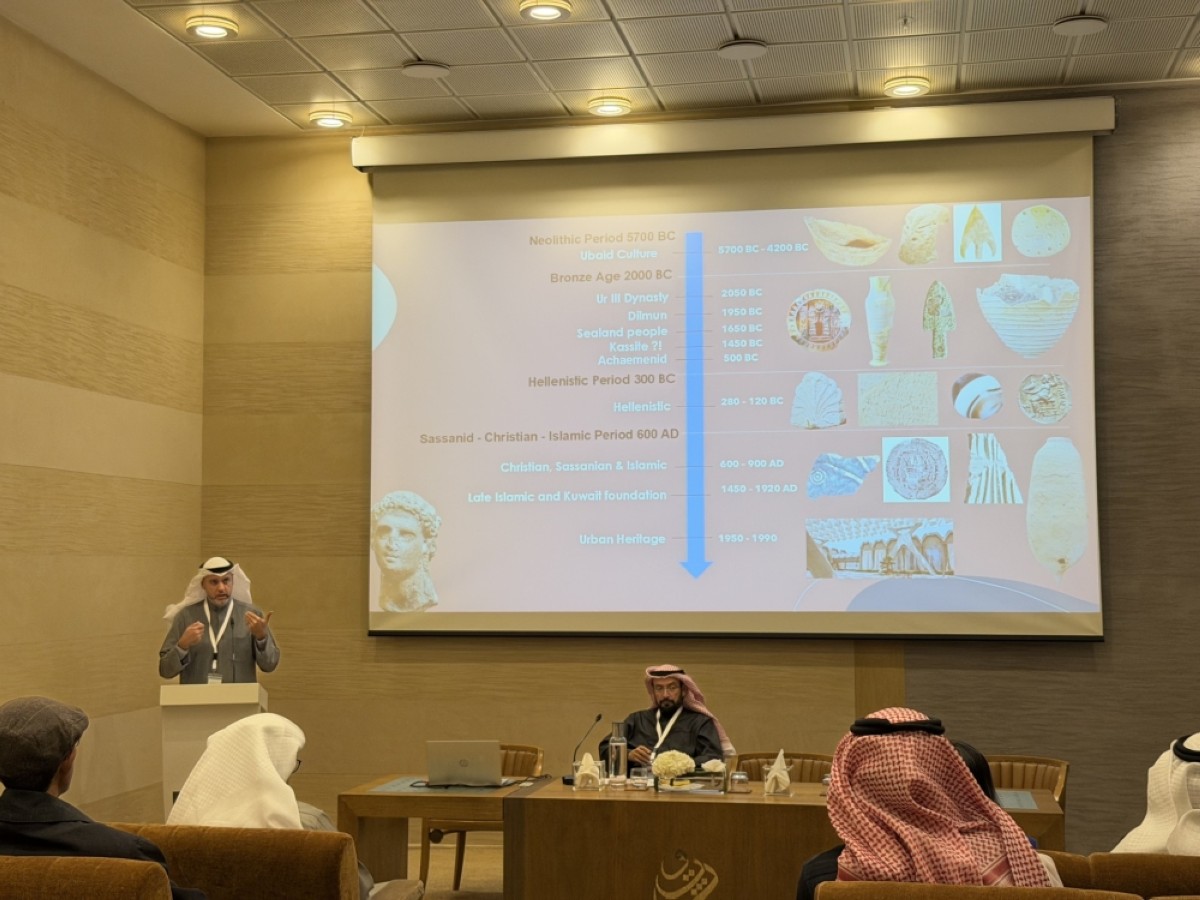
Current research efforts aim to build a database of Bronze Age pottery in the Arabian Gulf
MANAMA: Unified research efforts and expanded joint programs among GCC states are essential to improving the documentation and conservation of archaeological sites in the region, two Kuwaiti researchers said on Tuesday.
They said such cooperation would enable the use of modern technologies in archaeology and help ensure the long-term sustainability of Gulf heritage. The comments were made in separate statements to Kuwait News Agency (KUNA) by Dr Sultan Alduwaish and Dr Hasan Ashkanani during a regional symposium held in Manama.
Both researchers stressed that protecting Gulf archaeological heritage is a shared responsibility among GCC countries. They emphasized the importance of exchanging expertise and knowledge, and coordinating scientific programs to preserve Gulf cultural heritage as a human and civilizational legacy for future generations.

Excavations at the Bahra 1 site in Al-Subiya uncovered a Neolithic settlement, including 20 ancient kilns at the location seen in this photo published by NCCAL in November 2025.

A collection of beads and a Dilmun-ear seal recently discovered in Failaka Island.

Officials, including Dr Hasan Ashkanani, examine an excavation site on Failaka Island, where a Danish archaeological team uncovered foundations of older Bronze Age Dilmun temples, as well as pottery.
Organized by the Bahrain Authority for Culture and Antiquities, the symposium brought together archaeologists and specialists from across the region. It focused on exchanging knowledge, discussing recent discoveries and ongoing research, and reviewing methods used to document, protect and preserve archaeological heritage, while highlighting the Gulf’s shared cultural legacy.
Alduwaish, former director of antiquities and museums at Kuwait’s National Council for Culture, Arts and Letters, presented a lecture on the Ubaid Civilization remains discovered in Al-Subiya. He said the Subiya area is revealing new evidence of early human settlement in Kuwait, highlighting people’s ability to adapt to the environment and make use of natural resources. These findings, he added, shed light on the early beginnings of civilization in the Arabian Gulf.
World’s oldest boats
Alduwaish said excavations at the Bahra 1 site in Al-Subiya uncovered a Neolithic settlement with rectangular stone buildings of a geometric design influenced by Mesopotamia. The site also includes workshops for manufacturing shell beads, he said. Most of the artifacts discovered were pottery used in daily life, such as cooking pots and drinking cups, alongside vessels made from different materials.
He added that Al-Subiya has also produced evidence believed to point to the world’s oldest sailing boats. These discoveries indicate the presence of trade routes that passed through what is now Kuwait, he said. Alduwaish noted that the Subiya site, particularly Bahra 1, has been under excavation since 2009 by a joint Kuwaiti-Polish team.
Ashkanani, a professor of archaeology and anthropology at Kuwait University, said he is presenting a paper on the use of nuclear radiation techniques in the study of 4,000-year old Dilmun pottery from Bahrain and Kuwait. He said pottery from the Barbar period (2030–1950 BC) is among the most significant discoveries reflecting the cultural prosperity of the Dilmun civilization around 4,000 years ago.
These artifacts were found in Bahrain and on Failaka Island in Kuwait. Ashkanani explained that this period coincided with the development of burial mounds in A’ali, residential settlements at Qal’at Al-Bahrain and Saar, and temples in Barbar, as well as sites on Failaka Island.
First of its kind study
He added that Barbar-period pottery discovered in Bahrain and at Tell Sa’ad and Al-Khidr Port on Failaka Island serves as a key reference for reconstructing Dilmun’s cultural identity and development during the second millennium BC. Ashkanani said the discovery of pottery from other civilizations, including Mesopotamia and the Indus Valley, confirms that Dilmun was part of an active regional interaction network. This, he added, reflects the civilization’s administrative, social and economic development.
Ashkanani’s paper examines production methods of Barbar pottery using non-destructive portable X-ray fluorescence (pXRF) technology. The aim is to build a chemical database of Bronze Age pottery in the Arabian Gulf. Ashkanani said the research is the first of its kind. Its findings show that nuclear radiation techniques can successfully distinguish between different groups of Gulf pottery without damaging them. The analysis also identified mineral elements that help explain kiln-use methods, offering deeper insight into similarities and differences among Dilmun pottery types and their link to the civilization’s prosperity 4,000 years ago. — KUNA
