

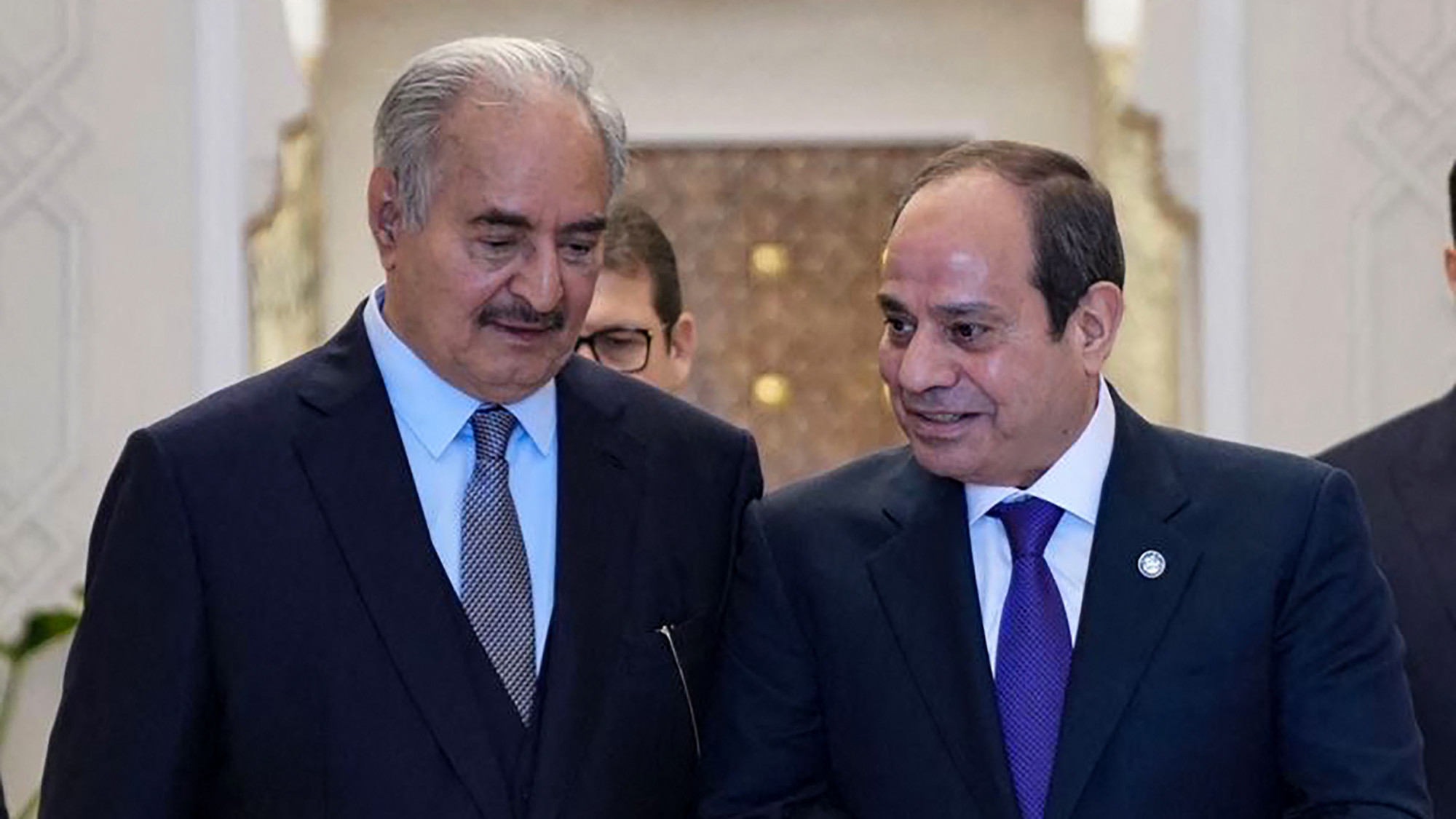
Weapons continue to flow from Libya to Sudan despite Saudi and Egyptian pressure on Khalifa Haftar to stop Emirati military support to the Rapid Support Forces (RSF), Middle East Eye has learned.
Earlier this week, MEE reported that the eastern Libya commander is coming under growing pressure from Cairo and Riyadh, which have warned that continued assistance could trigger a serious shift in Egypt’s relationship with him.
Saddam Haftar, Khalifa’s son and deputy commander of his self-styled Libyan Arab Armed Forces (LAAF), was “summoned” to Cairo earlier this month for a dressing-down, during which he was told to immediately end support for RSF, according to Egyptian sources.
Libyan sources with direct knowledge of the matter told MEE, on condition of anonymity, that Saddam is now also under pressure from the United Arab Emirates to continue the facilitation of weapon shipments to Sudan via eastern Libya.
Saddam remains undecided, the sources said, even as weapons continue to flow to Sudan.
New MEE newsletter: Jerusalem Dispatch
Sign up to get the latest insights and analysis on
Israel-Palestine, alongside Turkey Unpacked and other MEE newsletters
The pressure on Haftar forms part of a broader Egyptian-Saudi effort to block the transfer of arms, fuel and fighters to the RSF, curb Emirati influence and prevent further destabilisation along the Egypt-Libya-Sudan border.
When Saddam visited Egypt earlier this month, local media framed the visit as routine military cooperation. A source told MEE, however, that it was in fact a warning over confirmed Emirati weapons and fuel transfers to the RSF via Haftar-controlled areas.
“Egyptian intelligence and military officials delivered a strongly worded warning to Khalifa Haftar through his son,” the source said.
Officials also presented evidence of Emirati weapons shipments, drones and air defence systems reaching the RSF, along with fuel deliveries from Libya’s Sarir refinery to RSF leader Mohamed Hamdan Dagalo.
Since war broke out between the Sudanese Armed Forces (SAF) and the RSF in April 2023, Egypt has watched warily as its southern neighbour descends further into chaos.
Issuing a threat
Cairo backs the Sudanese government and military, which in recent months have lost a string of strategic towns and cities to the RSF, most notably Darfur’s el-Fasher, where thousands are believed to have been massacred by the paramilitaries.
While Haftar’s authorities in eastern Libya have long been supported by Egypt, he is also backed by the UAE, which is the RSF’s main patron and has been funnelling weapons, mercenaries and funds to the paramilitaries via Libya, Chad and Ethiopia.
As revealed in a recent report, supply lines via Libya that the RSF established by seizing border areas in June directly contributed to the group’s capture of el-Fasher, following a siege lasting more than 550 days.
According to the military source, Egypt has aerial imagery showing weapons shipments moving from Abu Dhabi to Haftar-controlled areas and onwards to the RSF, as well as Libyan fuel tankers transporting supplies to the RSF in Darfur.
“Egyptian security bodies have also monitored, through audio and visual surveillance, the arrival of mercenaries from Colombia and Venezuela into Libya, from where they are transferred to Sudan to join the RSF,” the source said.
“Without such support, the RSF would not have achieved its recent advances,” he added.
“The message was clear: continued support for the RSF would force Egypt to reconsider its entire relationship with eastern Libya.”

According to the Egyptian army official, Cairo and Riyadh offered Saddam Haftar cooperation and alternative financial and military support to replace Emirati backing.
The meetings between Saddam Haftar and Egyptian officials were followed by a Saudi arms deal with Pakistan worth $4bn, the source noted.
“The weapons are expected to be distributed between Haftar’s forces and the Sudanese army led by Abdel Fattah al-Burhan,” he added.
Haftar controls eastern and southern Libya, running an administration that rivals the internationally recognised government in Tripoli.
However, the army source said Egyptian military officials shared intelligence with Saddam Haftar outlining Emirati plans to fragment Haftar’s territory once the RSF secured control over Darfur and Kordofan and destabilised SAF-held northern Sudan.
“The Emirati plan involved dividing Libya into multiple zones, with some areas remaining under Tripoli’s control, others under Benghazi, and Jufra and Sirte separated,” the source said.
Regional friction
A feud between erstwhile allies Saudi Arabia and the UAE has erupted in public in recent weeks.
The UAE has sown discord across the Middle East and Africa in recent years by backing several insurgencies and separatist groups, including the RSF, which has been accused of a litany of war crimes, including genocide.
In Yemen earlier this month, the UAE-backed Southern Transitional Council separatist group was routed by pro-Yemeni government fighters backed by Saudi air strikes, after briefly seizing all of the country’s east.
The developments were accompanied by rare statements of condemnation between Saudi Arabia and the UAE, and Riyadh has since been openly assertive against Emirati policy in the region.
Egypt has joined Saudi Arabia in this.
Earlier this month, MEE reported that Cairo shared intelligence with Riyadh on Emirati activities in Yemen.
“The UAE’s backing of the RSF was part of a broader strategy to shape the future of Sudan and Libya and strengthen its foothold in the Horn of Africa and the Sahel,” a Cairo-based geopolitical analyst told MEE, speaking anonymously due to security concerns.
“But those ambitions increasingly clashed with Saudi interests, especially as Riyadh views the RSF’s rise as a threat to regional stability and a direct challenge to Saudi-backed forces in Yemen.”
