

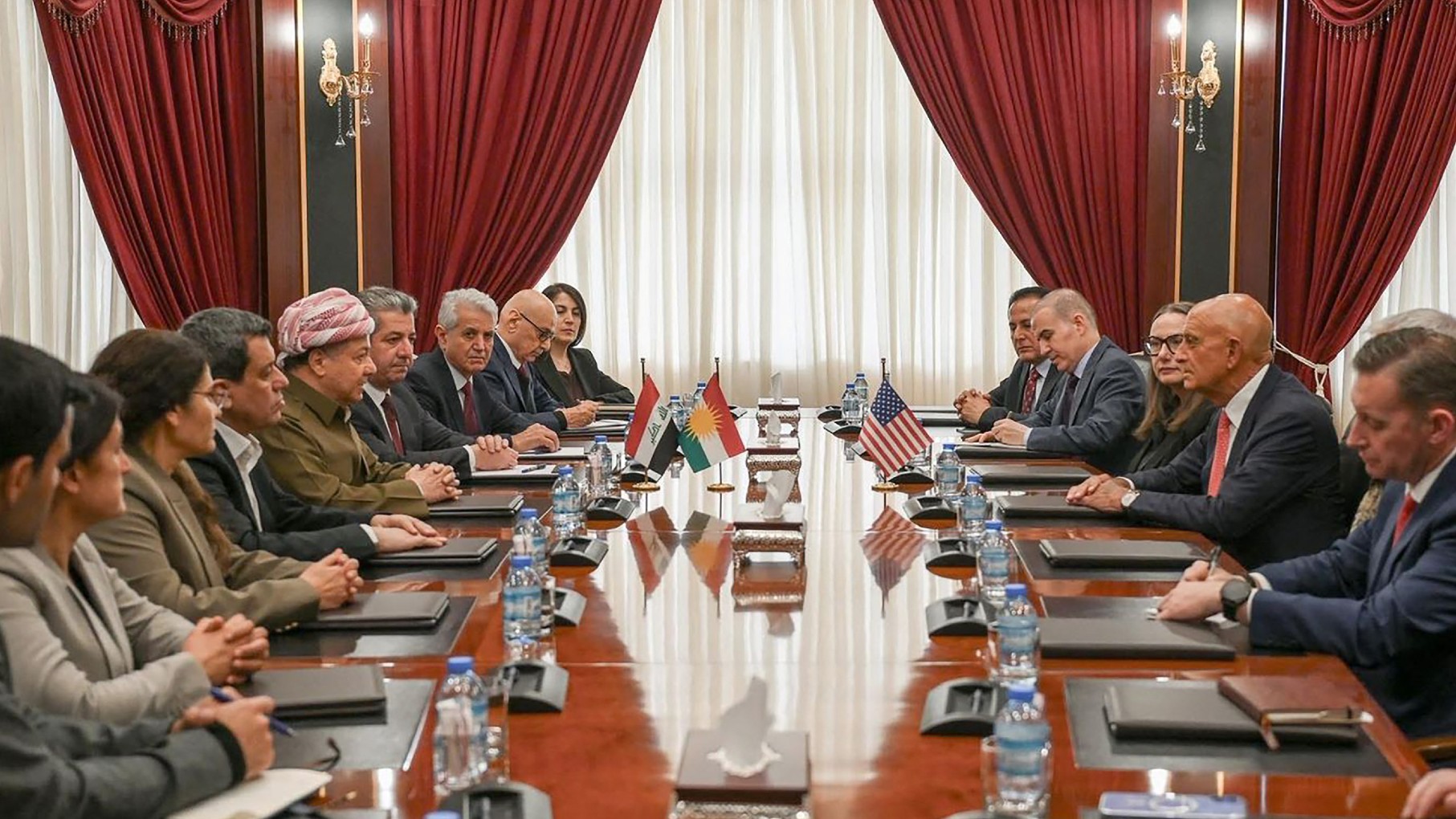
The US special envoy for Syria, Tom Barrack, accused the commander of the Syrian Democratic Forces (SDF) of attempting to drag Israel into internal Syrian matters during a tense closed-door meeting before Sunday’s ceasefire agreement was signed, diplomatic sources told Middle East Eye.
Two diplomatic sources speaking on condition of anonymity told MEE that the meeting, held in Erbil on Saturday, also included veteran Kurdish leader Massoud Barzani and took place as Syrian government forces advanced into SDF-held territory.
The sources said that Barrack sharply criticised Abdi for delaying the implementation of a March 2025 integration deal that was supposed to see the SDF merge with the Syrian army by the end of 2025.
The US envoy, who has repeatedly advocated for a unified state, accused the SDF leader of “stalling, failing to implement the agreement with the Syrian government, and relying on foreign powers,” the sources said.
“You are trying to drag Israel into the conflict, and this will not happen,” Barrack reportedly told Abdi, warning that such a move would bring destruction and risk friction between two of Washington’s most important regional allies, Turkey and Israel, the sources added.
New MEE newsletter: Jerusalem Dispatch
Sign up to get the latest insights and analysis on
Israel-Palestine, alongside Turkey Unpacked and other MEE newsletters
Senior figures within the SDF have openly acknowledged contact with Israeli officials and expressed openness to support from any external party that could help protect Kurdish communities and their political gains.
“There are certain figures from the side of the Israeli state engaged in communications with our side… and if this conversation leads to support, we would be open to support… from any source,” Ilham Ahmed, a senior SDF official, told reporters on Tuesday.
‘You [SDF] still want to deal with the situation as if Bashar al-Assad is ruling Syria… There is a fundamental change; Damascus is our partner today’
– Tom Barrack, US Middle East envoy
At Saturday’s meeting, Barrack also told Abdi that he was continuing to deal with Syria as though Bashar al-Assad were still in power, despite the collapse of the former regime and the emergence of a new political reality.
“You still want to deal with the situation as if Bashar al-Assad is ruling Syria,” Barrack said. “There is a fundamental change; Damascus is our partner today in the fight against terrorism.”
The sources said that Barzani, who was also at the meeting, struck a different tone during the talks.
The veteran politician, who served as president of the Kurdistan Region of Iraq from 2005 to 2017, described his recent meeting with al-Sharaa as positive.
However, Barzani also requested assistance in protecting Kurdish civilians, presenting documented video evidence of threats facing Kurdish communities, according to the sources.
The sources said that Barzani asked Barrack to arrange a follow-up meeting between Sharaa and Abdi to review the agreement of the March 2025 agreement, and told both that if there was a new agreement, he would be the “new guarantor”.
On Sunday, the Syrian government announced that a new ceasefire had been agreed with the SDF, with the Syrian military taking almost full control of the country and dismantling the Kurdish-led forces that controlled the north-east for over a decade.
During Syria’s civil war, the SDF was the US’s most important ally in fighting the Islamic State group, but the new Syrian government accused the SDF of tolerating Assad loyalists and members of the banned Kurdistan Workers Party (PKK) within its ranks.

Syria: SDF left weakened, short of territory and oil after ceasefire, experts say
Read More »
Hours after the government announced the deal, Abdi said the SDF had accepted the agreement, which stipulates their withdrawal from Raqqa and Deir Ezzor provinces “to stop the bloodshed”.
According to the deal, the SDF would have to give up the Raqqa and Deir Ezzor provinces – both Arab majority areas – to the Syrian government, as well as its border crossings and oil and gas fields.
There was no clear timeline on when and how the different elements of the agreement will take effect.
Al-Sharaa has since told journalists that it would be gradually implemented, beginning with the cessation of hostilities.
Following Sunday’s announcement, Barrack said the deal would lead to renewed dialogue and cooperation towards a “unified Syria”.
“President al-Sharaa has affirmed that the Kurds are an integral part of Syria, and the United States looks forward to the seamless integration of our historic partner in the fight against ISIS with the Global Coalition’s newest member, as we press forward in the enduring battle against terrorism,” Barrack wrote on X, using the acronym of the “Islamic State” group.
MEE reached out to the US embassy in Syria and the US embassy in Turkey for comment but did not receive a response by time of publication.
