

Last October might as well be five years ago at this point.
When we last did these rankings, two weeks before Halloween, Crystal Palace’s Oliver Glasner had just been named manager of the month for September. Ruben Amorim was in the middle of guiding Manchester United through a stretch that would earn him October’s manager of the month honors. And he would be followed up by Enzo Maresca, whose Chelsea won three and drew one in November.
Now, it’s early February. Both Maresca and Amorim have been fired by their clubs, and Glasner has publicly stated that he will be leaving his club. Oh, and the current reigning manager of the month? Unai Emery, who is managing the team we ranked 13th the last time we did this.
A lot has happened over the last three-and-a-half months, so we’re back to make sense of it all in the only way we know how: by ranking every Premier League team, from 1 down to 20.
Our rerankings — the combination of the individual rankings from Bill and Ryan — are listed along with the last rankings from October, and each team’s present points total and goal differential in the Premier League table.
Here’s the scary thing about Arsenal: they’re the best team in the world, and they could easily be even better.
If we strip out penalties and set pieces, then this is how everyone in the Premier League stacks up by their expected-goal differential:
In fact, that’s not too different from what markets and projection systems expected before the season: Arsenal and Liverpool battling it out at the top, with Manchester City just slightly behind.
But what if we look at only free kicks, corners, and throw-ins? Well …
Put it all together, and Arsenal have easily been the best team in the Premier League through the first 24 matches:
If you’re wondering why most Premier League teams have become obsessed with the moments when the ball goes out of play or the ref blows his whistle, then this is your answer: it’s enough to take you from being one of the best teams in the Premier League to being the clear number one.
Or: it’s enough to build a six-point lead over second place, despite the fact that the three strikers on your roster have combined to score six non-penalty goals in the league this season. Kai Havertz and Gabriel Jesus have combined for two starts in the league this season, and Jesus has scored two non-penalty goals.
The plan before the season was never to have Jesus contribute heavily, but the same can’t be said about Havertz, who is yet to score in the league. He’s recently back from a long-term injury, and the team always seems to play better when he’s out there — whether or not he’s scoring goals. He’s a winning player who does a little bit of everything.
Of course, Havertz was supposed to become more of a secondary figure this season after the club spent a lot of money to bring in Viktor Gyökeres from Sporting Lisbon over the summer. Gyokeres has scored four non-penalty goals and registered zero assists across 18 starts. Despite playing a lot of minutes, he ranks 34th in the league for non-penalty expected goals and assists.
If we look at the numbers on a per-90 basis, Gyokeres’ underlying attacking performance is roughly the same as that of Mikel Merino, last season’s emergency striker who was never supposed to play that position again after the club signed Gyokeres. And yet, Gyokeres has played six games so far against Tottenham, the Manchester clubs, Chelsea, and Liverpool, and he’s attempted one shot in those games.
While Arsenal’s slower pace of play and the general tactical state of the Premier League right now have both made it harder for their strikers to produce, six non-penalty goals from their center forwards is pretty much the worst-case scenario for a club with Arsenal’s ambitions. And yet their defense is so good, their other attackers so talented, their midfield so reliable, and their set-piece efficiency so otherworldly that it hasn’t really mattered at all.
That’s why it’s easier to see Arsenal getting better, rather than getting worse.
If Havertz and Jesus start playing more often and producing like they have in the past, they’ll both be big upgrades on Gyokeres. And while I don’t think it’s as likely for a player already more than halfway through his peak years, Gyokeres could also improve from here on out. (A number of other big signings from this past summer, notably Liverpool’s Florian Wirtz and Tottenham’s Xavi Simons, have kicked into another gear recently.) Or, if none of that happens, then Arsenal could just sign another striker over the summer and the team would immediately be a lot better.
The only reason there’s even still a semblance of a title race is because Arsenal aren’t getting any consistent production from the player in the center of their front three. If they ever do, then it might be a long time until somebody else catches them at the top. — Ryan O’Hanlon
Over the last couple of years, as we’ve done these reranking pieces, we’ve almost never had any reason to say something nice about Manchester United.
• “Everton and Manchester United: a tale of two underachievers.”
• “Manchester United: the model of mediocrity.”
• “Man United haven’t figured anything out yet.”
• And my personal favorite: “Manchester United: Still stinking up a storm.”
It’s never personal — it’s just how things go when the club that once ran the Premier League is falling to eighth in the table one year, then to 15th the next.
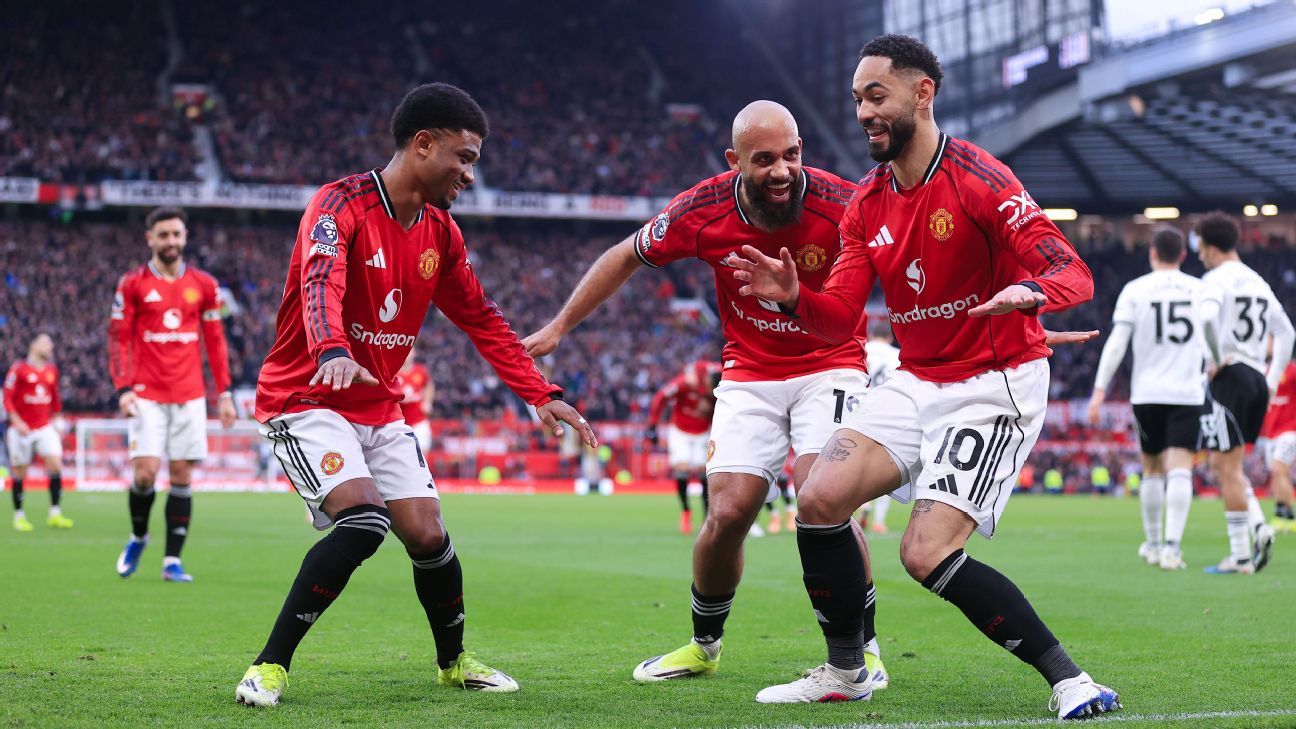
United rose from 11th to eighth in our October rerank, however — and despite mercifully sacking Ruben Amorim in early January — they’ve made another charge in the months since. They beat Manchester City and Arsenal back-to-back under interim coach Michael Carrick, sure, but even going further back than that, they’ve lost just twice in league play since September, and their expected goals differential for the season ranks third.
This is a verifiably good team, one that has a 49.1% chance of a top-five finish (and likely Champions League berth) per the Opta supercomputer, and a 59.3% chance per xStandings.
Carrick’s sample is far too small to judge with statistical rigor, and they’ve won these last three matches with pure directness — they’ve scored eight goals while averaging just 19 touches per match in the opponent’s box (opponents are averaging 29.7). There’s been a dose of good fortune in this streak, with Bryan Mbeumo, Matheus Cunha and Patrick Dorgu combining for six goals from shots worth 2.2 xG.
But the results haven’t just been lucky. Casemiro has looked very comfortable at the base of Carrick’s 4-2-3-1 system, and we knew from his time at Brentford that Mbeumo is dynamite in transition.
Be it through Amorim’s three-at-the-back approach or Carrick’s adjustments, United have been the best quick-strike team in the Premier League this season. They’re fifth in ball recoveries, but they’re first in both shots (15) and goals scored from ball recoveries (five); they’re fourth in high turnovers created, but they’re first in goals scored from them (16).
They have attempted by far the most first-time shots in the league (207) — meaning, they find openings and immediately try to exploit them. And while this still isn’t a particularly disruptive or physical defense, they’ve erased their old tendency of allowing opponents loads of shot attempts: Per possession, they’re currently second in shots and fourth in shots allowed.
1:33
Ogden: Carrick’s success is creating a problem for Man United’s hierarchy
Mark Ogden believes Manchester United will have to make a decision about Michael Carrick’s future soon.
Plenty of people in our line of work have attempted to immediately parlay this happy three-match run into “Are United title threats?!” headlines, and … no. They’re not. They’re 12 points behind Arsenal with 14 games to play, and their title odds are well under 1%.
But honestly, fans should treat that as a good thing. The day-to-day life of a Manchester United fan appears to be existentially exhausting, a nonstop ride of overreaction and resetting of expectations.
Sure, they’ve got a Champions League berth to play for — and lord knows the “Should Carrick become the full-time manager?!” headlines aren’t going to stop if they keep playing like this* — but at this moment they’re playing fun, fast, entertaining and semi-sustainable ball. For a little while, at least, that should be enough.
(*My own opinion: Sure, give him the full-time job. It’s fine. He’s a smart guy, former holding midfielders can make excellent coaches, he was decent in two-and-a-half seasons at Middlesbrough, people who are frequently wrong think it’s a bad idea, and hey, the manager doesn’t matter as much as he used to, anyway, right?) — Bill Connelly
At the time of the last rerank, Aston Villa and Brentford were 13th and 16th, respectively, in the Premier League table and 13th and 14th on our list. Villa couldn’t generate decent scoring chances to save their lives (they were 16th in goals and 19th in xG created at that point), and Brentford couldn’t keep opponents from scoring (16th in goals allowed, 14th in xG allowed).
Things have changed pretty dramatically since then:
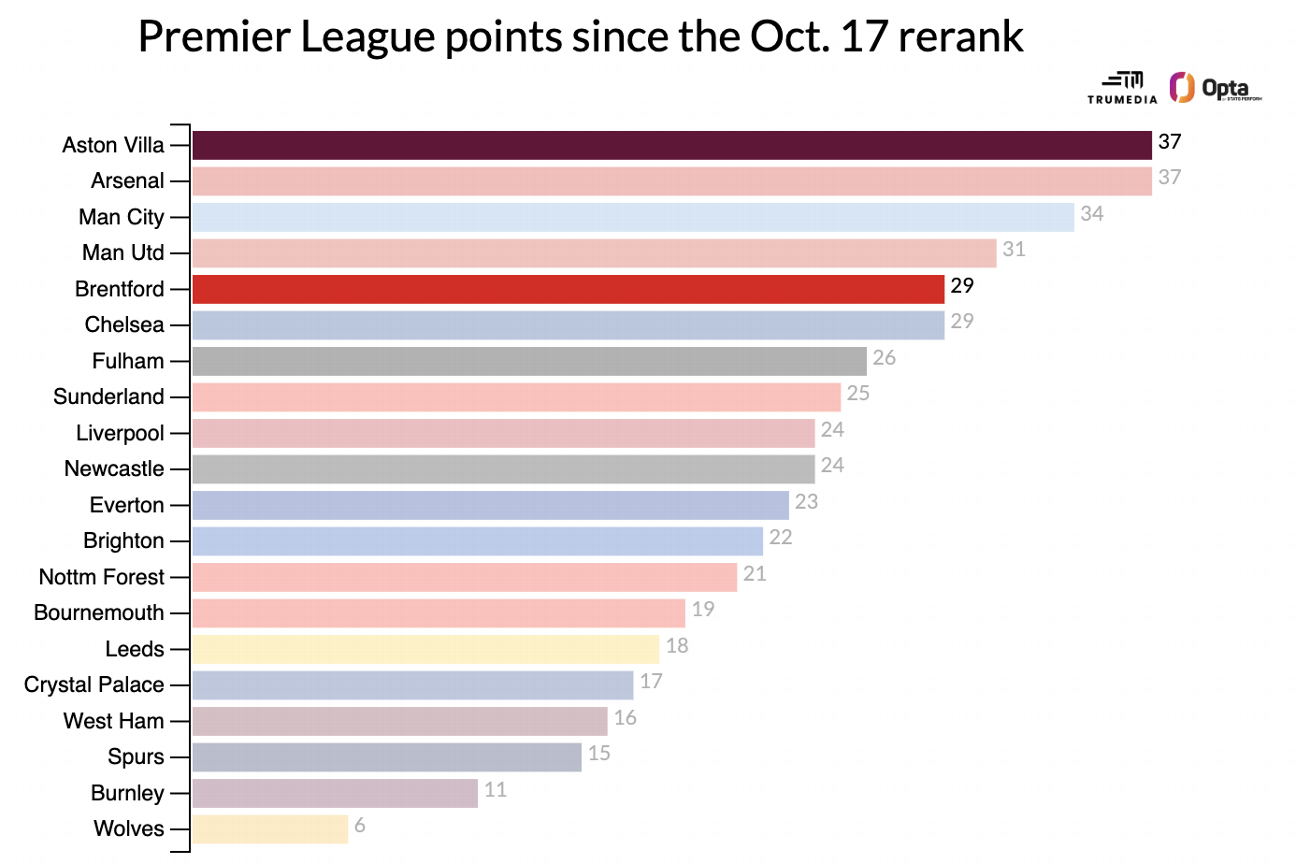
Villa have matched Arsenal with 37 points over the last 17 matchdays, while Brentford have been exceeded only by Villa, Arsenal and the Manchester clubs. Have they actually been among the five best teams in this span? Probably not. Villa’s plus-10 goal differential in these 17 matches has come from an xG differential of plus-0.6, and they’ve managed to win six games (with three draws) in matches with a negative xG differential. That’s awfully tough to sustain.
Brentford, meanwhile, have generated a beautifully high-variance style: In this 17-match sample, they’ve won seven matches by at least two goals and lost five matches by at least two goals. A high-variance approach is smart for a team with fewer resources, but it doesn’t make you particularly reliable. Brentford have beaten Liverpool, Villa and Newcastle in this span while losing to Nottingham Forest and taking one point from two matches against Spurs (who, as you see above, haven’t taken that many other points in this span).
Villa have done a lovely job of stockpiling points of late, even if there was some good fortune involved. The Premier League is exceedingly likely to earn a fifth Champions League spot this season via the coefficient table across Europe — and Villa, at 46 points, are as close to first-place Arsenal (53) as sixth-place Liverpool (39).
But Villa have a couple of different concerns at the moment. First, vengeance from the god of xG could be coming for them:
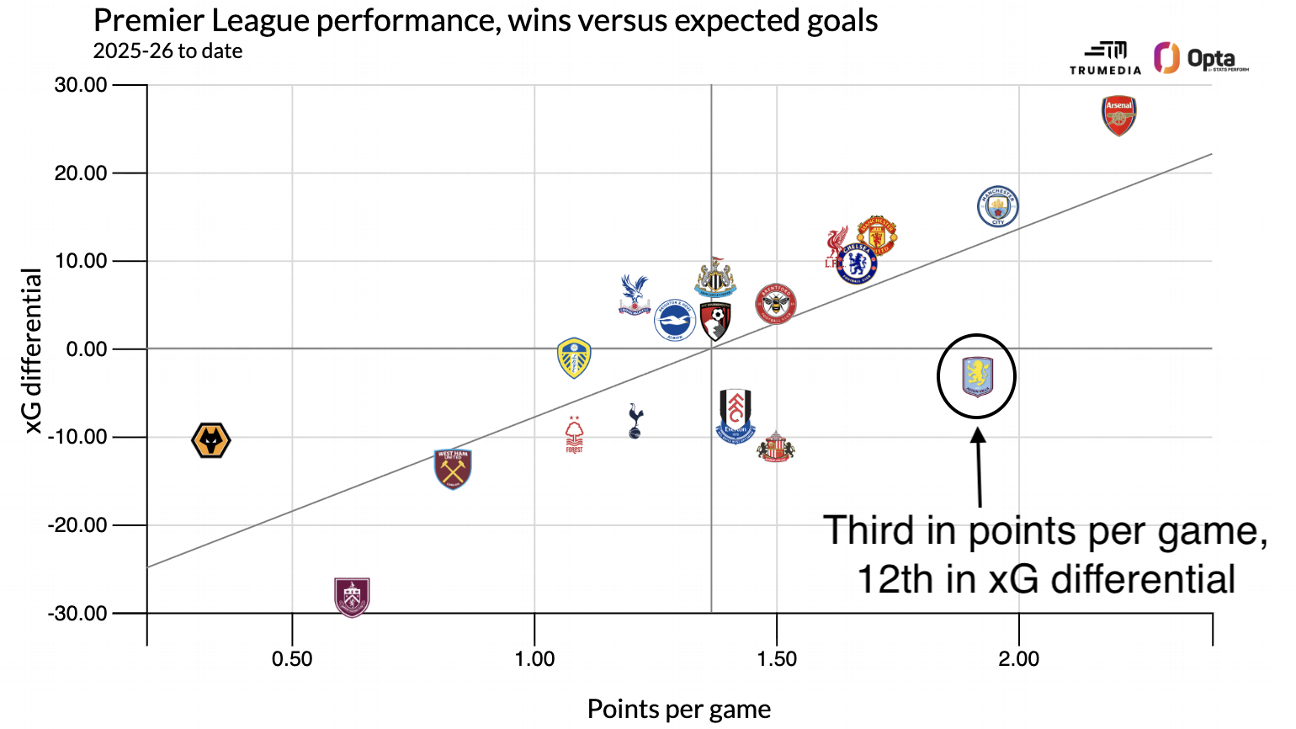
Even with an unlikely Sunday result — they lost 1-0 to Brentford despite an xG differential of +2.0 — they have the largest disparity in the league between their xGD and their place in the table. They rode a torrid finishing streak from Morgan Rogers to a nice series of results (from Nov. 23 to Dec. 21, he scored six goals while attempting shots worth just 2.1 xG). In this span, they won six straight matches, all by one goal. Sunday’s result might have been the start of a run of statistical comeuppance.
Even more worrisome than the stats are the midfield injuries. There are so damn many of them. Boubacar Kamara is out for the season (knee), Youri Tielemans (ankle) and John McGinn (knee) are out for a few more weeks, Ross Barkley (knee) is out, and Amadou Onana’s minutes are being managed because of muscle fatigue.
Villa added three players during the January transfer window, but only one — Juventus loanee Douglas Luiz, who was with Villa through 2023-24 — is, by trade, a midfielder. Villa’s next three league matches are against the teams ranked ninth through 11th above. Depending on what they get from a makeshift midfield, all three games are both winnable and losable.
Villa did make some short-term moves in January to theoretically shore up their top-five odds but Brentford, on the other hand, are not a short-term team.
Brentford’s only January move was for 18-year-old forward Kaye Furo, who had played only 89 league minutes for Club Brugge this season — that is the opposite of a win-now transaction. They’re going to ride with the hand they’ve been dealt, and of late it’s been a pretty good one. They’ve scored 14 goals in their last eight league matches, and that’s with Kevin Schade going through a minor finishing funk — since a Dec. 27 hat trick against Bournemouth, he’s failed to score despite generating shots worth 1.8 xG.
In these last eight matches, Brentford have attempted 26 shots worth at least 0.2 xG (most in the league) while allowing only 12 (sixth-fewest). This isn’t a team designed to generate huge shot volume, but if you’re attempting all the good shots, you’re going to give yourself a chance. And strangely enough, despite having hired prolific set-piece coach Keith Andrews as their manager — and despite playing in a league dominated by set pieces at the moment — they’ve done almost all their damage in open play.
Opta’s super computer now gives the Bees a 42% chance of finishing in the top seven, which would likely earn them a first ever spot in a European competition. But the next three matches will make a huge impact on those odds, one way or the other: They visit Newcastle on Saturday, then host Arsenal and Brighton. — Connelly
Let me take you back to the middle of October, when we last did these rankings. It was a time when there were three Premier League teams with a non-penalty xG differential of plus-4 or better: Arsenal, Manchester City, and Crystal Palace.
Sure, Palace had lost Eberechi Eze to Arsenal, but it seemed like it didn’t matter. This team was one of the best sides in the Premier League in the second half of last season, and the first seven games of this season did nothing to suggest that wasn’t still true. They beat Aston Villa, 3-0, and then thumped created nearly 3.0 xG worth of chances in a thrilling 2-1 win against Liverpool. With the potential for five Premier League teams to qualify for the Champions League, Palace looked like the most likely outsider to crash the party.
Come early December, they were crashing the party. A 2-1 win over Fulham moved them into fourth place, and they weren’t lucky to be there, either. Fifteen games into the season, only Arsenal, Manchester City, and Liverpool had produced better xG differentials.
So, uh, guess how many games they’ve won since then? That would be zero.
Over their last nine matches, they’ve drawn three and lost six. As you can see from some of the charts in the Arsenal section, Palace’s overall performance level still looks pretty good. But here’s how the league stacks up by non-penalty xG differential and goal differential from the most recent 10-game stretch:
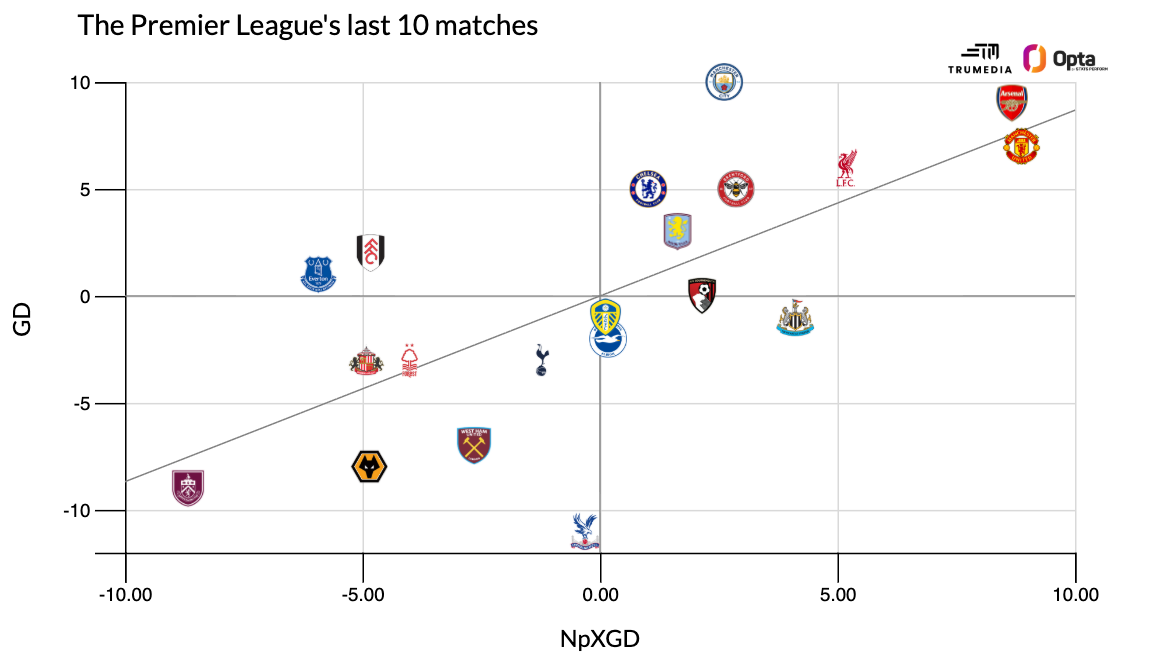
As you can see, you don’t go from being in the top four with peripherals that back it up to going winless in nine without two things happening: (1) your performance level dropping off and (2) the ball not bouncing your way. Palace have been about a league-average team for the last 10 games, but they’ve turned that into the worst goal differential in the league over the same stretch.
Normally, I’d say: hold tight, positive regression is coming! But it seems like this bad run has all but destroyed the club. Head coach Glasner had a public meltdown and announced he’ll be leaving after the season. After not allowing captain Marc Guéhi to leave over the summer, they decided it was fine for him to leave with just a couple months on his contract left and a much lower transfer-fee on offer. They also nearly let striker Jean-Philippe Mateta leave too — only for him to fail his medical exam with AC Milan.
On top of all that, there’s a good reason why the team got worse: they didn’t have enough players to handle midweek European matches that came with Conference League qualification. Through those first seven games, every member of their back five played every minute of every game. Since then: Guehi has left for Manchester City, and Chris Richards and Daniel Muñoz have both missed significant stretches of time. And everyone else has looked exhausted.
Now, Palace have added a couple of players in the January window: Brennan Johnson from Spurs and Jørgen Strand Larsen from Wolves, plus a loan for Aston Villa’s Evann Guessand. Johnson is a fine signing — a productive player from, technically, a Champions League side — while Strand Larsen is big, strong, has scored one goal this season, and plays the same position as Mateta. Guehi, notably, has not been replaced.
The performances haven’t been that bad, but the vibes are bad, the results have been terrible, and now they’ve lost their best player.
Healthy clubs are the ones that manage to overcome these runs of bad luck without panicking and sticking to the plan. If Palace wanted to be a healthy club, then they should’ve considered selling a 43% stake in the team to someone other than the guy who owns the New York Jets. — O’Hanlon
