

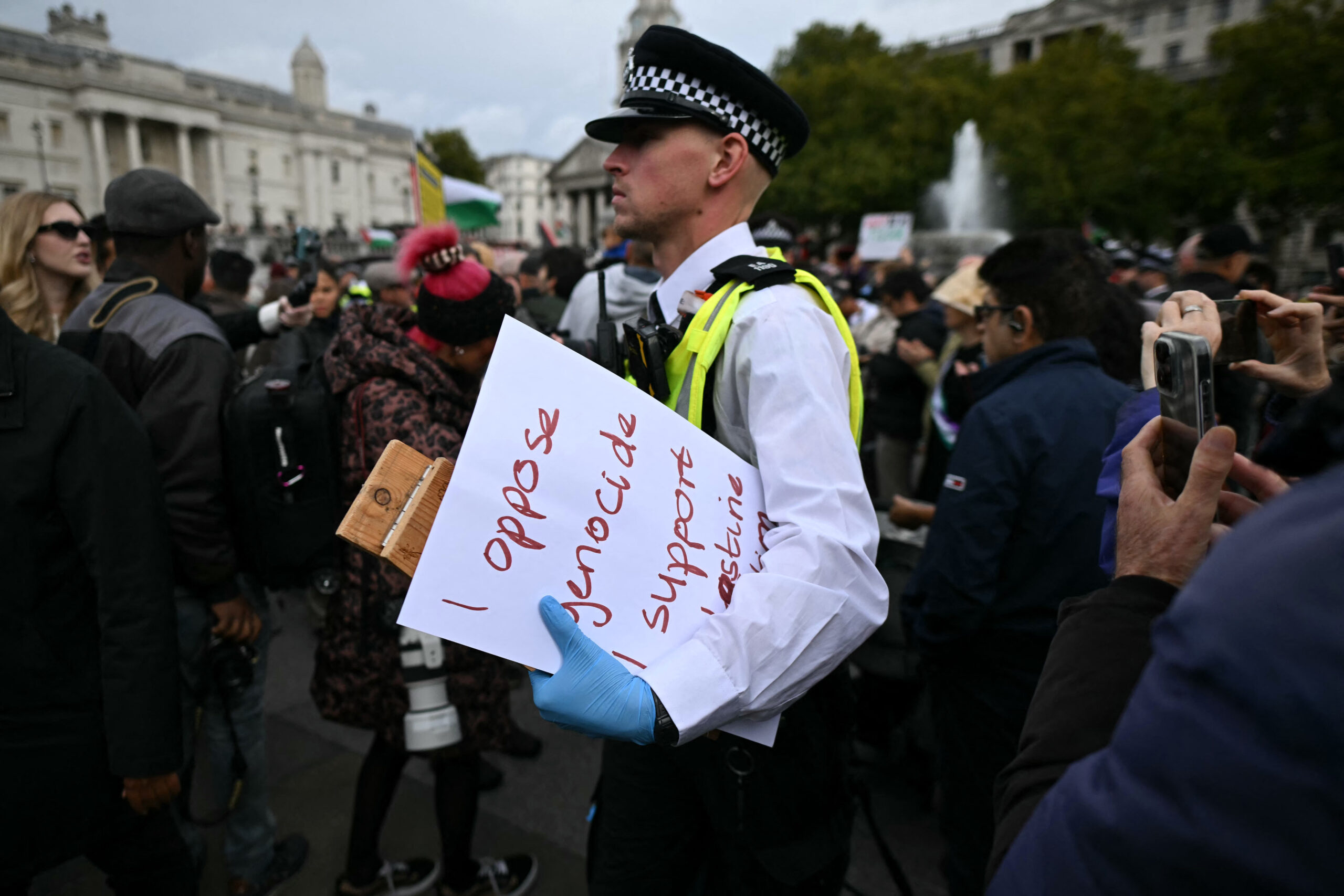
The Metropolitan and the Greater Manchester police forces are being accused of anti-Palestinian discrimination and clamping down on free speech after announcing that they will arrest people for chanting “globalise the intifada”.
In a statement on Wednesday, they said that protesters should expect the police to “take action” against anyone saying the phrase or displaying it on a placard.
“Violent acts have taken place, the context has changed – words have meaning and consequence. We will act decisively and make arrests,” they said.
At a protest outside the Ministry of Justice on Wednesday, four people were arrested for “racially aggravated public order offences” for their use of the Arabic word “intifada”, meaning uprising.
The move comes in the wake of the Bondi Beach shooting in Sydney on Sunday, in which two gunmen targeted a Hanukkah event, killing at least 15 people.
Several public figures have sought to link the shootings to Palestine activism, specifically referencing the chant.
Among them was British Chief Rabbi Ephraim Mirvis, who called the phrase “unlawful” and said that “Australians discovered what is meant by those words” after the attacks.
However, pro-Palestine activists and civil society organisations have rejected the characterisation of the chant as an antisemitic call for violence against Jewish people, giving examples of how it has been used throughout history and highlighting the role of prominent British Jewish figures in the movement.
New MEE newsletter: Jerusalem Dispatch
Sign up to get the latest insights and analysis on
Israel-Palestine, alongside Turkey Unpacked and other MEE newsletters
Advocates have also underlined that there have been no official reports linking the Bondi Beach attacks to Palestine activism.
Users took to social media to highlight the origins and meaning of the word “intifada”, raising questions over whether its English equivalent would also become criminalised.
“It is a problem when political speech is reclassified as racial hostility without properly considering the intent and context, particularly when we’re seeing the increasing criminalisation of Palestinian expression,” said one user on X.
Journalist Asa Winstanley described the policy as “pure anti-Palestinian racism”, saying that “’intifada’ is simply the Arabic word for ‘uprising’”.
“Palestinians are the only people in the world the British state says aren’t allow [sic] to revolt against occupation,” he added.
Several users expressed concerns over the implications of the decision on the future of free speech in the UK, warning of the dangers of increased infringement on democratic rights.
Foreign policy analyst Jasmine el-Gamal called the policy “a dark, dark turn of events”.
“The issue here isn’t ‘does the phrase globalise the intifada make people uncomfortable/feel unsafe’,” she said. “I understand it does and empathise… But is it a crime?”
“Let’s be clear what this means,” posted an activist. “Without any democratic decision nor legal instrument, the Met police are allowed to make political interventions in the law, literally police speech without basis and enforce them – with violence – with immediate effect.”
The word “intifada” in Arabic comes from the root “nafada”, which means to shake something off and to be finished with it.
When used in this form, “intifada” translates to a popular uprising, with its deeper meaning referring to the act of coming to consciousness about something and shaking it off from oneself.
The word has been used across the Arabic-speaking world to refer to a range of movements. It became popularised following the Palestinian uprising known as the First Intifada in 1987, which began after an Israeli army truck killed four Palestinians in Jabalia refugee camp in Gaza.
Some uprisings referred to as intifadas in Arab history were peaceful. In occupied Palestine, intifadas involved both civil disobedience and armed resistance against Israel.
