

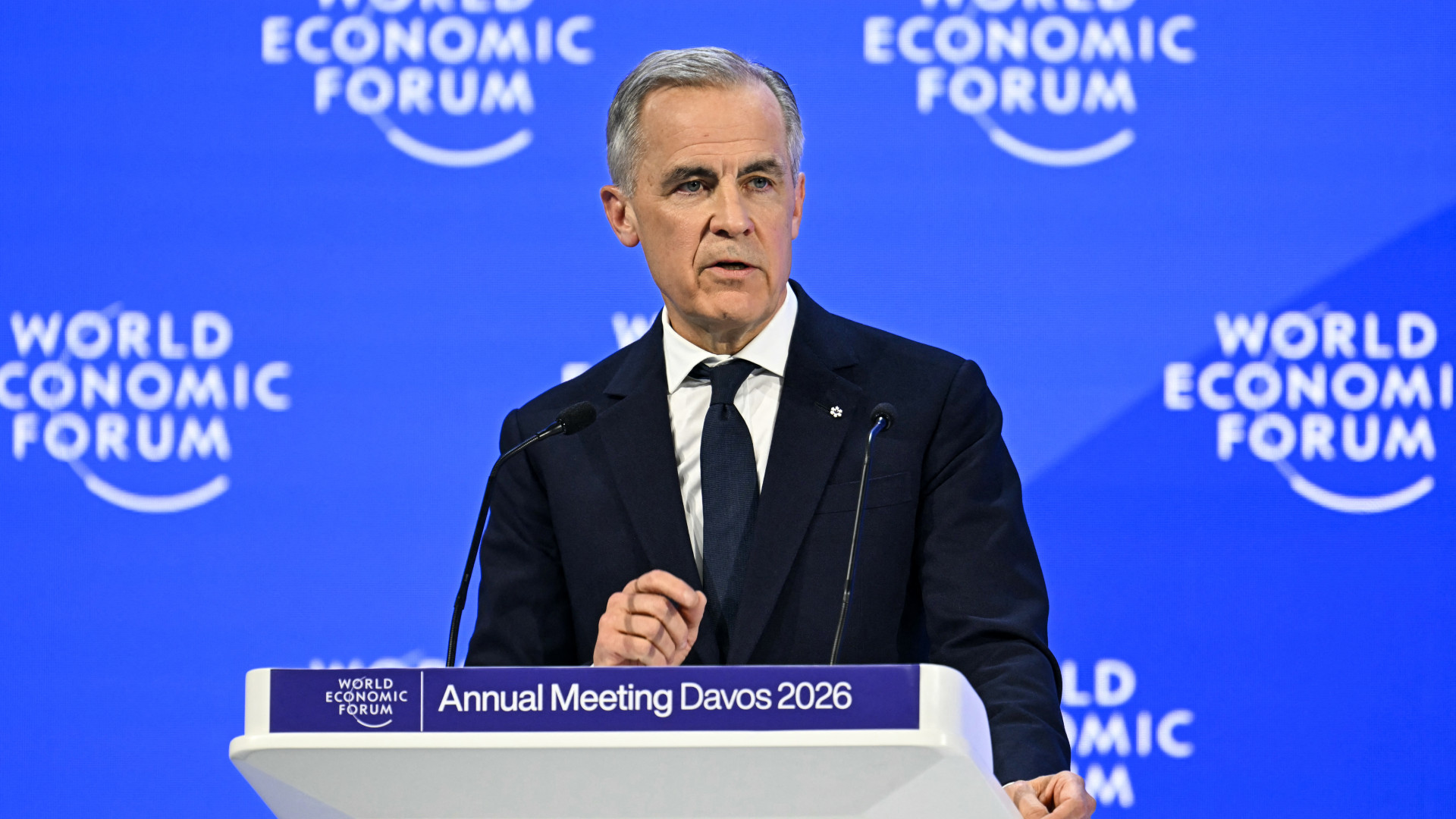
Sometimes historical turnarounds are triggered by minor events, such as a timely, inspiring and far-sighted speech.
In 1946, former British Prime Minister Winston Churchill delivered a landmark address in Fulton, Missouri, a largely unknown city in what was then a relatively secondary state of the United States.
He used the occasion to solemnly warn that an iron curtain was falling across Europe along the front line where the Allied powers had halted their advance after the defeat of Nazi Germany.
In retrospect, the speech became a historical rallying cry for the ensuing Cold War between the US and its allies on one side, and the USSR and its satellites on the other, following the brief convergence during the Second World War.
For many historians, the speech represented a wake-up call to western democracies about Soviet leader Joseph Stalin’s dangerous plan to spread communism globally following the defeat of the Axis powers.
New MEE newsletter: Jerusalem Dispatch
Sign up to get the latest insights and analysis on
Israel-Palestine, alongside Turkey Unpacked and other MEE newsletters
The 2026 edition of the World Economic Forum in the Swiss resort of Davos might be remembered as another historical turning point.
This time, however, the decisive moment may not be associated with US President Donald Trump’s now well-known behavioural incontinence, but rather with the speech delivered there by Canadian Prime Minister Mark Carney.
His remarks may one day be regarded by future historians as comparable in significance to Churchill’s address eight decades earlier, as they alerted western democracies to the collapse of the world order they had grown accustomed to and helped implement during the postwar era.
The speech also suggests that some western leaders are beginning to recognise a geopolitical reality that can no longer be ignored.
Davos shock
Carney’s words had a major impact. In Davos, they were tragicomically welcomed with a standing ovation – a rather odd reaction, considering that he sharply criticised many of the hypocritical and mistaken policies long promoted by the forum’s own audience.
His message also resonated widely across the Global South, where his candid and outspoken assessment of the end of the so-called rules-based world order (RBWO) confirmed what many had long believed.
The speech’s importance was further underscored by the fact that, for the first time, a leader of a G7 country showed the courage to tear away the veil of hypocrisy that has long covered western democracies’ global leadership.
In the temple of globalised capitalism, Carney stated that their beloved system was a scam steeped in double standards and that international law was invoked or ignored
As noted by British columnist Peter Oborne, Carney “took umbrage only when the US, under… Trump, threatened to treat the prosperous West in the same way it has long treated the Global South”. The double standard implicit in criticising western double standards was evident. Nevertheless, the speech may yet serve as a first step towards a more honest western posture.
From now on, the hope is that Canada will match its public statements on international politics with the words its prime minister uttered in the Swiss resort.
Carney did not hesitate in describing “a rupture in the world order, the end of a pleasant fiction and the beginning of a harsh reality – an era of great power rivalry, where the rules-based order is fading, where the strong can do what they can and the weak must suffer what they must”.
He recognised that Canada, like other western states, had prospered under that global system. However, he also admitted that “the story of the international rules-based order was partially false – that the strongest would exempt themselves when convenient, that trade rules were enforced asymmetrically, and that international law applied with varying rigour depending on the identity of the accused or the victim”.
In the temple of globalised capitalism, before an audience of financial and corporate elites, Carney stated that their beloved system was a scam steeped in double standards and that international law was invoked or ignored depending on whether friends or foes had violated it.
He further argued that the RBWO is no longer viable and is not facing a temporary crisis but a structural breakdown, caused by great powers that have shown no remorse for “using economic integration as weapons, tariffs as leverage, financial infrastructure as coercion, [and] supply chains as vulnerabilities to be exploited”.
Strategic shift
Although he did not explicitly name them, Carney’s remarks clearly referred to western democracies, and, above all, the US.
Still, it is important to note that these practices cannot be solely attributed to Trump, as they have been the gold standard for nearly all previous US presidencies. The only difference is that Democratic administrations, except for Joe Biden’s, were skilful in concealing their coercive policies behind lofty rhetoric and inspiring speeches, whereas Trump has been more blunt in his approach, discarding diplomatic pretence.
Carney delivered perhaps his most devastating blow when he warned: “You cannot live within the lie of mutual benefit through integration, when integration becomes the source of your subordination.”
Beyond its forceful denunciation of hypocrisy, the real value of the speech lay in the pragmatic course of action Carney outlined in response to this shifting landscape. “We actively take on the world as it is, not wait around for the world we wish it to be… and we are rapidly diversifying abroad.”
In this context, Canada appears to have adopted an escape route from US diktats. Carney agreed to a comprehensive strategic partnership with the EU and, in just six months, signed 12 other trade and security agreements across four continents, including new strategic partnerships with China and Qatar and ongoing negotiations for free trade agreements with India, Asean, Thailand, the Philippines, and Mercosur.
The rationale behind this activism and strategic shift is, as Carney himself put it, that middle powers must act together because “if we’re not at the table, we’re on the menu”.
This conclusion reflects a more realistic reading of world politics, in which intensifying great-power competition, driven by increasingly predatory instincts over strategic commodities, is generating a tectonic geopolitical shift towards a more polycentric world.
In this emerging order, multilateralism as a tool for resolving international disputes is increasingly sidelined in favour of coercion. Smaller states must adjust if they wish to avoid not only being “on the menu” but also the binary logic behind such alignments: either you are with us or against us.
Emerging order
Nothing captures the current shift in the world order better than Chinese President Xi Jinping’s call for the renminbi to assume a global reserve role. What was discussed discreetly only two years ago in a closed meeting of the Chinese Communist Party has now entered the open.
In Washington, it is widely regarded as one of the most sensitive threats to US power to date – more consequential than many of China’s military or technological advances – because it threatens one of the central pillars of American global hegemony: US control over the world’s financial system.
Indeed, the Global South had already recognised and begun preparing for this gradual shift in the international system. The Brics grouping – originally Brazil, Russia, India, China and South Africa – is one prominent example. It is now expanding to include new member states, mainly middle powers in Latin America, Africa and Asia that seek to distance themselves as much as possible from what is now perceived as a decadent yet aggressive Global West.

Carney wants a new world order – but only for the West
Read More »
Canada appears to be the first to break ranks.
One of the most striking consequences of Carney’s speech was not only its disruptive content, but the complete absence of any meaningful reaction from Europe’s top leaders. Only Finland’s president described it in clearly positive terms, while Nato Secretary General Mark Rutte responded politely, seemingly without realising that his Canadian counterpart had just called into question much of what he, as a Dutch politician, had stood for over the course of a not particularly distinguished political career.
More disappointing still is that such a pronouncement did not come from a European leader. In Davos, the same EU leaders whom Trump had just slapped down appeared to tolerate similar treatment from Ukrainian President Volodymyr Zelensky. He brazenly criticised them even after they had just committed a further €90 billion ($106bn) in aid to his war-ravaged country.
It remains to be seen whether the Canadian prime minister’s speech will prove to be the long-overdue wake-up call that western democracies, especially in Europe, need to rethink their self-harming policies. For now, however, that prospect appears closer to wishful thinking.
If the past two decades come to be seen as a kind of Second Cold War, Carney’s speech may one day be remembered as the moment when western democracies began, slowly and reluctantly, to recognise that they were losing it.
The views expressed in this article belong to the author and do not necessarily reflect the editorial policy of Middle East Eye.
