

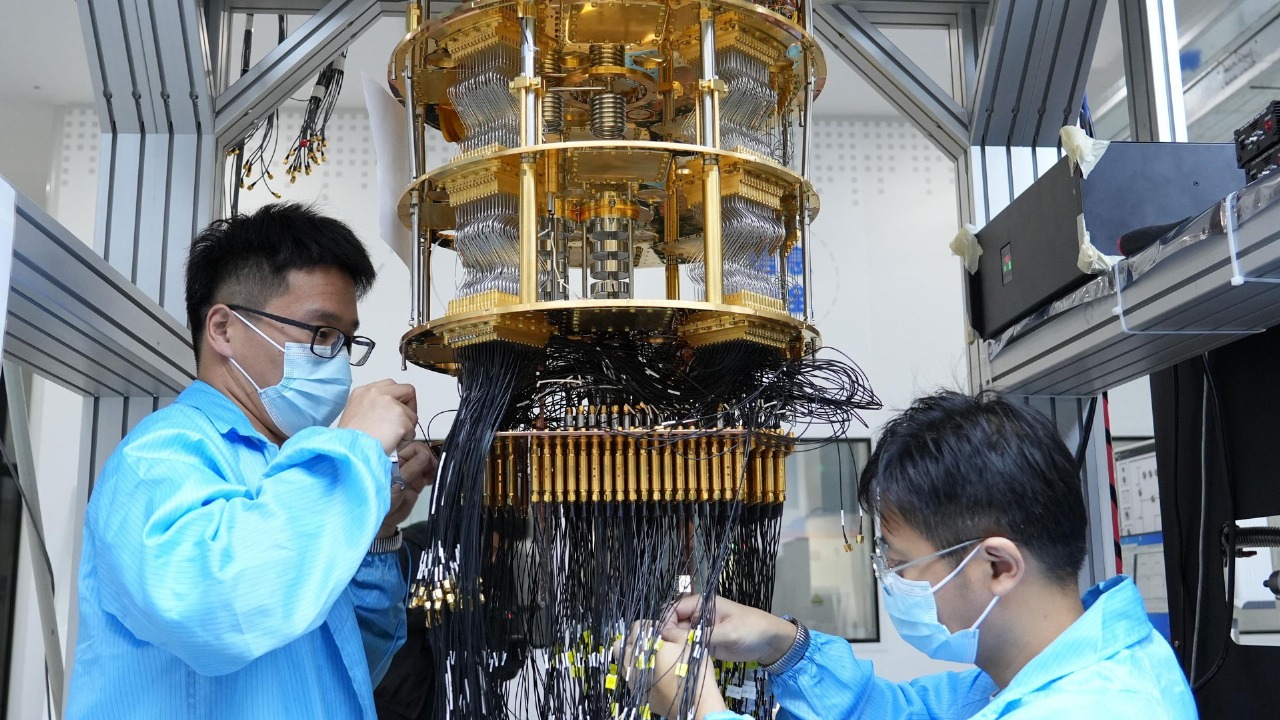
Quantum computing may be the asymmetric weapon China deploys to finally roll back decades of US military dominance.
This month, Nikkei Asia reported that China’s rapid push into quantum computing is emerging as a potentially decisive military equalizer, with experts warning that the technology could eclipse traditional symbols of US power such as aircraft carriers.
Experts note China’s investment surge — including a planned 1 trillion renminbi (US$140 billion) state-backed fund to accelerate “hard technologies” like quantum systems — is aimed at securing an advantage ahead of the expected 2030s arrival of “Q-Day,” when quantum computers may be able to break all classical encryption.
Jesse Van Griensven of EigenQ said quantum machines could eventually disable airports, power grids and military networks, reducing the US “to the Stone Age” without firing a shot.
Ryan Fedasiuk of the American Enterprise Institute (AEI) warned that if China achieves an error-corrected quantum computer before the US, Japan or Taiwan transition to quantum-resistant algorithms, China could read decades of stolen data under its “harvest now, decrypt later” strategy.
Analysts also noted China’s large-scale rollout of quantum communications and Quantum Key Distribution (QKD) networks, giving it a head start in securing its own systems. Although quantum capabilities remain immature, experts said the first nation to achieve fault-tolerant machines could gain instantaneous access to adversaries’ secrets, fundamentally reshaping future warfare.
These quantum breakthroughs matter far beyond hacking and encryption — they cut directly into the platforms that anchor the US’s strategic power.
Quantum computers use qubits that occupy multiple states at once, letting them explore countless possibilities in parallel rather than step by step. QKD, meanwhile, uses quantum particles to transmit encryption keys that expose any attempt to intercept them.
Underscoring the military advantages afforded by quantum computing, a May 2025 US Defense Intelligence Agency (DIA) report mentions that quantum communications, computing and sensing will probably provide militaries with more advanced capabilities in decryption, positioning, navigation and timing, as well as intelligence, surveillance and reconnaissance (ISR).
It adds that quantum-enabled advances will improve targeting and long-range precision fires, potentially giving early adopters a decisive edge. The report stresses that while a true quantum breakthrough is unlikely through the next decade, the technology is nearing real-world application, posing strategic challenges for US defense planning.
In terms of nuclear deterrence, Jahara Matisek and other writers mention in an October 2025 article for the Center for Strategic and International Studies (CSIS) think tank that quantum sensing threatens to expose nuclear delivery platforms long considered invulnerable.
Matisek and others say that nuclear ballistic missile submarines (SSBNs), the backbone of any nation’s second-strike capability, could be tracked through quantum magnetometers detecting minute magnetic anomalies, while gravimeters reveal hidden intercontinental ballistic missile (ICBM) silos or tunnels. They add that stealth bombers, designed to evade radar, may be detected through quantum optical sensors that exploit atomic-scale precision.
They state that by compressing decision timelines and eroding survivability, these technologies risk destabilizing strategic balances, as adversaries gain the ability to neutralize second-strike forces. They warn that without rapid adaptation, quantum breakthroughs could shrink maneuver space and weaken the credibility of nuclear deterrence.
China’s recent military messaging reinforces these fears. Beijing hasn’t shied from flaunting its developments in quantum technology, touting a drone-mounted quantum device and a quantum gravimeter for submarine detection and navigation, and a quantum radar detector for use against stealth aircraft.
These claims may show that China is increasingly focused on the air-and-sea-based legs of the US nuclear arsenal, with the US use of land-based ICBMs potentially constrained by the problem of overflight over Russian territory to hit China from existing US missile silos.
Illustrating the potential threat that US SSBNs and strategic bombers pose to China, a March 2025 report by the South China Sea Strategic Situation Probing Initiative (SCSPI), a Chinese think tank, states that in 2024 at least 11 nuclear attack submarines (SSNs), two nuclear guided-missile submarines (SSGN) and one SSBN operated in the region, supported by intensified tender activity, signaling a strengthened and sustained underwater presence.
It also adds that US strategic bombers conducted 56 sorties—nearly double 2023 levels—primarily B-52Hs, with additional B-1Bs and rare B-2 appearances. It notes that these bomber deployments emphasized dynamic force employment, including “north–south double-axis” routes via Luzon and the Sulu Sea, and increasingly integrated exercises with allies such as Australia and Japan, underscoring expanded air-based deterrence.
Taken together, these developments suggest a coherent Chinese strategy. Propaganda or not, these claims show that China may be taking a technological leapfrog approach to offset established US advantages.
In this case, China may not be seeking to match the US in terms of nuclear warheads, SSBNs, ICBMs and stealth bombers, but is planning to employ quantum technology as an asymmetric means to offset longstanding US advantages – in this case, a mature nuclear triad.
Dismissing these Chinese signals outright would be risky; strategic surprises rarely announce themselves. Thus, it would be prudent to plan for a contingency where US second-strike capabilities are compromised. In line with that, quantum technology can reinforce US missile defense – keeping abreast of potential adversary advances, thereby maintaining US advantages or strategic stability.
Paul Lipman, in a July 2025 Forbes article, mentions that quantum optical atomic clocks deliver picosecond accuracy independent of GPS, ensuring synchronized operations across satellites, radars and interceptors. Lipman adds that quantum radiofrequency sensors detect faint or stealthy missile signals even in jammed environments, enabling passive, resilient monitoring.
He adds that quantum-inspired AI rapidly processes massive multisource data, distinguishing real threats from decoys and guiding interceptors in real time, and that ruggedized quantum systems deployed in space add resilience under attack. Altogether, Lipman states these advances create a layered, adaptive shield that detects, tracks, and neutralizes advanced missiles, reinforcing deterrence by denial.
Still, all the military advantages and claims touted by quantum technology proponents should still be taken with a grain of salt.
Michal Krelina mentions in a July 2025 report for the Stockholm International Peace Research Institute (SIPRI) that forecasting the military impact of quantum technology is inherently uncertain because it is impossible to predict how fast specific quantum applications will mature, whether they will scale beyond laboratory conditions or how states will choose to integrate them into force structures and doctrines.
Krelina notes that operational timelines remain speculative and that military adoption will depend on factors such as engineering feasibility, industrial capacity, procurement priorities and strategic incentives. As a result, he says, assessments of quantum-driven shifts in deterrence or strategic stability should be treated with caution, not inevitability.
