

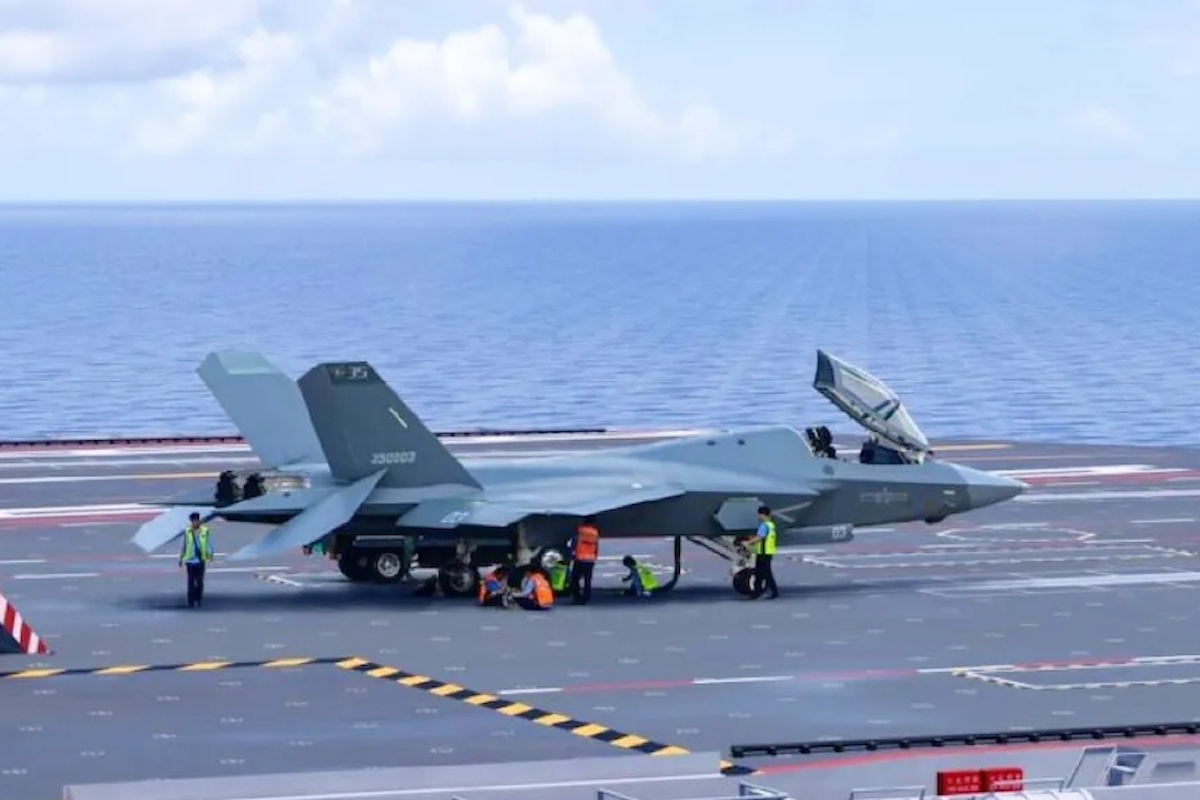
China’s push to expand production of the J-35 stealth fighter reflects its drive to link industrial scale with a carrier-centric doctrine, thereby strengthening its position against Taiwan, narrowing the gap with US airpower and capturing high-end export markets.
This month, the South China Morning Post (SCMP) reported that China’s leading naval fighter manufacturer has signaled a significant ramp-up in combat aircraft production as China accelerates its military modernization drive.
The Shenyang Aircraft Corporation (SAC), a subsidiary of state-owned Aviation Industry Corporation of China (AVIC), released footage showing a J-35 stealth fighter conducting its first flight of the year at its airfield in Liaoning province, while pledging to double overall warplane output within three to five years.
Images accompanying the video showed at least two green-primed J-35 jets fresh off the assembly line, underscoring what Chinese state media described as a steady production pace following the aircraft’s official induction into service last year.
According to a Liaoning Daily report cited by state media, SAC’s new assembly plant was structurally completed in mid-2025, with mass production expected to begin this year as part of a sprawling “Shenyang Aerospace City” industrial zone.
The company plans to build an “intelligent manufacturing” system spanning the entire production chain, after investing 8.6 billion yuan (US$1.2 billion) in a new 4.2-square-kilometer facility.
The J-35, China’s most advanced carrier-based stealth fighter, is meant to form the core of air wings on its new-generation aircraft carriers. Operating from catapult-equipped carriers, the J-35 aims to contribute to Chinese power projection, provide fleet air defense and assist in achieving sea and air control in regional conflicts, particularly a potential conflict over Taiwan.
Justin Bronk mentions in a Royal United Services Institute (RUSI) article this month that while the J-35 is still in the early phases of its rollout, production is expected to scale rapidly, following patterns seen with the J‑20 and J‑16.
He notes the J-35 will likely integrate avionics, sensors and weapons technologies derived from the mature J‑20, giving it advanced networking, active electronically scanned array (AESA) radar and compatibility with long‑range missiles.
The Chinese military describes the J-35 as a medium-sized multi-role stealth fighter capable of both air superiority and strike missions against ground and maritime targets, in contrast to the larger J-20, which is a heavy stealth fighter designed for air superiority.
Official Chinese sources also indicate the J-35 will operate alongside the Type 003 Fujian carrier and amphibious assault ships, integrating carrier aviation into broader joint maritime operations.
But how would China likely employ the J-35 in combat? The China Aerospace Studies Institute (CASI) mentions in a July 2024 report that the People’s Liberation Army Navy’s (PLAN) catapult-equipped carriers, including the Fujian and subsequent designs, will enhance battlegroup capabilities, including airborne early warning and command (AEW&C), anti-surface warfare and with more advanced fighters such as the J-35.
The report states that in wartime, carrier groups could help the People’s Liberation Army Navy (PLAN) defend against the enemy’s efforts to disrupt its vital sea lines of communication (SLOC) and may also participate in strikes on high-value targets within the adversary’s “strategic depth.”
Contextualizing that doctrine into a Taiwan scenario, Lianhe Zaobao mentions in a November 2025 Think China article that the Fujian carrier and Type 076 Sichuan drone-centric amphibious assault ship would operate as a paired, mutually reinforcing force.
Lianhe notes that the Fujian, a full‑sized carrier with manned J‑35 and J‑15T fighters, would position east of Taiwan to cut off escape routes, impose sea and air control, and block US or Japanese intervention. He adds that the Type 076 Sichuan would focus on landing operations and launching drones, helicopters and amphibious forces to suppress defenses and deliver troops ashore.
Together, he notes that the Fujian and Sichuan form a “dual electromagnetic‑catapult” strike system combining air dominance, drone swarming, reconnaissance and amphibious projection for multidirectional pressure.
But how would China’s J-35 fare against US and its allies’ air power?
Asia Times noted in April 2025 that Taiwan’s air force would face a significant qualitative and numerical disadvantage against China’s J‑20 and future J‑35 fleets. As of 2025, China already fields an estimated 300 J-20s and roughly 57 J-35s on top of a large number of older-generation fighters such as the J-10, J-11, J-15 and J-16.
Taiwan’s estimated 200 upgraded F-16Vs may still be outclassed by China’s stealth fighters, much as Ukraine’s older-model F-16s struggle against Russia’s Su‑35s. Still, Taiwan could employ its F-16Vs against China’s older generation fighters, use them in strikes against Chinese ships and landing forces, or employ them to launch standoff munitions while staying out of range of Chinese air defenses and fighters.
While the J-35 has been derided as a clone of the US F-35, Isaac Seitz notes in a June 2025 National Security Journal article that the J-35 is likely less stealthy than the F-35 but offers higher speed (Mach 2.0+), a slightly longer combat radius and is optimized for carrier operations.
In contrast, Seitz says the F-35 has superior all‑aspect stealth, world‑leading sensor fusion and a proven combat record. Still, he stresses that while the F‑35 retains a technological edge, the J‑35 signals China’s rapidly advancing aerospace capabilities.
In a November 2025 article in the peer-reviewed RUSI journal, Rahul Manohar Yelwe mentions that China sees the J-35 as a potential breakthrough into the high-end fighter export market but faces major structural hurdles.
Yelwe notes that China aims to market the J-35 as a lower-cost, politically less conditional alternative to the F-35 for states excluded from Western defense networks, with Pakistan, parts of the Middle East and Africa identified as potential customers.
However, he notes that export prospects are constrained by intense competition from the F-35 and emerging rivals such as South Korea’s KF-21 Boramae, persistent concerns over Chinese aircraft reliability, immature engines and avionics, and perceived weak after-sales support.
Yelwe states that China must improve lifecycle sustainment, quality control and provide a clear upgrade roadmap for the J-35 to become a credible, long-term export success.
Together, the J-35’s expanding production, evolving carrier role and uncertain export prospects highlight both the speed of China’s aerospace rise and the unresolved gap between industrial scale and sustained qualitative advantage.
