

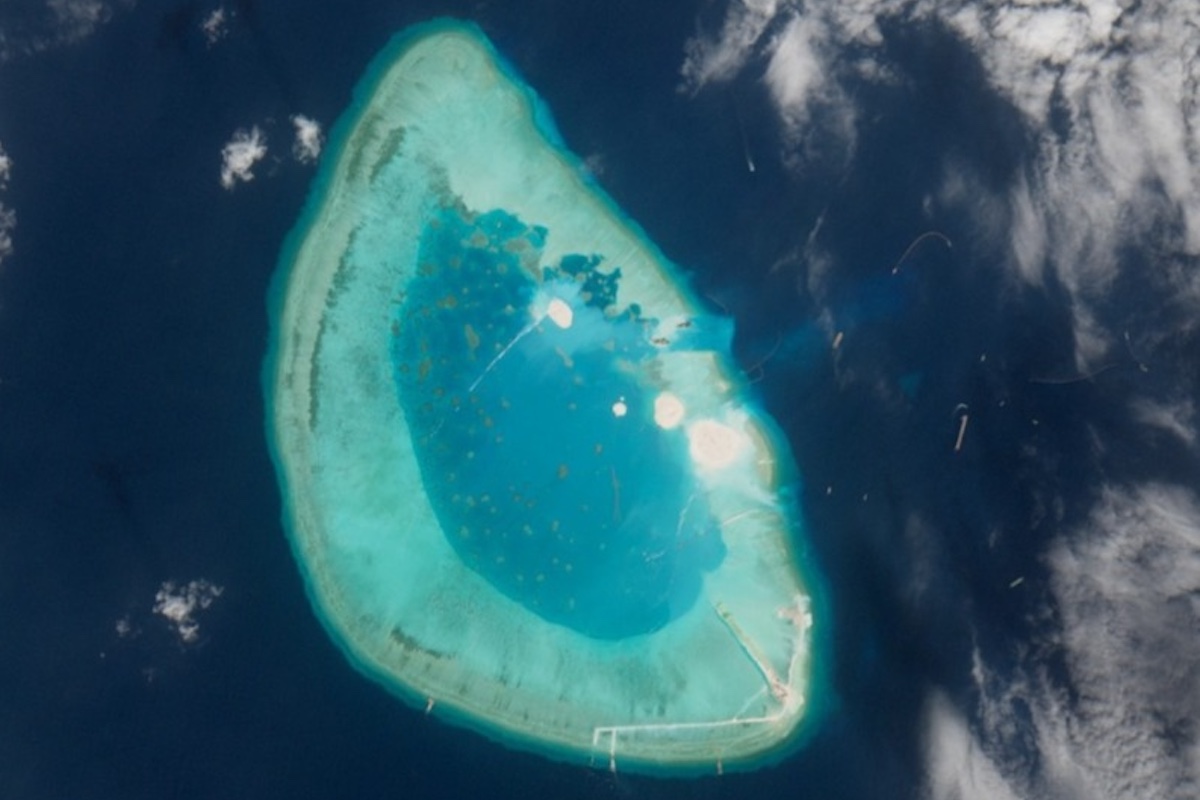
China’s renewed construction at a little-known reef in the South China Sea is sharpening a deeper debate over whether US military power can still decisively roll back China’s expanding maritime footprint in a high-end conflict.
This month, Newsweek reported that China has stepped up land reclamation at Antelope Reef, a disputed coral feature in the South China Sea, according to satellite imagery showing new dredging activity beginning in October, underscoring the continued consolidation of its maritime claims.
The reef, known as Linyang Jiao in Chinese and Da Hai Sam to Vietnam, lies in the western Paracel Islands, about 400 kilometers east of Vietnam’s Hue and roughly 281 kilometers southeast of China’s Sanya naval base on Hainan.
Images from the European Space Agency’s (ESA) Sentinel-2 satellites show sand dredging concentrated at four sites along the eastern and southern edges of the lagoon, with additional land forming on both sides of an existing outpost and port facility.
China, which has controlled the Paracels since seizing them from South Vietnam in 1974, claims most of the South China Sea, a vital trade route that carries up to one-third of global maritime commerce.
The latest work fits a broader pattern of strategic investment following earlier upgrades to China’s artificial islands, including enhanced surveillance and electronic warfare capabilities.
The activity comes as Vietnam accelerates its own reclamation in the Spratlys, heightening regional tensions, though Vietnam has historically calibrated its protests to avoid damaging ties with China.
Before these efforts, the Asia Maritime Transparency Initiative (AMTI) groups Antelope Reef, along with Observation Bank, Quanfu Island, and Yagong Island, as features that were “little more than sandbars,” having minimal infrastructure, just one or two buildings. However, AMTI observes that the presence of construction materials and small structures suggests China may be planning to expand these features – possibly at this moment.
Situating China’s island-building efforts into a larger tactical picture, a July 2025 article published by the People’s Liberation Army (PLA) says that China’s South China Sea outposts provide all-weather and all-round situational awareness capabilities, which can effectively monitor every move of military forces within the area.
Within the Paracels, Antelope Reef could serve as an additional forward site for helipads and anchorage for China’s warships, maritime law enforcement, and maritime militia, with the advantage of being readily resupplied from Hainan.
It also enhances dispersion, overlap, and redundancy for PLA surveillance and anti-access/area denial (A2/AD) capabilities in the area, including signals intelligence (SIGINT), electronic warfare, and host anti-air or anti-ship missile systems. These capabilities become more effective as the number of dispersed sites increases.
China’s reclamation work on Antelope Reef may be intended to turn a weak link into a functional node in its artificial island network in the South China Sea. In the larger picture, China’s force posture on its artificial islands makes it risky for weaker rival claimant states, such as Vietnam, to assert their territorial claims in the South China Sea, thereby securing de facto Chinese control of the area.
However, that strategy may fail in wartime – especially when a US-China conflict over Taiwan spills over to the South China Sea. A May 2025 US Congressional Research Service (CRS) report states plainly that PLA bases in the South China Sea would be vulnerable to a US attack.
Highlighting that assessment, Isaac Kardon notes in a January 2023 hearing before the US-China Economic and Security Review Commission that widely diffused precision-strike technologies could make these island bases soft targets.
Despite those confident assessments, US strikes against military airfields may not be as effective as thought. For example, although the US used 59 Tomahawk cruise missiles against Al-Shayrat Airbase in Syria in 2017, the airbase was quickly repaired within a few hours, and flight operations resumed shortly after the US attack.
In line with that, Thomas Corbett mentions in a June 2023 China Aerospace Studies Institute (CASI) report that the PLA has invested heavily in rapid runway repair and airfield recovery in anticipation of US airstrikes, treating damaged airfields as an expected feature of modern warfare.
Corbett notes that the PLA has institutionalized runway repair training across the PLA Air Force (PLAAF) and PLAN Aviation, focusing on explosive ordnance disposal (EOD), crater cutting and refilling, resurfacing, and rapid debris removal.
He adds that the PLA has adopted quick-drying concrete, specialized engineering equipment, and structured repair drills, often integrating local militias and civilian construction assets under its military-civil fusion (MCF) strategy.
However, he cautions that exercises often lack realism, with pre-positioned equipment and variable timelines, meaning actual wartime effectiveness remains uncertain.
It may also be prohibitively expensive for the US to neutralize China’s outposts in the South China Sea. Gregory Poling notes for War on the Rocks that it could take up to 300 missiles to destroy China’s major Spratlys outposts, 100 missiles for Woody Island, and dozens more for smaller outposts. Poling stresses that such a scenario could stretch limited US missile stocks from more critical areas near Japan and Taiwan.
Highlighting this potential missile shortfall, Seth Jones mentions in a January 2023 Center for Strategic and International Studies (CSIS) report that the US would likely run out of long-range precision-guided munitions such as Tomahawks in less than a week during a US-China conflict over Taiwan, impacting its ability to sustain combat and weakening deterrence.
Jones argues that the US defense industrial base lacks sufficient surge capacity, with missile production timelines measured in years rather than months, leaving it ill-prepared for a protracted, high-intensity war with China.
But instead of preparing to absorb such punishing strikes, China may be aiming to make such strikes not an option in the first place.
Considering China’s electronic warfare capabilities in its South China Sea outposts, a November 2025 report by the US-China Economic and Security Review Commission notes that the PLA seeks to suppress, disrupt, and degrade adversary sensors, communications, and GPS signals to gain an advantage on future battlefields, especially in high-end contingencies such as a Taiwan conflict.
The report states that the PLA’s doctrine increasingly emphasizes electromagnetic spectrum control as part of joint operations, aiming to deny adversaries timely and accurate information while protecting its own networks.
These capabilities may also prevent US and allied forces from communicating, detecting, identifying, tracking, and engaging a PLA core advantage — its robust command, control, and communications systems dispersed across its artificial islands.
This prompts questions about whether US firepower can succeed against China’s strategy, which restricts US access to information—essentially blinding the former. It also highlights a strategic difference: the US targets key vulnerabilities, while China aims to restrict adversaries’ choices.
In sum, China’s buildup at Antelope Reef points to a strategy focused less on defending island bases than on denying the US information and options, raising the cost and uncertainty of intervention over Taiwan rather than winning a direct strike exchange.
