

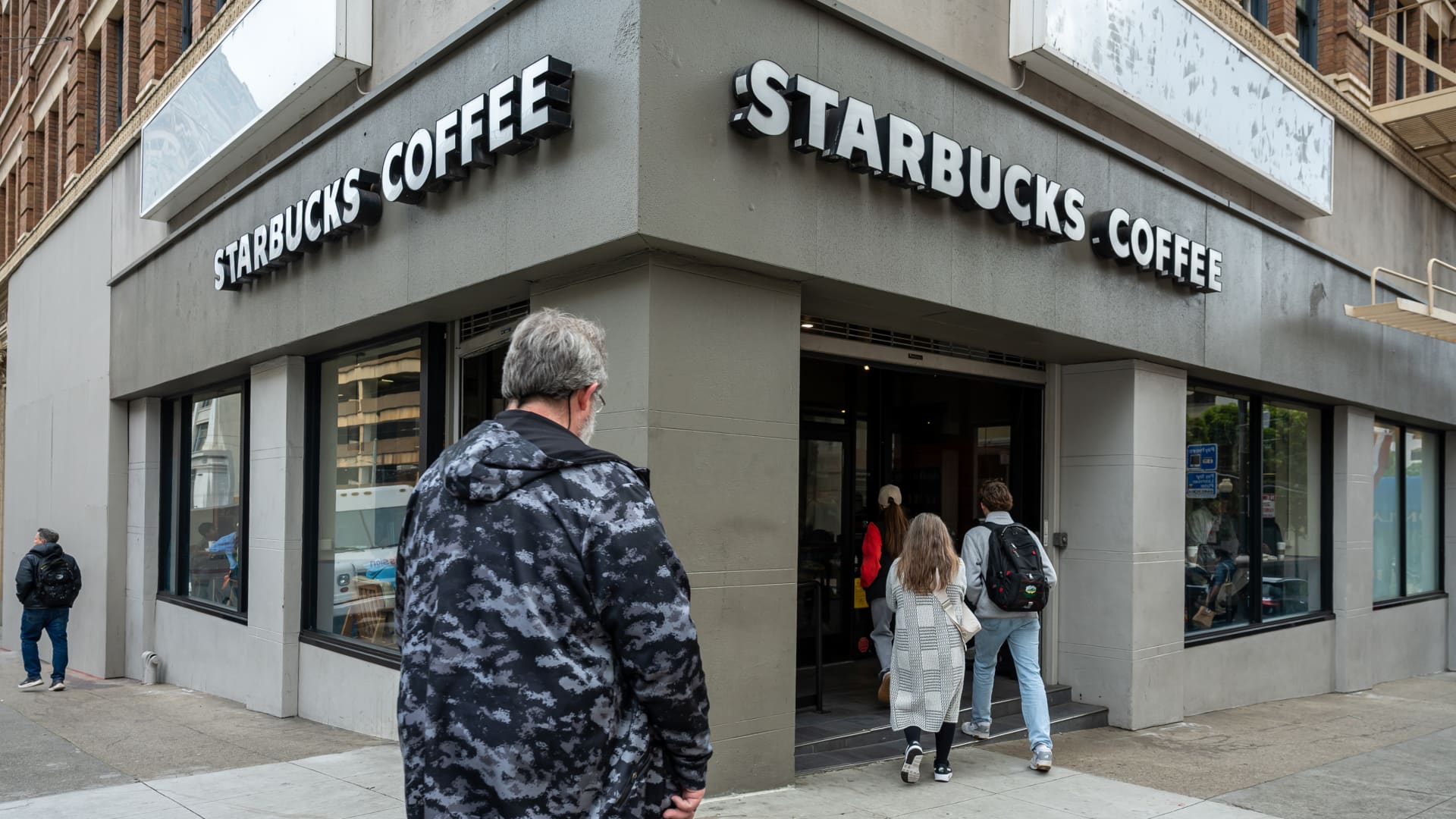

Starbucks has returned — at least, that’s what executives said at the company’s investor presentation in New York City on Thursday.
“Starbucks is back today,” Chief Brand Officer Tressie Lieberman said. “One in three consumers say that Starbucks is their first choice for coffee or tea away from home.”
Her proclamation comes more than a year after CEO Brian Niccol joined the company and kicked off a turnaround strategy, of course named “Back to Starbucks.” The plan largely took aim at improving the coffee chain’s in-store experience, after years of prioritizing mobile orders and profits at the expense of customers and employees. The strategy included small touches, like reintroducing the condiment bar and requiring baristas to use Sharpies to write personal messages, and bigger investments, like staffing more baristas and revamping its cafes for $100,000 a pop.
“Frankly, the shine is back on Starbucks, both here in the United States and around the world,” Niccol said on Thursday.
The company’s latest financial results seem to show that customers are coming back, and the turnaround is taking hold. As a result, this year, Starbucks plans to look forward, rather than back.
“In fiscal 2026, we’re going to be shifting to play offense and to innovate,” Niccol said. “We’re not finished with our ‘Back to Starbucks’ plan or our broader transformation, but I am confident in our strategy, our progress, the pace of change and the opportunity ahead of us.”
By fiscal 2028, the coffee chain is projecting global and U.S. same-store sales will grow at least 3%, revenue will rise at least 5% and earnings per share of $3.35 to $4. It also plans to add more than 2,000 cafes globally in fiscal 2028, including 400 net new company-owned U.S. locations.
“This is just a waypoint in our turnaround. Our ambitions extend well beyond this timeline,” Niccol said.
In the coming months, Starbucks plans to reintroduce tiers to its loyalty program, launch Energy Refreshers and more efficient espresso machines, all with the aim of meeting those new financial targets.
In fiscal 2028, Starbucks is also aiming for consolidated operating margins in a range of 13.5% to 15%. To achieve pre-pandemic margins, the company plans to grow sales and cut $2 billion in costs, CFO Cathy Smith told CNBC’s Kate Rogers.
“For us, pricing is going to be our last lever,” Smith said. “Having a great value perception by our customers is really important.”

Starbucks investors did not appear as confident as executives Thursday: shares of the company slid more than 1% in morning trading. The stock has fallen about 12% over the last year, dragging Starbucks’ market value down to about $109 billion. In addition to skepticism about the company’s turnaround, investor concerns about the broader pullback in consumer spending and higher coffee prices have weighed on the company’s valuation.
‘Just the beginning’
The investor day comes a day after the company released its fiscal first-quarter earnings report.
For the first time in two years, the coffee chain’s traffic rose, fueling same-store sales growth of 4%. A year ago, the company’s same-store sales fell 4% as transactions shrank 6%.
The company has made progress on some of its goals, like making every drink in under four minutes, CEO Brian Niccol said on CNBC’s “Squawk Box” on Thursday morning.
“This is really just the beginning,” Niccol said of the company’s turnaround.
But while Starbucks’ turnaround strategy is bearing fruit on the top line, investments in its restaurants and labor weighed on profits during its fiscal first quarter. The company’s quarterly earnings per share missed Wall Street’s estimates.
Executives on Wednesday also shared the company’s first annual forecast since Niccol suspended its outlook more than a year ago, shortly after taking the helm at Starbucks. For fiscal 2026, Starbucks is projecting adjusted earnings per share in a range of $2.15 to $2.40 and global and U.S. same-store sales growth of at least 3%.
Menu changes like protein cold foam have helped Starbucks draw both loyal and infrequent customers, Niccol told CNBC’s Andrew Ross Sorkin. Ahead, the company has more menu innovation on deck, plus changes to its rewards program and an improved digital experience, he added.
Much of that innovation will, of course, focus on Starbucks’ drinks. This spring, the coffee chain plans to launch a premium, sugar-free version of its chai, Lieberman said during the investor presentation.
Starbucks is also going to introduce Energy Refreshers, the latest expansion of its $2 billion drink line. The new additions will contain more caffeine than the original Refreshers, which give drinkers roughly the same boost as a caffeinated soda.
Starbucks’ China pivot
Executives also shared more details on the company’s international operations, which will undergo a major transformation when Starbucks forms a joint venture with Boyu Capital to run its business in China, the company’s second-largest market.
After the deal closes in the second quarter of fiscal 2026, pending regulatory approval, Boyu will hold up to a 60% interest in the joint venture.
While the deal will result in lower international revenue, the division’s asset-light model is expected to boost Starbucks’ profits in the long run. Over the last decade, McDonald’s and Coca-Cola have pursued similar strategies, refranchising their international restaurants and bottlers, respectively, to cut operating costs and lift earnings.
In fiscal 2025, Starbucks’ international margins were 13%; assuming the joint venture is formed, the company expects that margins will rise to the high teens, according to Brady Brewer, CEO of Starbucks International.
Both the fiscal 2026 and fiscal 2028 forecasts assume that the company will continue to operate Starbucks’ retail stores in China. While the company expects profit margins would rise as part of the plan, overall earnings may not increase quickly.
Under the joint venture model, the company’s earnings per share in fiscal 2028 would fall by about 15 cents, Smith said.
“I do want to say that’s with our current plans for the China market,” Smith said. “We fully expect, with our new partner, that actually we would see higher growth in China … and so I would think that we would be able to offset some of that into the future.”

