

The most dreaded part of Mainul Islam’s journey back to Saudi Arabia is passing through Dhaka International Airport.
The 34-year-old construction worker’s journey to Dammam begins with a five-hour train ride from his village in north-west Bangladesh.
Carrying more bags than he can hold, Islam jumps off his train in Dhaka, weaving through the city’s busy roads, to walk up the ramp towards the airport, joining the legions of Bangladeshis leaving the country to work in the Gulf.
“Sometimes you have to pay the police outside the airport a bribe to avoid the extra and unnecessary checks on my bags and passport,” said Islam.
“The officials look down at us like we mean nothing when we work so hard across the world to bring in millions of dollars to help this country.”
New MEE newsletter: Jerusalem Dispatch
Sign up to get the latest insights and analysis on
Israel-Palestine, alongside Turkey Unpacked and other MEE newsletters
But Islam remains hopeful that this will be the last time he faces his treatment. He will be able to vote from Saudi Arabia in Bangladesh’s elections on Thursday for the first time, without having to come back to the country.
Postal ballots
For decades, Bangladeshi workers like Islam have been effectively shut out of the country’s democratic process.
Despite sending billions of dollars home each year, most workers were unable to vote unless they returned in person, an often impossible journey for workers who are often on low wages and restrictions imposed by the contracts they are tied to.
Bangladesh’s constitution does not technically forbid expatriates like Islam from voting, with Article 122 of the constitution requiring voters to be citizens of voting age who are registered to vote, without requiring them to be residents.

UAE pardons Bangladeshis jailed for protesting against ousted leader Sheikh Hasina
Read More »
But the exclusion of overseas Bangladeshis from the ballot box was cemented in 1982, when an ordinance introduced a requirement that voters must “ordinarily reside” in their constituency.
For the country’s growing migrant workforce, living thousands of miles from home, the clause made participation in elections virtually impossible.
More than two decades later, the Electoral Rolls Act of 2009 removed that restriction, which came into force in January that year and remains in effect, allowing them to vote in elections.
But recognition came without representation. While migrant workers were allowed to vote in principle, no mechanism was established to enable them to vote.
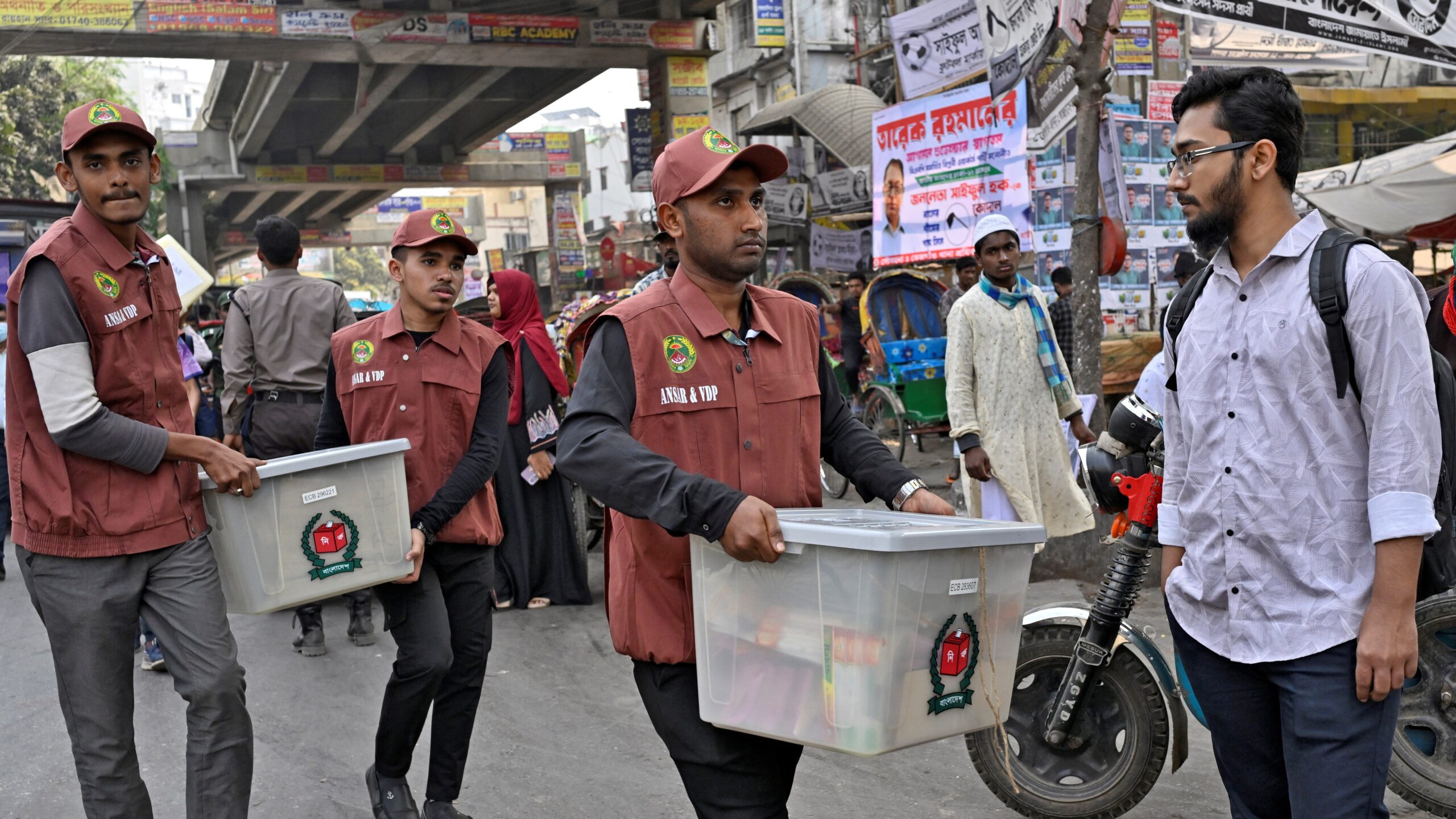
Until now. Following the removal of former Prime Minister Sheikh Hasina, Bangladesh’s reform commission set up a postal ballot system supported by a mobile app.
Overseas Bangladeshis have a long history of political engagement. During protests against Hasina, hundreds of workers in the UAE were arrested. But they were eventually released after the direct intervention of chief adviser Muhammad Yunus. Today, millions like Islam can finally exercise their right to vote from abroad.
Official figures show that more than 1.5 million Bangladeshi expat workers are registered to vote through the postal ballot.
Among them, approximately 239,186 are registered in Saudi Arabia, out of an estimated 3.5 million Bangladeshi workers living and working there, highlighting both the scale of the expatriate community and the challenges of enabling voting abroad.
Low voter registration
Workers had to register to vote with their local embassies, a process that proved challenging for many.
Shariful Hasan, who heads the migration programme for BRAC, a global development organisation based in Bangladesh, described the decision to give workers the chance to vote as a “positive step” in Bangladesh’s history.
“It’s a great step because for the first time, a large section of our electorate will be able to vote, and their vote matters,” said Hasan.
“This move will empower them and is reflective of the country – and the political parties – recognising their contribution to our economy.”
‘For the first time, it feels like my work and my voice matter…I hope this is just the beginning’
– Mainul Islam, Bangladeshi migrant worker in Saudi Arabia
Hasan attributed the low registration numbers to the precarious conditions many Bangladeshi workers face.
“Most migrant workers in Saudi Arabia and the wider Gulf do not have permanent addresses. Many live in crowded accommodation, 10 to 12 sharing a single room, often in slum-like conditions,” said Hasan.
“These living situations make it extremely difficult for them to register or access a postal ballot.”
He also pointed to technical difficulties with the mobile app and to the electoral commission’s lack of preparation.
“While this is a good start, in the future, the commission should take the nature of migrant life into account and ensure the process is accessible. Voting cannot just be a tick-box exercise.
“Measures need to include proper outreach, support services, and technology that works for people who are not educated or working in offices.”
Hasan added that political parties have largely ignored the diaspora in their agendas.
“If the government and parties take migrant workers seriously – provide support before, during, and after migration, ensure dignity and care – the impact of their votes will be more meaningful. This is a beginning, but there is much more to be done.”
For now, Islam remains hopeful. He has managed to cast his vote, with the app confirming that his ballot has reached its destination.
“For the first time, it feels like my work and my voice matter,” said Islam.
“I hope this is just the beginning.”
