

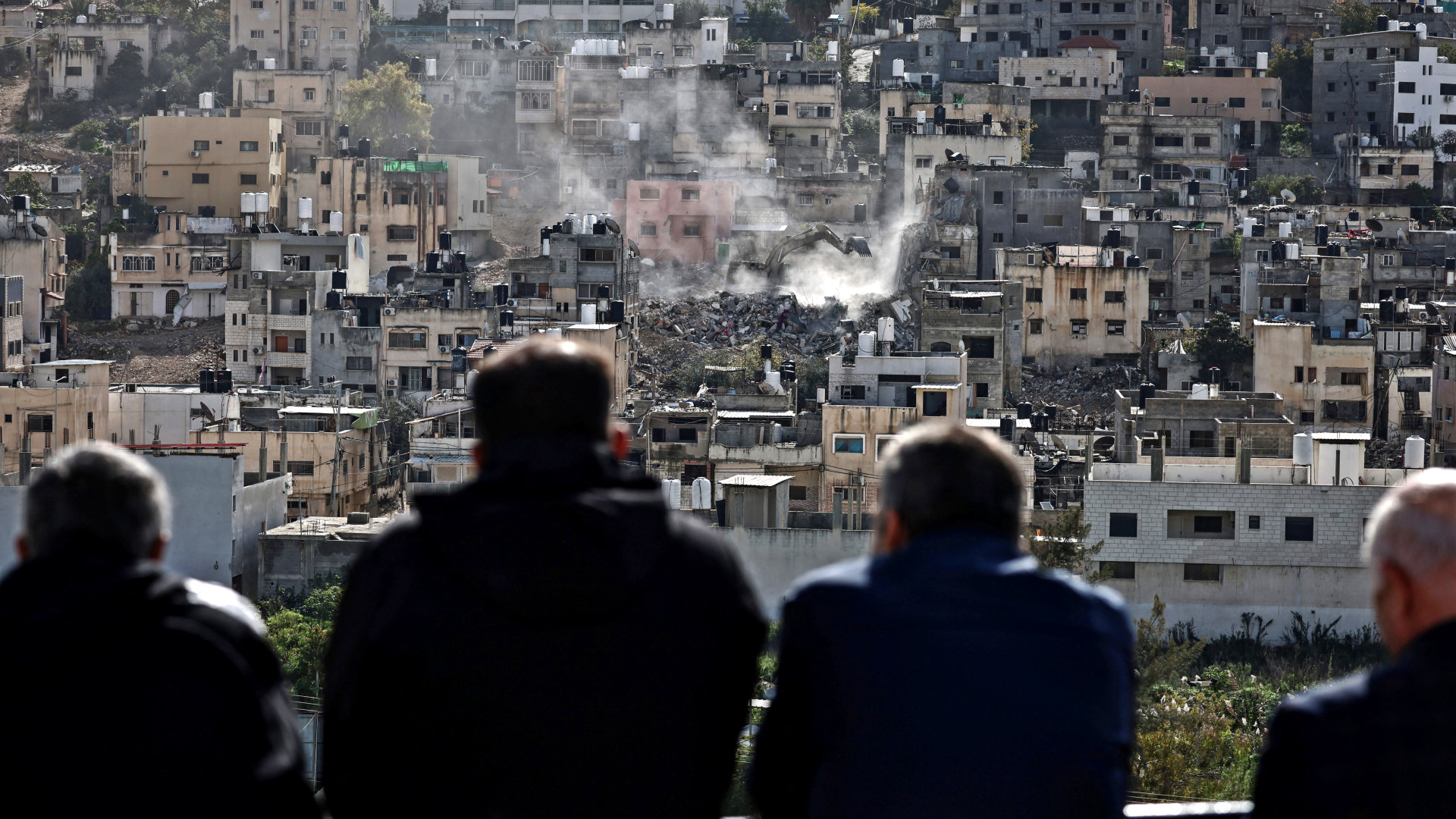
Israel’s destruction of refugee camps in Jenin and Tulkarm is severing families from their homes, emptying communities and accelerating Palestinian erasure
Israel’s genocide of the Palestinian people has never been confined to Gaza alone.
Nowhere is this more evident than in the shattered, bomb-scarred, ghostlike refugee camps of Jenin, Nur Shams and Tulkarm, destroyed and emptied by Israel as a stark warning to Palestinians of the consequences of resisting occupation and genocide.
This decades-long settler colonial project in Palestine has multiple planes of erasure. While the world has, albeit through a distorted lens, focused on the catastrophe wrought upon Gaza, Israel has ensured that its plans for Palestinian elimination proceed apace in the West Bank.
Settlement expansion, settler attacks on farmers under the protection of Israeli forces, the routine theft of livestock, the destruction of village schools and homes and the forced displacement of Palestinians in the East Jerusalem neighbourhoods of Sheikh Jarrah and Silwan all amount to systematic attempts to destroy, in whole or part, the Palestinian people and their relationship to their ancient homeland.
During a recent visit to the northern West Bank, I witnessed the physical destruction of refugee camps and was struck by how closely the lives of Palestinians there mirror the devastation faced by refugees in Gaza.
New MEE newsletter: Jerusalem Dispatch
Sign up to get the latest insights and analysis on
Israel-Palestine, alongside Turkey Unpacked and other MEE newsletters
It was a glaring reminder that this genocide targets all Palestinians across historic Palestine.
Between 21 January and 9 February 2025, Israel launched Operation Iron Wall, targeting alleged “terrorist elements” in three refugee camps in the northern West Bank.
During the 19-day operation, around 40,000 refugees from the camps of Jenin, Tulkarm and Nur Shams were forcibly removed from their homes
The head of the Nur Shams Public Committee, Nihad Shawish, told us: “Just as in Gaza, they are trying to claim the camp is a centre for terrorism. But in reality, the resistance is just a few people looking for freedom.” And, just as in Gaza, all Palestinians are conceptualised by Israel as “terrorists” and targets for elimination.
During the 19-day operation, around 40,000 refugees from the camps of Jenin, Tulkarm and Nur Shams were forcibly removed from their homes by heavily armed Israeli special forces using armoured vehicles, drones and bulldozers.
Unrwa, the UN agency for Palestinian refugees, has described the Israeli offensive as “the longest and most extensive displacement crisis since 1967”. It estimates that 43 percent of Jenin, 35 percent of Nur Shams and 14 percent of Tulkarm refugee camps have been destroyed or severely damaged.
Buildings on either side of the lanes in Nur Shams camp, which extended from the main road between Nur Shams and Tulkarm up to the top of the camp, were bombed or bulldozed to widen two-metre alleys into 12-metre tank-accessible thoroughfares. Every inhabitant was expelled.
Apartheid journeys
The journey itself to these devastated camps exposes, at every turn, the brutal reality of Israeli apartheid.
Travelling through the West Bank is a daily endurance challenge for Palestinians. An apartheid road system means that while illegal Israeli settlements are connected by unfettered highways to Jerusalem and Tel Aviv, Palestinians are forced to travel on rough, circuitous roads and pass through tunnels blocked by endless checkpoints and stark yellow barrier gates.
Israel and Palestine: What’s happened in the West Bank since October 2023?
Read More »
A journey that would take 20 minutes on settler roads takes three hours or longer for Palestinians.
En route from Ramallah to Tulkarm, we encountered a new spectacle of Israeli supremacism: enormous Israeli flags lining both sides of the highway every 10 metres. To outside observers, they may reflect deepening Israeli insecurity, but for Palestinians, they are simply another intimidation tactic.
We passed the beautiful village of Sinjal, now encircled by 30-metre-high layers of razor wire. All but two entrances have been permanently sealed by Israel, while the remaining two may be closed at any moment at the whim of Israeli forces. Villagers have no explanation as to why they have been targeted so viciously beyond “another act of occupation”.
The settlement project has expanded dramatically since my last visit in 2022.
Emboldened by global impunity and a far-right government in which settlers hold key ministries, Israel has approved the legalisation or construction of 69 new settlements.
“We’re advancing de facto sovereignty,” Finance Minister Bezalel Smotrich declared as he announced plans for more than 3,400 settlement homes in the E1 project, which would link vast settlement blocs in occupied East Jerusalem to Maale Adumim, thus physically isolating Palestinians in East Jerusalem from those in the occupied West Bank.
We drove past the large and expanding illegal settlement of Eli, perched on a hill with its ghastly red-roofed houses themselves a statement of genocidal intent, a threat to the well-being of local Palestinian villagers who saw their olive trees uprooted and faced violent attacks.
Eli is also known for its Bnei David pre-military academy, which trains settlers for officer positions in elite combat units.


We passed petrol stations Palestinians are forbidden to use, and new outposts disfiguring ancient terraces and olive groves. These ugly illegal outposts will inevitably expand into ugly illegal settlements.
A nearby road we could see but not access would have brought us to our destination in Tulkarm in less than half the time. But Israel has barred all Palestinians from it.
Instead, we travelled rough roads, stopping at unpredictable checkpoints where threatening young soldiers determined whether our journey would continue or end. At one point, we took an alternative route to avoid another closure.
These cumulative acts of apartheid are designed to make Palestinian life so unbearable that people will be driven to leave their land.
Gaza in the West Bank
We eventually reached Tulkarm via a gravel road. The ruins of Nur Shams refugee camp lay on our left, its entire population forcibly expelled in January.
The camp is now an eerie ghost town, with about a third of its buildings completely or largely destroyed. Great empty swathes have been cut through the heart of Nur Shams by Israeli bulldozers. Hundreds upon hundreds of homes were demolished ostensibly to create armoured vehicle and tank access.
A blue Star of David had been spray-painted on what was once the home of a Palestinian refugee, now used as a military base. No one else remains. As I climbed a mound to take a photograph, two passers-by urgently warned me to step down. “Snipers shoot at anyone and without warning,” they called out.
Follow Middle East Eye’s live coverage of Israel’s genocide in Gaza
Refugees described how, as soon as they invaded the camps, Israeli forces cut off all communication and utilities. Internet, electricity and water disappeared instantly. These displaced refugees were evicted to literal nowhere. Some found relatives to stay with, while many more sought shelter in mosques, abandoned schools, wedding halls and other public spaces. They now live at the margins of survival.
Refugees sheltering in the unfinished El Muowahad School in Thenaba village, between Nur Shams and Tulkarm, described the terror of heavily armed raids, Apache attack helicopters overhead, exploding suicide drones and the frantic flight from their homes with only the clothes on their backs.
“They started blowing up our houses on 26 January, and in seven days the camp was completely emptied,” recalled Khaled, 50, sitting exhausted on a plastic chair in the school corridor he shares with 21 families from Tulkarm camp.
“Nobody expected this,” he continued. “I didn’t even get one T-shirt from my home. It’s demolished now.” Houses left standing were set on fire. Evictions were brutal. “Even when the Red Crescent gave us the medicine we needed, soldiers snatched it from us and threw it to the ground,” Hakem told us, adding that more than 1,800 homes in the Tulkarm camp were destroyed.
For nearly 12 months, 122 displaced refugees have lived in the unfinished school, sharing cramped rooms of 10 to 12 people. “Facilities are minimal or non-existent,” Khaled explained.
“When we arrived, there was no electricity, so we connected it ourselves.” On the ground floor, four toilets are shared by all men, women and children. One shower serves everyone. “Like prisoners, we all stand in a line,” he added.
One washing machine serves all families. Clothes hang from every railing as people cling to small pieces of routine while their camp lies in ruins metres away.
“Camp life was hard,” Nadia, 38, told me, “but not as hard as this.”
Dystopian landscape
In Tulkarm and Nur Shams, the already dire conditions for refugees continue to deteriorate. Unrwa initially provided food and services, but this has stopped as Israel’s prohibition on its operations in the occupied Palestinian territories takes hold.
“My fridge is empty,” Hakem told us. “We all used to work in the occupied cities from Jaffa to Haifa, Jerusalem to Tel Aviv. Now we are living under siege with no possibility of work.”
‘My house is uninhabitable, but I am ready to go and live above the rubble. The dignity of the human is in the home. I can see my house from here, but I cannot reach it’ – Fatma
They are also forbidden by military order from rebuilding their destroyed homes. “I just want to go back and live on the rubble of my home,” Hakem said. “What else can we do?”
Nadia showed me a video taken by a neighbour after the camp was emptied. The only sounds in this dystopian landscape were footsteps crunching over debris and the eerie noise of birdsong.
Hasan Khreisheh, a Tulkarm politician working with the displaced families, described what has happened in the northern West Bank camps as following Israel’s blueprint in Gaza, but in a form of “silent elimination”.
For 17-year-old Ayhem, whose education ended when his home was demolished and his family was forced out: “It’s very similar to what has happened in Gaza. When I see Gaza on television, I see exactly what we are experiencing.” He sleeps with nine family members in one small school room. “I have no social life. My friends have all been forced into different areas, and my best friend was killed. I have lost everything.”
Near the school stands what remains of the Nur Shams Public Committee office. Despite the trauma they have experienced, 10 volunteers continue working to support those expelled from the camp. From its roof terrace, we looked out over the devastation of what had once been their homes.
“My house is uninhabitable,” said Fatma, 70, “but I am ready to go and live above the rubble. The dignity of the human is in the home. I can see my house from here, but I cannot reach it.”

Israel’s violent expansion is never done, yet it still cannot ‘finish the job’
Read More »
Nihad, the head of the Committee, described the scale of the military assault. Israel’s campaign inside the six neighbourhoods of Nur Shams began on 9 January. Hundreds of soldiers, tanks, military vehicles and drones stormed the camp, forcing out every resident.
“Anyone who refused was shot outside their house to encourage people to leave,” he said. “The forces controlled the routes we could take. We were forced into a line and filmed by drones. Anyone who stepped outside the line would be shot.”
“The Israeli occupation decided to finish the camps,” he continued. “In Nur Shams, with a population of 13,000, we had 400 buildings. Each building had multiple levels and housing units. Even if a house wasn’t demolished with bulldozers and explosions, the forces set fire to it to make it uninhabitable. Around 2,300 families were forced to leave, and 70 percent of them are living in poverty.”
“There is no water, no electricity inside the camps. No sewage pipes, no streets. The whole infrastructure has been destroyed,” Fatma added.
Nihad put it bluntly: “The camp has been assassinated.”
They also targeted and destroyed the youth centre, the kindergarten, the wedding hall and the disability centre.
‘Return to rubble’
Fatma, a highly respected leader of the Nur Shams community, described her experience on the morning of the attack: “They came at 7am on 9 February. They were already inside the camp. They demolished half my house, but we stayed. They used one of our neighbours as a human shield. They came with dogs to search. Then they took over our home and used it as a military barracks. At the end of the day, there were maybe 100 soldiers in my house.”
Fatma has cancer. Soldiers tore up her medical notes and destroyed her water tank. “Our small television was shot. They destroyed my washing machine and fridge, which I hadn’t finished paying for.”
As they destroyed homes, livelihoods and community spaces, Israeli soldiers had also committed a range of other crimes, including openly looting.
“In front of our eyes, they stole our things,” Fatma said. “They took my purse and stole the 2,650 shekels I had been given by a Hebron foundation to repair my house, as well as two gold rings, a necklace, a bracelet and a medal.”
Despite many refugees saying they would “return to the rubble”, the reality is bleak. The destruction of the camps, the expulsion of their residents and Israel’s broader drive to remove Palestinians from their land mean their chances of returning are remote.
“‘Returning to the rubble’ is just a slogan,” said Khaled. “How can we go back? Israeli forces will choose who can return, and anyone with links to fighters will never be allowed to. Every day, there is a new decision targeting the families of resistance fighters. And every day they are subjected to collective punishment.”
Khreisheh noted that Israel recently announced that some refugees might be permitted to return, except “the families of those martyred, those injured, imprisoned or involved in politics”. This would, in practice, exclude almost everyone.
Even renting elsewhere in the West Bank has become increasingly difficult for displaced Palestinians. “We have no money and no place to go,” Khaled said. But poverty is only part of the problem. Landlords fear renting to camp refugees.
“Whenever we try to rent a home,” he explained, “they first count us, then ask where we are from. When we say ‘Nur Shams’ or ‘Tulkarm camp’, they invariably respond: ‘I don’t rent my house to anyone from the camps.’ In some ways, I understand. If any relative is in prison, is a fighter or was killed, landlords fear raids. So they don’t rent to us.”
Everyone is a refugee
All inhabitants of the camps are refugees, their status derived from the mass expulsions of the 1948 Nakba and Israel’s 1967 war.
Refugee status rightly spans generations and is inseparable from the Palestinian right of return. Through international law and at least five UN resolutions, including Article 11 of UN General Assembly Resolution 194, Palestinians are guaranteed the right to return to the lands from which they were displaced.
A core element of Israel’s project has always been to prevent the refugees of 1948 and their descendants from returning to their homes.
Yet every refugee I spoke with viewed their status as the ultimate guarantor of return.
More than seven million Palestinian refugees live in exile worldwide. For Israel, the possibility of their return is a demographic nightmare, and it seeks to prevent it at all costs.

Amid Gaza’s nightmare, a quiet genocide has been unfolding in the West Bank
Read More »
Khreisheh was clear that the destruction of the West Bank refugee camps is part of a broader genocidal project to eliminate the very idea of the refugee camp and the political status it confers. Many others echoed this.
“Refugees and their descendants are the only witnesses of the 1948 Nakba,” several told me, “and now Israel wants to eliminate the witness camps and eliminate the Palestinian issue.”
“You will find a sad and painful story from everyone who fled,” one refugee said. “Homes and land grabbed. They have repeated what happened in 1948. The scene is repeating itself.”
“We are moving from pain to pain,” another added. “This occupation wants to eradicate people from the land. They want to get rid of all the witnesses to the crimes committed since 1948.”
The destruction of Jenin, Nur Shams and Tulkarm camps is a calculated act of genocide. By destroying communities, dismantling Unrwa and expelling refugees, Israel seeks not only to dispossess Palestinians of their homes, but to extinguish their history, rights and future claims to justice, including the right of return.
As Nihad said: “They want to end refugee status by eliminating the camp, destroying the possibility of the right of return and, by extension, any possibility of Palestinian self-determination.”
“In Nur Shams, our goal is not just to go back to the camp but to go back to our family villages. This is our historic right. We will never depart from this right. The camp is just a station for us. We all hope to return to our homelands.”
The views expressed in this article belong to the author and do not necessarily reflect the editorial policy of Middle East Eye.
