

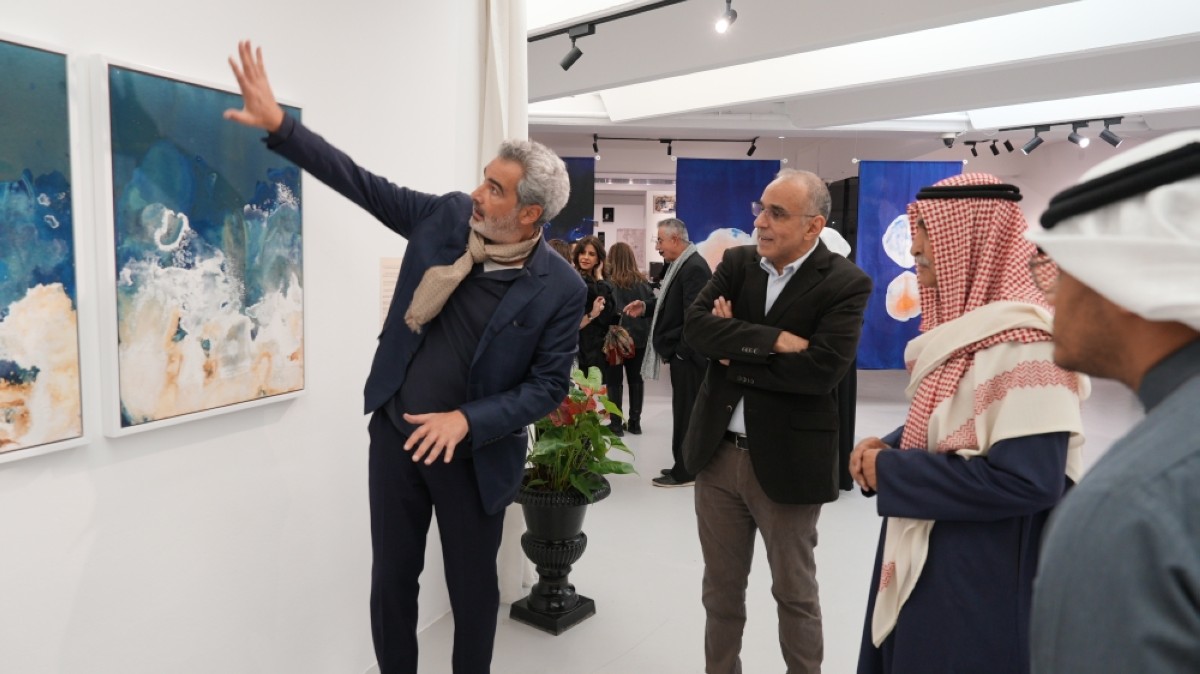
KUWAIT: The empty streets and crumbling buildings of Failaka Island have long preserved stories of Kuwait’s past. For theater director and writer Sulaiman Al-Bassam, they also offered a place to imagine the future. Searching for a space to write, he found inspiration on the island, leading him to establish an artistic residence where researchers and artists can pursue ideas beyond conventional boundaries.
Al-Bassam spoke with Kuwait Times during the opening of On Site: Art, Research and Experience on Failaka Island – Seasons One and Two, held Wednesday at the Contemporary Art Platform (CAP). He is the founder of Dar FIKAR, a non-profit organization fully dedicated to Failaka Island. “(Dar FIKAR) was created to bring attention to this precious island, which has been home to civilizations since the dawn of history and today exists as a largely deserted place struggling to survive in the modern life,” he said.
The FIKAR residency program provides participants with logistical and creative support to stay on Failaka for a certain period and engage directly with the island’s civilizational history, landscapes and biosphere, as well as its mythical pasts and imagined futures.
Now in its third season, the residency’s atmosphere provides the foundation for the work produced by resident artists and researchers. “Dar FIKAR’s residency is a clear example of the model we are striving for in NCCAL,” said Dr Mohammad Al-Jassar, Secretary General of the National Council for Culture, Arts and Letters (NCCAL). “We hope that the private sector and civil society become producers of culture, not the state alone.”
Despite limited resources, he noted that its residences have generated outstanding work and contributed to our broader goal of connecting Failaka Island to world heritage. The exhibition showcases a selection of projects developed during the first and second seasons of Dar FIKAR, reflecting a wide range of backgrounds and creative approaches. It brings together Kuwaiti teams, local artists and researchers, as well as participants from neighboring Gulf countries and Europe, illustrating the residency’s multidisciplinary and international scope.
Dr Al-Jassar noted that this event is particularly exciting as on the same day’s morning, a meeting was held with the Minister of information and culture and representatives from the World Monuments Fund, during which the fund presented the final report on the strategic vision for Failaka Island, aimed at establishing it as a cultural tourism site listed on the World Heritage Register.
He added that the exhibition opening coincides with the first tangible outcome of this collaboration. “Sustainability of events on Failaka is the true foundation for cultural tourism. What we see today began as a personal initiative on the island, which then expanded to include a group of artists and writers. The results of that effort are now visible in this exhibition, as well as in previous productions.”
