

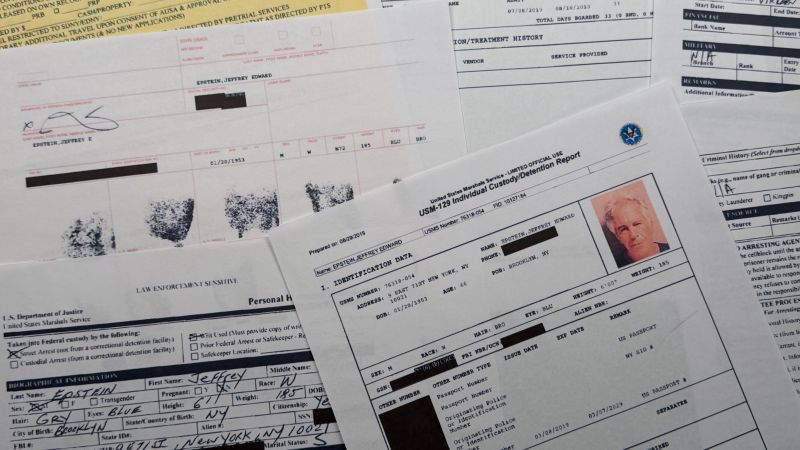
Deputy Attorney General Todd Blanche pledged last month that the Justice Department was not protecting anyone — least of all Donald Trump.
Those assurances by the president’s former personal lawyer are facing new scrutiny following remarkable developments in the Jeffrey Epstein scandal.
Intrigue deepened after lawmakers emerged perplexed after being given the chance to read unredacted versions of blacked-out investigative files previously released to the public in massive document dumps compelled by Congress.
“We didn’t want there to be a cover-up, and yet what I saw today was that there were lots of examples of people’s names being redacted when they were not victims,” Maryland Democratic Rep. Jamie Raskin said.
The lawmakers started inspecting the documents at the DOJ on a day of broadening fallout from a scandal that has blown the lid off the late sex offender’s stunning global network of billionaires and powerbrokers.
While new concerns surfaced over the DOJ’s handling of the files and the case more generally, the push for accountability raced ahead in Europe, where the political careers and reputations of powerful people are in shreds.
And suspicions among survivors that their long quest for justice is being impeded yet again were reinforced by an extraordinary offer made to Trump by a lawyer for Epstein’s jailed associate Ghislaine Maxwell. The gist was this: Grant clemency to Maxwell, a convicted sex trafficker, and she’ll put the president in the clear.
Lawmakers who were able to see some unredacted copies of the Epstein files did not directly accuse the DOJ of a cover-up. But their findings will only fuel mistrust among many of their colleagues and the public about its handling of the case. This is especially so since the names of many people linked to Epstein were redacted in public disclosures, while the names of some victims were visible.
Democratic Rep. James Walkinshaw demanded answers. “I can say that I saw many names, including names in emails to and from Jeffrey Epstein, that suggests these individuals were involved in crimes or at least knew about crimes,” the Virginia lawmaker told CNN’s Erin Burnett. “And again, I’m not able to explain why they were redacted in a way that’s consistent with the law.”
Raskin said the department hadn’t explained why certain redactions were made, but that he saw “a whole bunch of them that seemed very suspicious and baffling to me.”
Democratic Rep. Jared Moskowitz told reporters he’d seen “lots of names, lots of co-conspirators and they’re trafficking girls all across the world.”
DOJ was supposed to limit redactions to the personal information of victims and materials that would jeopardize an active criminal investigation. And Congress has not yet received a privileged log from DOJ explaining why certain redactions were made, which DOJ is compelled to provide 15 days after its January 30 release of documents.
The experience of lawmakers means an even tougher reception for Attorney General Pam Bondi when she testifies to the House Judiciary Committee on Wednesday. Many Democrats already believe that her department, whether by design or omission, is failing to honor the Epstein Files Transparency Act passed after a GOP revolt against Trump last year.

The law’s authors, California Democratic Rep. Ro Khanna and Republican Rep. Thomas Massie of Kentucky, expressed disappointment with the DOJ.
It was another stunning day of Epstein fallout on Monday.
Maxwell was piped in from her detention facility in Texas to provide testimony to a House committee investigating the scandal, but she invoked the Fifth Amendment to avoid self-incrimination, as is her constitutional right.
But her lawyer made a stunning proposal. “Ms. Maxwell is prepared to speak fully and honestly if granted clemency by President Trump,” attorney David Oscar Markus said in a statement during the deposition, which he later posted on X.
“Only she can provide the complete account,” Markus continued. “Some may not like what they hear, but the truth matters. For example, both President Trump and President Clinton are innocent of any wrongdoing.”
Neither the current nor the ex-president has been charged with any crime in connection to Epstein. Both deny having had knowledge of his offenses.
Trump has struggled to explain his friendship with the disgraced financier and said he threw Epstein out of his Mar-a-Lago club after they became estranged.
But the clemency play is the epitome of an age when attempted quid pro quos play out in public in hopes of swaying a president who mocks ethics and exploits power granted by voters for his own ends. Anything that Maxwell said in the event she was released from prison would be immediately regarded as not credible, given her incentive to improve her own plight. But such is Trump’s outlandish past use of his pardon powers that her gambit cannot be dismissed. It might even work.

The atmosphere of thwarted accountability on one side of the Atlantic only sharpened the contrast with an extraordinary political crisis engulfing Britain.
Prime Minister Keir Starmer battled to save his job amid recriminations over his decision to appoint Peter Mandelson, a former Epstein friend, as ambassador to Washington. And in a mind-boggling move, King Charles III offered to cooperate with police in any investigations into his brother, the former Prince Andrew, who has had his royal titles stripped after he obfuscated his ties to Epstein.
Underscoring the peril the affair poses to the monarchy, the heir to the throne, Prince William, and his wife, Princess Catherine, offered empathy to Epstein survivors through a spokesperson.
In Norway, where another royal has been shamed by the affair, authorities said they were investigating a former diplomat suspected of “gross corruption.” The reputation of a highly respected former French culture minister was tarnished by his past contact with Epstein. And Poland is investigating whether the convicted sex offender was linked to Russian spies.
Khanna marveled at the contrast between the UK and the US.
“Look at what’s happening in Britain. You have a left government — actually, I know Keir Starmer, I was excited when he won, and yet I believe he needs to be held accountable with what’s happened with Mandelson. You have the British monarchy having to answer questions — I mean, the King of England is putting out statements. And yet in our country we have not had that reckoning.”
What explains the difference?
It’s complex, especially since none of the people who came into contact with Epstein, apart from Maxwell, have been charged with crimes. That doesn’t necessarily point to a cover-up. Evidence may not lead in such a direction.
But the growing push for accountability is raising the question of what this network of powerful and sophisticated people — mostly rich men — knew about Epstein’s activities and crimes, especially once he emerged from prison in 2009 after serving a 13-month sentence for sex offenses.
There have been some consequences for Americans who had links with Epstein. Former Treasury Secretary and former Harvard University President Larry Summers stepped away from public life after the release of embarrassing email exchanges with Epstein. Last week, Brad Karp resigned as chairman of Paul Weiss, one of the country’s top corporate law firms, over Epstein ties.
But such downfalls in the United States have been precipitated by reputational damage to individuals rather than government action. In Europe, the machinery of investigation and accountability remains independent. In the US, the Justice Department is run by Trump loyalists who’ve heard his calls for the country to move on.
Mandelson is facing a criminal investigation over allegations he passed secret and market-moving government information to Epstein. It’s hard to see the Trump DOJ launching a probe in similar circumstances. Mandelson has apologized for his past links with Epstein and has resigned from the Labour Party and the House of Lords.

The shock over disclosures about Epstein’s behavior and his sprawling network of contacts is palpable in Europe.
But why is disgust less obvious in the United States? Perhaps, 10 years into the Trump era, the country is just punch-drunk on scandal. Or maybe the spectacle of Epstein’s influence-peddling isn’t such big news in a nation where politics is saturated in campaign cash.
Each day brings new revelations about Epstein’s extraordinary global network of interlocking ties between bipartisan political leaders and influencers, finance and business titans, international organizations, academia and billionaires.
But amid the cacophony, people often forget what this is really about: grievous harm inflicted on the women who were trafficked by Epstein as girls and forced to perform massages and sex acts. Their trauma is only exacerbated by the apparent impunity of powerful people who flocked around their abuser.
“I think that what people also need to remember is that, you know, the survivors of this crime know what happened,” Epstein victim Liz Stein, wearing a sweater reading “Courage is Contagious,” told CNN’s Jake Tapper on Monday. “And so when we see things coming out that, you know don’t parallel what our truth is, we really — we’re taking notice.”
