

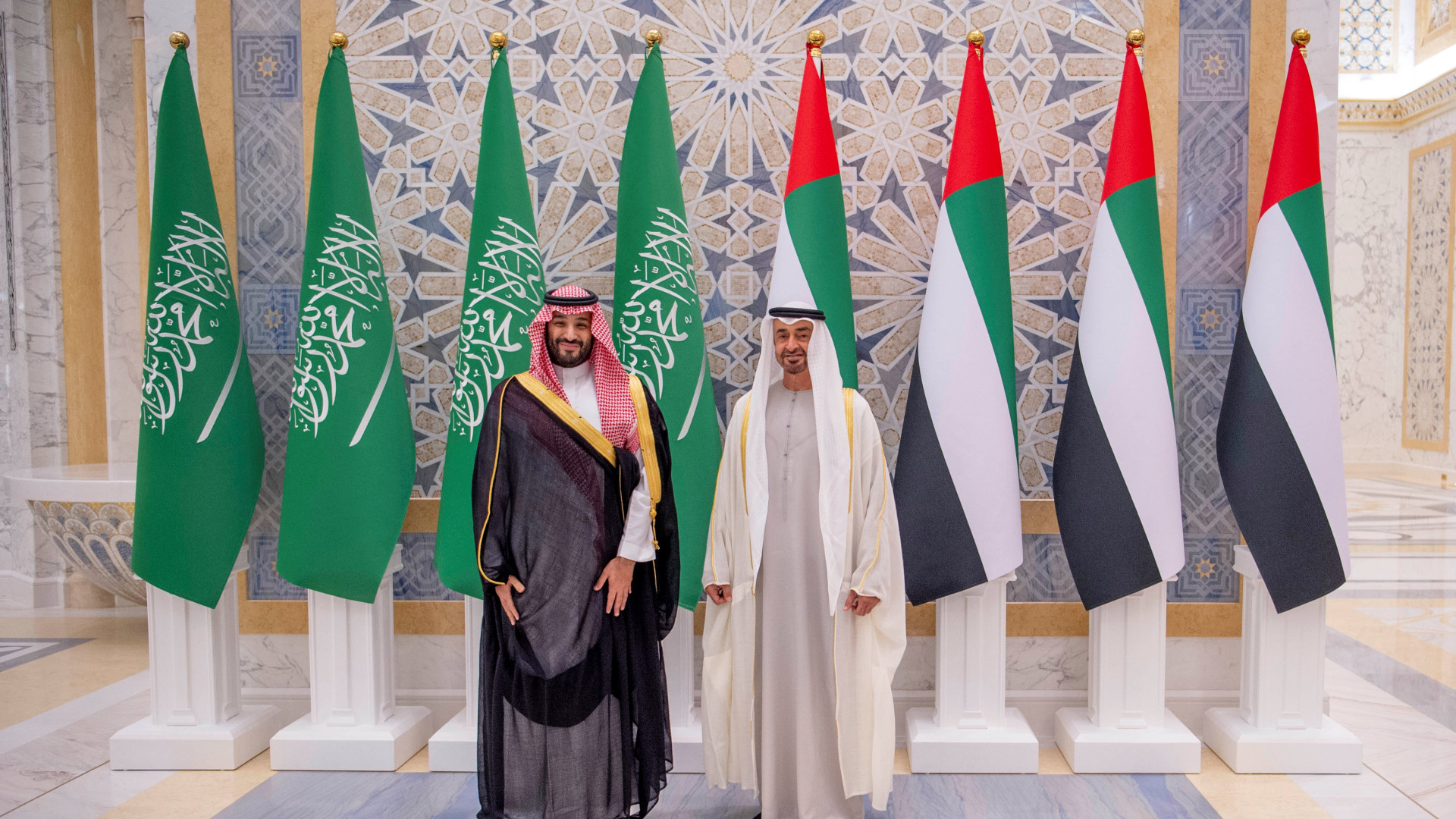
With each passing day, it becomes clearer that Saudi Arabia’s strikes against UAE-backed secessionists in Yemen late last year and early this month were the beginning, rather than the end, of a conflict between the two Gulf states.
What may have appeared to some as a tactical dispute over Yemen is in fact a strategic rupture with far-reaching implications for the post-Arab Spring regional order.
In late December, Saudi Arabia bombed a UAE weapons shipment in the port of Mukalla that had been intended for the Emirati-backed Southern Transitional Council (STC). Then, early this month, a Saudi-led coalition launched air strikes against STC camps in Hadramawt and al-Mahra.
Almost overnight, the STC collapsed as both a military and governing force, with its leader, Aidarous Zubaidi, fleeing to the UAE.
The Saudi campaign signalled that, from Riyadh’s perspective, the Emirati jig was up. Saudi Crown Prince Mohammed bin Salman was no longer willing to sit by as the UAE expanded its military footprint by backing secessionist militias from Yemen to Sudan and beyond.
New MEE newsletter: Jerusalem Dispatch
Sign up to get the latest insights and analysis on
Israel-Palestine, alongside Turkey Unpacked and other MEE newsletters
More broadly, the operation marked a significant falling-out between two Gulf states that have historically enjoyed close ties.
The UAE and Saudi Arabia worked together to organise post-2013 counterrevolutions across the Arab world and to impose a four-year blockade on Qatar from 2017 to 2021. The unravelling of this alliance now points to a deeper regional realignment.
Media war
Saudi and Emirati political and media discourse in recent weeks – particularly since the brief military campaign against the STC – has made clear that the dispute runs far deeper than Yemen.
Both the Saudis and Emiratis have extensive experience in media and digital warfare, so it is no surprise that a battle over narratives marks this critical phase of their dispute
Riyadh has unleashed a fierce media campaign targeting the Emirati leadership and its wider political project. Notably, the media offensive has framed the UAE as seeking to fragment Arab states for its own – and Israel’s – political gain.
This week, Saudi state channel Al-Ekhbariya alleged that the UAE has been “investing in chaos and supporting secessionists” across North Africa and the Horn of Africa. Prominent Saudi writer Salman al-Ansari went further, calling UAE economic support for Egypt “one of the largest political deception operations” in modern history.
Last week, Saudi academic and columnist Ahmed bin Othman al-Tuwaijri accused the UAE of deliberately undermining Saudi Arabia by throwing itself “into the arms of Zionism” and serving as “Israel’s Trojan horse” in the region.
Notably, the UAE has responded less through its own media than through its closest strategic ally, Israel. In recent days, attacks on Saudi Arabia have come from pro-Israel lobbying networks, American media figures and pro-Israel US politicians.
On 23 January, the Anti-Defamation League posted on X in support of the UAE, warning of the “increasing frequency and volume of prominent Saudi voices … using openly antisemitic dog whistles and aggressively pushing anti-Abraham Accords rhetoric”.
Last week, pro-Israel American broadcaster Mark Levin posted a series of anti-Saudi remarks to his five million X followers. On 26 January, for example, he wrote that he would “never forgive” Saudi Arabia for the 11 September attacks and accused bin Salman of “trying to destroy the UAE… our closest Arab ally”.
Pro-Israel US Senator Lindsey Graham also rebuked the kingdom for its “attack on the United Arab Emirates”. Jewish Insider, the Jerusalem Post, Axios, the American Enterprise Institute and other outlets have also come to the UAE’s defence.
Both the Saudis and the Emiratis have extensive experience in media and digital warfare, so it is no surprise that a battle over narratives marks this critical phase of their dispute. The UAE, in particular, has invested heavily in sophisticated propaganda campaigns aimed at discrediting political opponents.
Research by Marc Owen Jones found that the UAE deployed Twitter bots during the 2017-2021 Gulf crisis to promote disinformation about Qatar. More recently, he reported that the Emirates used 19,000 bots to boost Sudan’s Rapid Support Forces after they carried out massacres in El Fasher.
A 2014 investigation by The Intercept also revealed that the UAE hired an American consulting firm, the Camstoll Group, to help plant anti-Qatar stories in mainstream US media.
Shifting alliances
The impact of the UAE-Saudi conflict is already becoming visible, with the UAE suffering setbacks to its ambitions in the Red Sea, Gulf of Aden and beyond.
In addition to the STC’s retreat, Somalia has cancelled major contracts with Abu Dhabi and is reportedly seeking, along with Egypt, a defence deal with Saudi Arabia. A joint Saudi-Somali-Egyptian arrangement would be significant because it would weaken Emirati influence over the Bab el-Mandeb Strait.
Why Arab states now oppose a US-Israel attack on Iran
Mohamad Elmasry
Read More »
More significantly, Turkey may seek to join a September 2025 Saudi-Pakistani defence pact, bringing several powerful Muslim-majority countries closer to something resembling an “Islamic Nato”. Such a bloc would carry implications not only for the UAE but also for Israel and the United States.
As its proxies weaken and alliances shift, the UAE appears increasingly cornered. It is now moving to deepen ties with the Modi government in India, while quietly expanding surveillance and intelligence cooperation with Israel related to Gaza.
The current political moment also represents a rare opportunity for Saudi Arabia, which appears to have emerged from the fallout of the 2018 murder of journalist Jamal Khashoggi.
Egypt, once a regional heavyweight, remains economically and diplomatically fragile, while an increasingly assertive bin Salman now seems poised to present himself as a leader in the Arab and Muslim worlds.
Only a few years ago, it would have been unthinkable for Recep Tayyip Erdogan to consider a defence arrangement with bin Salman. Today, such a pact is reportedly under active discussion.
Regional stakes
It is still too early to determine where all this will lead, and there are more questions than answers. Will Saudi Arabia move closer to Turkey and Qatar? Will bin Salman try to regain a stronger foothold in Egypt, positioning Riyadh as a counterweight to growing Emirati influence there?

Will anyone stop Israel and the UAE sowing chaos across the region in 2026?
Read More »
Other questions centre more directly on the US and Israel.
To what extent will Saudi Arabia be willing to confront the emerging Israeli-Emirati axis? Is a direct military confrontation between Saudi Arabia and the UAE conceivable, even as Washington maintains strong ties with both?
How would the US respond if the Saudis continue their campaign against the Emiratis, especially if Saudi-Israeli relations deteriorate further?
It is also possible that Saudi Arabia is seeking to force an Emirati policy retreat before returning to its longstanding strategy of containing political Islam. If so, could normalisation with Israel once again return to the table?
It may be months, or even years, before these questions are answered. What is already clear, however, is that the Saudi-UAE partnership that once anchored the post-Arab Spring order is fractured, perhaps beyond repair. The ongoing media and digital war has revealed the full scale of the rift.
The views expressed in this article belong to the author and do not necessarily reflect the editorial policy of Middle East Eye.
