

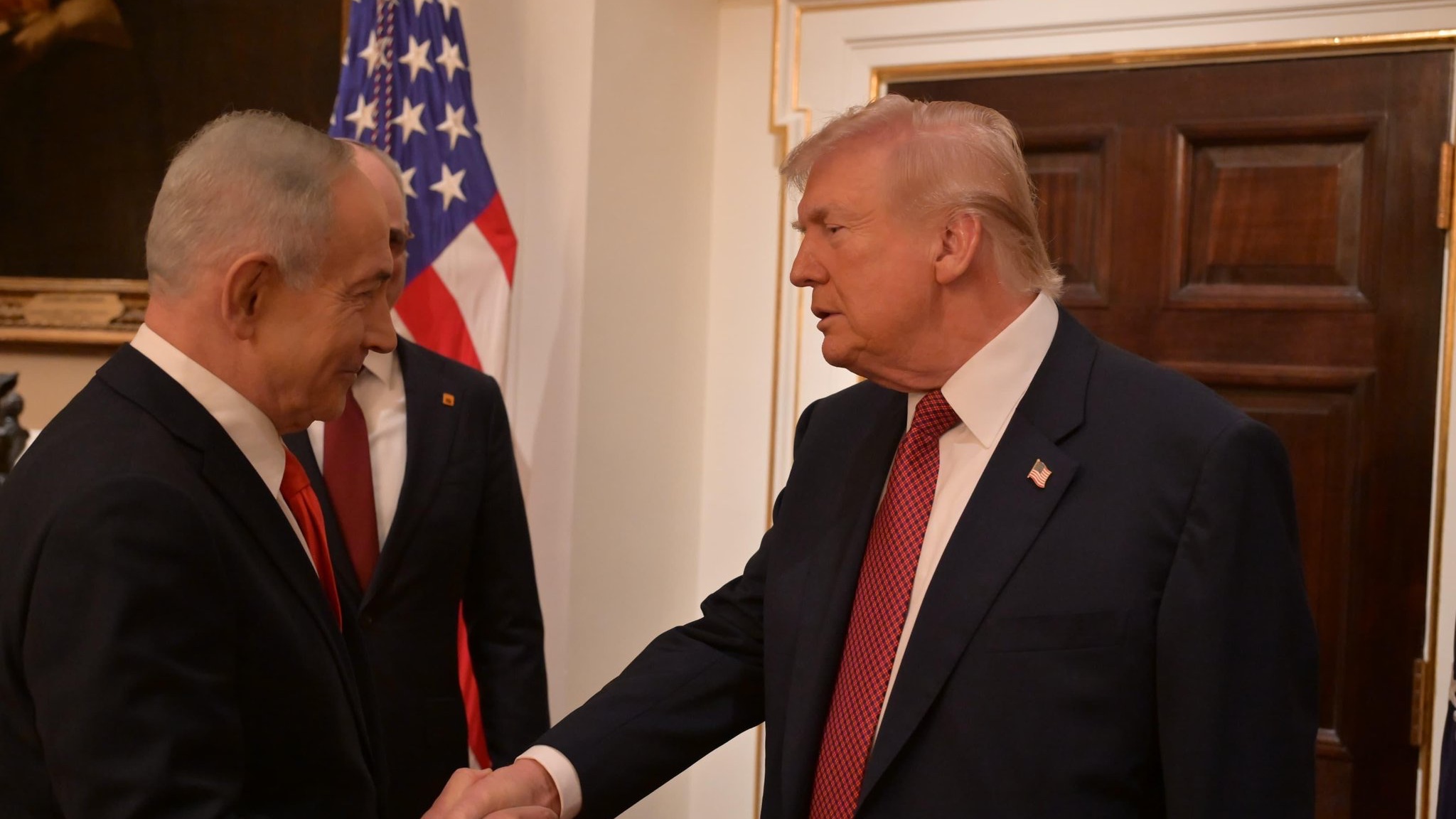
US President Donald Trump told Israeli Prime Minister Benjamin Netanyahu that his “preference” is for negotiations to continue with Iran, as the Pentagon prepares a second aircraft carrier strike group to deploy to the Middle East.
“There was nothing definitive reached other than I insisted that negotiations with Iran continue to see whether or not a Deal can be consummated. If it can, I let the Prime Minister know that will be a preference. If it cannot, we will just have to see what the outcome will be,” Trump wrote on his TruthSocial platform immediately after Netanyahu left the White House on Wednesday.
Netanyahu arrived at the White House shortly after 11am local time via the South Lawn entrance, avoiding the press and photographers who typically assemble at the north entrance.
One official photograph was released from inside the building of Netanyahu shaking hands with Trump.
Netanyahu departed the vicinity at nearly 2pm, local time, after a nearly three-hour meeting.
New MEE newsletter: Jerusalem Dispatch
Sign up to get the latest insights and analysis on
Israel-Palestine, alongside Turkey Unpacked and other MEE newsletters
The Israeli prime minister’s office then said on X that the two leaders “discussed the negotiations with Iran, Gaza and regional developments”, and that Netanyahu “emphasized the security needs of the State of Israel in the context of the negotiations”.
They also “agreed on continued coordination and the close contact between them”.
The Wall Street Journal reported on Wednesday that the Pentagon had told another aircraft carrier strike group to “prepare to deploy to the Middle East”, as the president refused to rule out strikes in his meeting with Netanyahu.
“Last time Iran decided that they were better off not making a Deal, and they were hit with Midnight Hammer – That did not work well for them. Hopefully this time they will be more reasonable and responsible,” Trump added on his TruthSocial post.

Trump must defy Netanyahu’s push for war on Iran
Read More »
The US has already carried out a major military buildup in the region since protests rocked Iran from December last year until mid-January this year.
Trump’s negotiation team held talks with Iran in Oman earlier this month, and Trump’s current position is “no nuclear weapons, no missiles”, he told Fox Business in an interview this week, which is a shift from the longtime US focus on Iran’s nuclear capabilities.
The Iran nuclear deal – cemented in 2015 before breaking down in 2018 thanks to Trump’s withdrawal – did not include limits on Iran’s ballistic missiles.
But ever since Netanyahu’s last visit with Trump on 29 December, talk of banning the development of ballistic missiles in Iran has become a condition espoused by the president.
“Iran has always been his number one concern over the Palestinian issue and all the other issues,” Guy Ziv, an Israeli politics expert and associate professor at American University in Washington, DC, previously told Middle East Eye.
Netanyahu joins ‘Board of Peace’
While in Washington, Netanyahu officially signed onto Trump’s “Board of Peace”, his office confirmed in a post on X on Wednesday.
Netanyahu attended a breakfast meeting with US Secretary of State Marco Rubio at Blair House – the guest residence afforded to those visiting the president – where the two men were photographed together holding up the ceremonial document.
Several aides and the ambassadors from both sides attended the meeting.
The signed document appears backdated to 19 January. Trump ratified the Charter of the Board of Peace in Davos, Switzerland, on 22 January. Netanyahu did not attend, as Switzerland is a party to the International Criminal Court, and would have to arrest him, per the warrant for war crimes and crimes against humanity in Gaza.
The Board of Peace is expected to have its inaugural meeting at the newly renamed Donald J Trump Institute for Peace in Washington, DC, next week.
Middle East Eye understands that Netanyahu pushed up his trip to the US not only to discuss his concerns about Iran with the president, but potentially also to avoid being photographed alongside world leaders he perceives as hostile, including those from Turkey and Qatar, among others who have joined the Board of Peace.
Not long after Netanyahu landed on Tuesday night, local time, he attended a meeting hosted by the Israeli ambassador to the US, Yechiel Leiter, along with Trump’s envoys on Gaza and Iran, Steve Witkoff and Jared Kushner.
Kushner is the president’s son-in-law and holds no official role in the administration. The White House has previously said he conducts negotiations on Trump’s behalf as a volunteer, but Kushner has significant personal financial dealings in Israel and some Gulf states.
“Additionally, we discussed the tremendous progress being made in Gaza, and the Region in general. There is truly PEACE in the Middle East. Thank you for your attention to this matter!” Trump said on TruthSocial after his meeting with Netanyahu.
Work in progress
Eran Etzion, a former deputy chief of Israel’s National Security Council, lambasted Netanyahu on X for joining the Board of Peace without first obtaining the Knesset’s approval.
In a post in Hebrew, Etzion attached an enlarged image of the signed document held up by Rubio and Netanyahu earlier in the day, and called it “crazy”.
“Netanyahu is signing it as a de-facto dictator, and not as the leader of a democratic state,” Etzion wrote.
“He is approving that his signature binds the State of Israel, without the need for approval from any democratic institution whatsoever. As if there is no government in Israel, no Knesset, no law, and no democracy. There is only Netanyahu, the sole ruler. Just like the rest of the dictators who joined the ‘Peace Council.'”
Indeed, the overwhelming majority of the world leaders who agreed to be “Founding Members” of the board are considered autocrats.
The board was established with Trump as its chairman in October to oversee the political transition and reconstruction in Gaza after Israel’s two-year-long genocide.
While it was created under United Nations Security Council Resolution 2803, Trump administration officials have openly suggested that the Board of Peace could be an entity on par with the UN, where peace deals settled around the globe would be approved.

What is Trump’s ‘Board of Peace’ and who will govern Gaza?
Read More »
Such sentiments have prompted concerns from several US allies who have, so far, chosen not to join the entity, including major Nato members such as Canada, the UK, and Germany.
The German ambassador to the US, Jens Hanefeld, told Middle East Eye last week that Berlin is considering its options vis-a-vis the Board of Peace.
“We’re actually looking into it. That’s essentially what I have to say,” he said.
“We are reviewing it at this point in time, trying to learn a little more in conversation with our American friends, trying to take a different tack through the UN as well,” he added.
Other nations in the Global South have criticised the board for including Netanyahu in the first place, given there is an ICC warrant out for his arrest.
There is also the matter of what exactly the Board of Peace has achieved per its mandate, given that another 11 Palestinians were killed by Israeli fire in Gaza on Tuesday.
A total of 591 identified Palestinians have been killed since Trump announced the Gaza ceasefire on 10 October.
And all in all, since the Hamas-led attacks on southern Israel on 7 October 2023, and Israel’s ensuing genocide in Gaza, the Gaza health ministry has counted 72,045 Palestinians killed as of Wednesday morning, local time.
Thousands more are missing and presumed dead.
Pushback on Iran strikes
On Tuesday, 25 US organisations wrote to lawmakers urging them to stem the Trump administration’s war posturing.
The groups include peace activists, churches, think tanks, and Muslim and Jewish organisations.

Iran says right to enrich uranium is a red line in talks with US
Read More »
“We write to urge you to support the vital War Powers Resolutions on Iran in both the House and Senate that clarify that there is no authorization for the use of force against Iran,” the letter said.
“We do not believe that military strikes would help the protestors [in Iran]. Rather, they would pose a much graver risk of causing instability inside Iran that leads to more suffering while potentially triggering a regional conflict,” the letter continued.
“Iran has not attacked the United States nor threatened an offensive strike, and Congress has not authorized any military action against Iran. As a coalition of groups concerned with reckless military escalation, we urge Congress to represent its constituents, assert its Constitutional role and block an unauthorized war with Iran.”
In a statement on Wednesday, the president of the National Iranian American Council, Jamal Abdi, said that while “Iranian Americans are watching with profound grief the increasing brutality of the Islamic Republic against its own people and the fallout of decades of failed US policy that helped impoverish” their countrymen, “war hawks are trying to exploit this tragic moment to justify bombs falling on Iranian civilians”.
“There is no military solution to the challenges within Iran,” he added, “and no legal basis for a US war with Iran”.
The US was engaged in what seemed to be breakthrough direct negotiations with Iran nearly one year ago, before eventually following Israel’s trajectory in its 12-day war with Iran, and carrying out unprecedented US strikes on three of Iran’s nuclear sites.
Trump has insisted the sites were “obliterated”, but outside experts and Iranian officials have maintained that the damage was not so extensive.
